Juan Bautista Lavié Pere – El jardinero y la fe
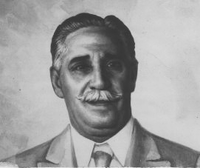
Juan Bautista Lavié Pere: French by birth, Cuban by devotion, founder of a work of love and faith.
The dawn breaks. At the ringing of the bell the faithful leave their beds and little by little everything comes to life; it is the "San Juan Bautista" farm, a 24th of June in Manzanillo de Cuba, barely three kilometres from La Demajagua (Altar of the Homeland), where Cubans began to be men because they decided to be free; some may consider it a coincidence, but it is rather a coincidence because only the magic of poetry can explain it. Some, mainly men, go to sweep the paths leading to the places of worship: the Star, the Garden of Anthony, the Nativity, the Little House of the Master; others - especially women - adorn with refined and singular taste the X Hall; while the Central Cross offers the visitor the intertwined banners of Cuba and France and in all their loftiness, nouns that attract, like a singular magnet, men and women in search of Light, Love, Union and Peace. Dozens of them arrive, on pilgrimage, from the most dissimilar corners of the island. From the United States, especially Florida, 2 or 3 missionaries also make an appearance, who invites them, why do they wish, on such a special day for them, to reach the place, what makes them leave the sublime routine of their lives and cross the doorway that places them, face to face, with the sweet and marble gaze of the Nazarene? They want, once again, to pay homage, to serve and to give themselves in spirit to Heaven all through a "Gardener" who, through faith, gave many a sense of life.
At 10 o'clock in the morning of 26 August 1884, Prosper Lavie, aged 32, a day labourer and resident of Sauveterre, a commune and canton of the same name in the Lower Pyrenees, presented to the deputy mayor - in charge of the commune's civil registry - as his son a three-day-old child whom he and his wife Maria Pere, aged 34, had decided to name Jean Baptiste. Thus, in a humble and natural way, he entered the human annals, a life that, crossing the ocean, would mark the religious belief of thousands of people and would endow Cuban spiritist, a religious practice sprouted and burnished with magnificent cultural interweavings, in an identifying sign of Cuban Manzanillo and beyond.
Allan Kardec, a Frenchman like John Baptist and systematiser of the spiritist theory, defines spiritism as "[...] the science which deals with the nature, origin and destiny of spirits, and their relations with the corporeal world"; however, to arrive at such a postulate, it was first necessary the appearance of the first phenomena that gave rise to it in the United States. In 1847, in Hydesville, near New York, in the family home of John Fox, father of a family and fervent Methodist, the first events took place which, like wildfire, spread throughout the great city on the Hudson; then, on November 14, 1849, in the "Corinthian Hall" in Manchester, the first great public meeting was organised to communicate with the spirits, a date which marked the beginning of the spiritist movement. Later, the events crossed the Atlantic and reached Europe, where they were conceptually and theoretically structured to become doctrine, which, expanded in France, England and Spain itself, returned to Hippano-Lusitanian America, although it is no less certain that the influence of the new movement also reached Latin America from North America.
From an ethical and moral perspective spiritism "[...] is essentially Christian, because what it teaches is nothing more than the development and application of that of Christ [...]"; nevertheless,
[...] Kardec's morality sometimes departs from the morality defended by the churches, and in particular by the Catholic Church. Kardec's morality is situated on the path traced by Jesus Christ in his teachings and by his example. A path which, according to Kardec, was followed by the sects of the early Christians, but "denaturalised by the Fathers of the Church" at the Council of Nicaea, when Christianity became confused with the Roman Empire and sought to associate the interests of Caesar with the interests of God.
Another element linked to the origins of the practice and which would undoubtedly mark the belief in Cuba and the origin of its militants was that:
[...] most of the Masonic lodges of the time were occult-oriented, and there were many spiritists in them. It was precisely the tendency of the spiritist circles to mix and even merge with the Masonic lodges that attracted the attention and later the hostility of the bishops towards Kardeism. Freemasonry, despite the theosophism of many of its members, then associated the democratic ideas of Liberty, Equality and Fraternity with often severe forms of anticlericalism. However, it would be a misrepresentation of 19th century spiritism as a substitute for Freemasonry. All that can be said objectively is that there were Kardecist spiritists who were also Freemasons.
Jean was 23 years old when he joined his life to a young girl a year and a half younger than him. On that day, 26 February 1908, at 7 o'clock in the evening, his parents accompanied him to the commune of Tarnos, in the district of Saint Martin de Seignanx, in the Landes department, where Gracieuse Saint Cristau, his future wife, lived. Gracieuse had lost her mother, so her mother was not present at the ceremony where the two young people were united in hope. After the formalities were completed, the marriage certificate was drawn up and signed by all, including the witnesses, except the bride's father who did not know how to do so, and they were declared man and wife.
There were five siblings of Prosper, Juan's father: two females and three males, the females bore the same grace: Marie, while the males were Pierre (the eldest), Bernard and Jean Pierre. It was perhaps chance, transcendent causality or any other reason, but the fact is that Pedro, Juan's eldest uncle, decided to migrate and already in the last decade of the nineteenth century we find him in Manzanillo engaged in the leather tanning and fur business. The influence of the surname was notable during the first half of the 20th century: the small square Lavié, a street and even a distribution area, validate the affirmation.
Jean and Gracieuse love each other and the fruit becomes a girl when Marie is born in 1909; but misfortune overtakes him when he snatches his beloved out of his sack. Desolation overwhelms him and he decides to emigrate, but who will take care of the little girl? Agustine, one of his sisters, takes on the beautiful task of educating and raising the little girl because Martha also crosses the Atlantic. She would never see her daughter again, but she would not forget her and neither would she. When Marie died in 1999, two letters appeared in an old boot, one from 1935 and the other from 1937, where the signs of affection on both sides were evident and faith in God had strengthened John, and he put aside the sadness of the past: "[...] I live with God and God lives with me because he who loves God, God is with him; and with determination he affirmed: "[...] today, being older, I am stronger than when I was 20 years old because God has given it to me".
When Juan Bautista arrived in Manzanillo, at the beginning of the second decade of the 20th century, his uncle welcomed him; however, it was not the tannery or the trade that caught the attention of the newcomer. By this time the spiritist practice was consolidated, the "centres" abounded and the contributions that the creed would make to the convulsive and critical 1920s were prepared, giving them a Cuban touch, different from the dominant Catholic creed. It was not for nothing that Agustín Martín Veloz, founder of the Socialist Party in the city; Paquito Rosales, the first communist mayor of Cuba and René Vallejo Ortíz, Commander of the Rebel Army and Fidel Castro's personal doctor, were spiritists.
Infarcted in the depths of his being, not only by the pain, but also by the heritage he had gained in the French South of France, together with a religiosity whose origin was not foreign to him, Jean-Baptiste began to frequent the spiritist centres in the area, especially that of Louise Munoz in La Sal, a place which served as a school for the development of his peculiar mediumnity.
The extent of the practice of cordon spiritism was such that it was impossible for the avant-garde intellectuals of Manzanillo not to deal with the subject. In a costumbrista book of fine irony, Manuel Navarro Luna, in a letter to Epifanio Sánchez Quesada - who was at that time suffering from severe arthritis - explains in detail the therapeutic conduct to be followed by the latter with regard to his illness and, in passing, describes, with brilliant subtlety, the characteristics of the practice of cordon spiritism:
What self-conscious person, who knows how bad medicine has always been, and who is not ignorant of the marvellous and infinite advances of Spiritist Science, is capable of placing himself in their hands? ... In Manzanillo, as in most of the towns of the Orient, doctors have been relegated to a second place [...] Poor people, as well as rich people; white people as well as coloured people; illustrious people as well as people without any lustre, only call on doctors when a premature, irremediable circumstance demands it. For example: to issue a death certificate [...] The real doctors' offices [...] are in the spiritist centres.
From the prayers that were said it is easy to deduce that the prayer books were those of Allan Kardec: "Creed", "Everyday Prayer", "Praise to God", "Guardian Angels" and "Prayer of the Mediums", of course, the Lord's Prayer was also recited.
The year 1933 was singular for Manzanillo, not only because of the fall of the dictator Gerardo Machado, but also because on that date the spiritist weekly Psiquis Moderna was founded and the temple run by Juan Bautista Lavie was definitively erected just 10 km from the city. Some time before, the flames had destroyed one erected on the banks of the Jibacoa River, but now, the new precinct would welcome the souls who, gathered in the "Los Apostolados" Association, would attend to listen to the preaching of Juan, who would begin to be called by his faithful as "The Master".
From that moment on, Juan developed an intense preaching work, especially in the area of Manzanillo, Niquero and Camagüey. His word, with great prophetic breath, captivates and he declares himself "more Cuban than all of you", he says before hundreds of souls who enthusiastically listen to him. His miracles (healings and prophecies) are spread by word of mouth and hopeful people come to the temple from many places. His prophecies still resound: the defeat of Nazi Germany, the construction of a road that would take believers to the very door of the temple, the descent from the Sierra Maestra of a man who would change the destiny of Cuba, the catastrophic results of climate change, the deplorable state of humanity in the event of World War III, the difficulties - in the case of Cuba - with transport and his virile stance in the face of American arrogance when in the Zanjón de Camagüey he takes a piece of paper in his hands and declares: "the papers of the Americans I will put them under this table".
In 1944, the Chancellor of the Archbishopric of Santiago de Cuba sent a questionnaire to the parish priest of Manzanillo, who, answering question 18 which read: "What opinion do you have about the importance and dangers of the Protestant propaganda of the Catholic faith in that parish? Has it made much progress?", replied: "I think that the Protestant danger is of immense proportions in Cuba. In this parish of Manzanillo perhaps spiritism is more dangerous than Protestantism [...]".
John used to talk to his followers wherever he thought it was convenient for preaching, he told them: "I have a long journey to make"; they all thought he was going to visit his own people because he had not seen them since his arrival. In January 1937 he told his daughter: "Now I am writing to tell you that I have not been able to make the trip as I thought I would, but I am sure I will this year. I think that in May or June I will go to see them"(20); but Jean-Baptiste Lavié would not return to his native France, he would embark on a journey whose return "[...] only heaven knows" and on 7 April 1945, following a heart attack, the French gardener who loved the scent of lilies died.
Esteban Valderrama, a notable Cuban painter, has painted a faithful portrait of his face which, with a serene gaze, welcomes all those who arrive at Salon X; while the inspiration of mediums and headboards (guiding the cordon) has resulted in the composition of about 40 transmissions (canticles) in his name.
The temple and the practice founded by John would be - and still are - an example of a much more refined spiritist practice, perhaps closer to spiritualism and with proximities to Catholicism (presence of abundant iconography and novenas), and although contact with the spirits is made, their presence among the incarnated is not generally requested for the cure of bodily or mental illnesses or for the resolution of material problems, since these are essentially left to prayer and the intimate link with the Creator; but for moral advice and preaching based essentially on the example of Christ and the first martyrs of Christianity. The cordon, the basic ritual of the seances, is not performed as in most temples and house temples, i.e., the mediums holding hands and dancing rhythmically around the hammered cross, but in two lines, one of men and one of women, all the faithful, including the children, march to the beat of a transmission, which is intoned by the headmen and answered by the choir, and whose rhythm varies according to the melodic beat.
Saturday is the day chosen for the worship service. From 1 p.m., with the singing of hymns, until the closing of the service at 5.00 p.m., the souls devote themselves to worship and communion with God. There are several Complimentary days: May 3rd, October 21st, November 17th and of course, August 23rd and April 7th, the birth and departure of the Master; while the Compliments, big days - usually 5 days - are the framework for the faithful, from early in the morning until 7 or 8 pm, to pray, sing and reverence Creation from a Christian point of view, at the end of January and in St. John's, as it could not be otherwise.
The Central Temple, also known as the San Juan Bautista farm, is the nucleus of the society, but other branches can be counted: Río Nuevo, Santa María and La Alegría, all in Niquero; while the chapels in Camagüey, Havana and Miami, are not only proof of the permanence of the faith, but also of its expansion. During the January and June celebrations it is common to see hundreds of people arriving from Manzanillo, Tunas, Holguín and Camagüey who, grouped in other spiritist fraternities, come to share with the "Sons of John", days of peace and union.
At the beginning of the third millennium, the spiritist practice in the city maintains vitality, and although the religious openness and therefore the penetration and/or solidification of other beliefs and religions has increased, the pre-eminence is still held by the doctrine codified by Kardec and its cordonera variant, as confirmed by the nearly 40 temples, house temples and places where charity and instruction are offered, On the other hand, it is striking that the bust of Emelina Alarcón Alba, a well-known spiritist of the city, unveiled in January 2005, is the only one that adorns a tomb in the Municipal Necropolis, while the Apostolados pantheon is the tallest in this holy field, which, topped by a cross, rises to the infinite blue.
 English (UK)
  Español
  Deutsch
  Português do Brasil
  Français
  Русский
  Türkçe
  Italiano