Anna Rebello Prado
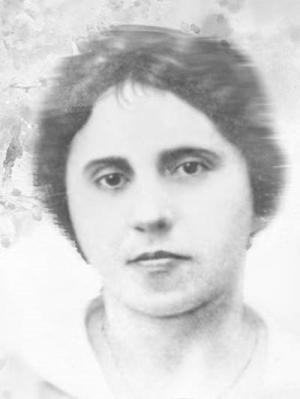
Anna Rebello Prado was born around 1883 in Parintins, Amazonas, a river island located on the right bank of the Lower Amazon, discovered in 1749 by Portuguese navigator and explorer José Gonçalves da Fonseca. The Rebello family actively participated in various Spiritist associations in the Amazonian capital. Anna's maternal uncles, Emiliano and Jovita, federal civil servants, devoted themselves to spreading Spiritism.
Emiliano participated in the founding of the Amazonas Spiritist Federation. Anna's mother, Ermelinda de Carvalho Rebello, also took part in the Amazonas spiritist movement. Thus, although Anna came to profess Catholicism, we can conclude that she had lived surrounded by the meridian lights of Spiritism, which surely favoured her solid and elevated moral and spiritual formation.
There are no records of her childhood and adolescence, which must have taken place in her hometown, where she married Eurípedes de Albuquerque Prado, from Ceará, on 9 June 1901. Eurípedes was always concerned with questions of the immortality of the soul. A merchant, journalist, teacher, and public figure, he held the position of Municipal Superintendent of Parintins (now the position of mayor). He learned about the Spiritist Doctrine through the book Heaven and Hell and devoted himself to Spiritist activities in his city.
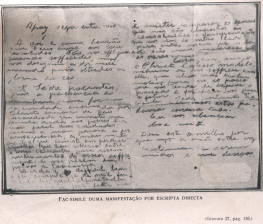
Sample of Prado's direct writing
Later, the couple, with their children Eurídice, Eratósthenes, Antonina, and Dinamérico, moved to the capital of Pará. Knowing theoretically about the phenomena of table turning and finding no support for the experiments in the Belém Spiritist community, Eurípedes chose to conduct them in his own home. Anna, who was resistant, did not participate in the first meetings held by her husband and two older children, always claiming domestic chores or disbelief.
Finally, on a Sunday afternoon, taken by surprise, she had no way to avoid it and participated in the meeting. The first phenomena recorded were around the table, which presented crackling sounds and violent shaking. Then came the tiptology, the throwing of objects to the ground, and the transport of a flower from the garden to the table in the house. This was followed by materialisations in complete darkness, only perceptible by touch, (...); gradually, from complete darkness, there was a very faint light and materialisations of scattered limbs - an arm, hands, etc. - to the appearance of perfect figures and even their recognition by relatives.
Anna's mediumistic abilities developed rapidly. From within her home, they reached the public domain, crossed the borders of the state of Pará and, shortly afterwards, also the borders of the country and the American continent, being reported in France and Germany. She suffered all sorts of tribulations. The prejudice of the time defamed and persecuted her, attacking her in various ways. She was publicly accused of being a comedian and subjected to harsh tests, such as being locked in an iron cage during trance to prove the truth of the phenomena she caused: tiptology, knocks and noises, levitation of objects, direct writing, somnambulism, transportation, unfolding, dematerialisation, appearance of spiritual lights, psychophony, and hearing.
Everything was thoroughly documented with minutes and photos. While in Belém, in a somnambulistic state, she visited her family and relatives in Parintins, revealing facts about the unrest experienced there, all of which were confirmed in subsequent letters by those she visited. It should be noted that the materialisations involved more than one spirit at the same time. On one occasion, with a painful abscess in her mouth, the medium herself was operated on, in a trance, by the materialised spirit of a doctor. In one of the sessions, on 27 October 1922, the spirit Maria Alva materialised, bringing a scarf which, in full view of everyone, she transformed into a wicker basket and then into a tray full of flowers.
Another extraordinary phenomenon was recorded as that of the dried flowers. On 25 January 1920, Colonel Simplício Costa had given the materialised spirit João some flowers, which were returned to him dried by the same spirit in another session fourteen months later. João, it should be said, was the guiding spirit of Anna Prado's mediumistic production. He was her maternal uncle, Felismino Olympio de Carvalho Rebello. Aware of the interesting phenomenology produced by the medium Francisca Jatahy, skin psychography, Anna Prado asked the Spirit João to try the same experiment.
He did not hesitate. He wrote on the medium's arms: Deus e João (God and João), a fact that was published in the Revista Reformador magazine, of the Brazilian Spiritist Federation (FEB), on 1 November 1921. He also prompted Anna to germinate, in a thirty-minute session, eucalyptus seeds from Rio de Janeiro. During the development of her mediumistic work, Anna Prado offered countless proofs of the veracity of the phenomena:
Annita (a thirteen-year-old girl), whenever she materialised, used to produce beautiful flowers in paraffin wax; João, when materialised, made several moulds of his feet and hands in paraffin wax, including a mould of his hand with his fingers closed; Rachel Figner, whose materialisations reached the highest perfection, produced remarkable works in paraffin wax. Anna Prado, after five years of intense mediumistic production, returned triumphantly to the spiritual life. She suffered an accident at her home with an alcohol stove. Her death, recorded on 23 April 1923, was attributed to collapse following extensive burns to her body, particularly her abdominal area.
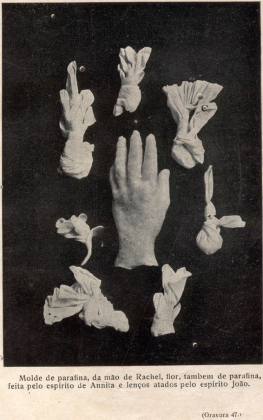
Materialized objects in plaster having been captured in paraffin wax moulds: a hand, flower, and sitters handkerchiefsf said to have been knotted by João
Her death was widely reported in Spiritist periodicals in Brazil and by the Revue Spirite. She was only thirty-nine years old. Francisco Cândido Xavier referred to her on the programme Pinga-Fogo, on TV Tupi/SP, on 28 July 1971, as responsible for the most legitimate materialisation phenomena. And more than three decades after her death, she returned through the pen of the medium from Minas Gerais (24.2.1955) and brought an interesting message entitled Observação oportuna (Timely Observation), published in the book Instruções psicofônicas (Psychophonic Instructions) (ed. FEB).
 English (UK)
  Español
  Deutsch
  Português do Brasil
  Français
  Русский
  Türkçe
  Italiano