Antonio Hernández Lozano

Antonio Hernández Lozano
He was born in Las Torres de Cotillas (Murcia) on 6 September 1948. Passionate from a young age for writing - both prose and verse -, he won the first runner-up prize in the Ill Juegos Florales de Las Torres de Cotillas 2009. He is a writer for the section: Misterios Desvelados of the group Radio Onda 92 Multimedia. Collaborating in various radio programmes and literary magazines. He is a lecturer on transcendental and spiritual subjects such as: reincarnation, mediumship, channeling with the spiritual world, near-death experiences, etc. Among his best-known published titles, the following stand out: Reincarnation Universal Law, Out of Time, The Guardian of My Destiny, From the Astral of Light, The Footprint of the Spirits and Eternal Hope.
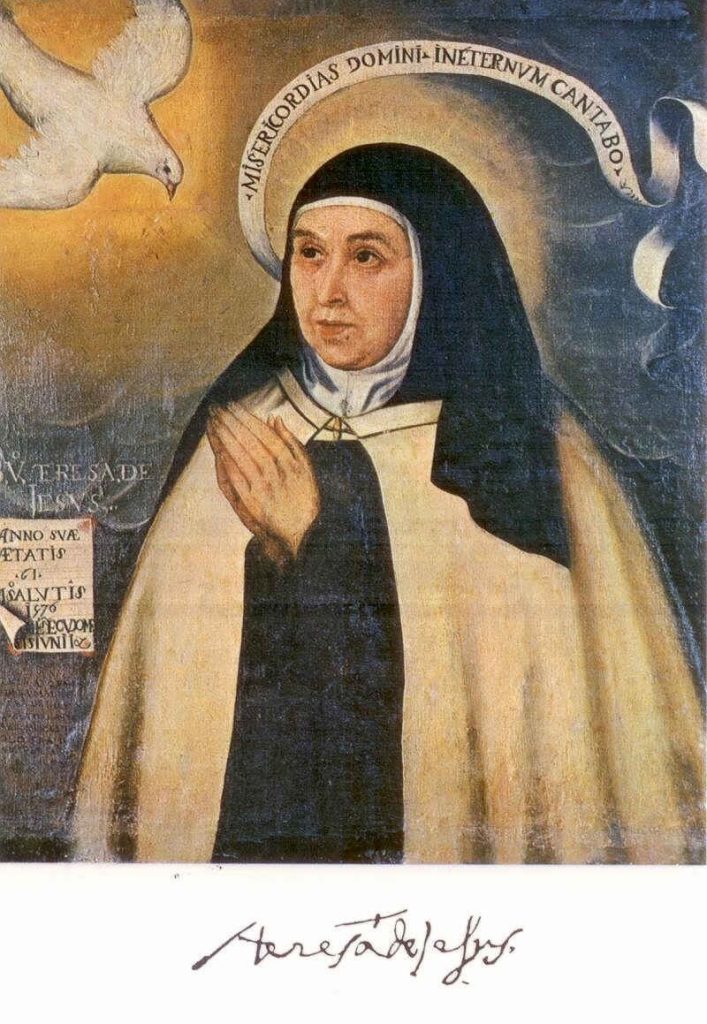
Teresa of Jesus
Teresa Sánchez Cepeda Dávila y Ahumada was born in Ávila on 28 March 1515. She was the third child of Don Alonso Sánchez de Cepeda, with his second wife, Doña Beatriz Dávila y Ahumada, who died when the saint was fourteen years old. Teresa was brought up by her pious father, who was a lover of serious books, and by a tender and pious mother. After his death and the marriage of her elder sister, Teresa was sent to the Augustinian nuns in Avila to be educated, after eighteen months she had to leave them because of illness, to return to the family. She wanted to take vows and, not obtaining her father's consent, in November 1535 she secretly left her father's house to enter the Carmelite Convent of the Incarnation in Avila. She was influenced first by the Dominicans and then by the Jesuits. She began to have visions and divine visitations, which forced her to seek advice from her confessors. St. Francis Borgia and St. Peter of Alcantara, and later various Dominicans (particularly Pedro Ibáñez and Domingo Bañez), Jesuits, and other religious and secular priests, were asked to discern God's work and guide her along a safe path. The accounts contained in his Autobiography, in the Relations, and in the Interior Castle about his spiritual life form one of the most important spiritual biographies, which can be compared only with the Confessions of St. Augustine. To this period also belong the extraordinary manifestations, such as the transverberation of the heart she experienced, her spiritual betrothal, and her mystical marriage. St. Teresa founded the convent of the Discalced Carmelite Nuns of the Ancient Observance of the Rule of St. Joseph in Avila on 24 August 1562, and, after six months, she obtained permission to reside there. Four years later, she was visited by Juan Bautista Rubeo (Rossi), the General of the Carmelites, who not only approved of what she had done, but also gave her licence to found other convents, both of friars and nuns. Almost immediately, she founded a convent of nuns in Medina del Campo (1567), Malagón and Valladolid (1568), Toledo and Pastrana (1569), Salamanca (1570), Alba de Tormes (1571), Segovia (1574), Beas and Seville (1575), and Caravaca (1576). After meeting Antonio de Heredia, prior of Medina, and St. John of the Cross, he began his reform of the friars in 1568 and the first convents were those of Duruelo (1568), Pastrana (1569), Mancera, and Alcalá de Henares (1570).
She continued her work in her old age and with her health failing, she made more foundations in Villanueva de la Jara and Palencia (1580), Soria (1581), Granada (through her assistant, Blessed Ana de Jesús), and Burgos (1582). She died in Alba de Tormes on 4 October 1582 and was beatified in 1614, and canonised in 1622 by Pope Gregory XV. St. Teresa's place among writers on mystical theology is unparalleled. In her writings on this subject, she narrates her personal experiences with great clarity, thanks to her profound vision and her capacity for analysis. The Thomistic substratum can be traced back to the influence of her confessors and directors, many of whom belonged to the Dominican order. She had no intention of founding a school, in the literal sense of the term, and there is no trace in her writings of any kind of influence of the Areopagite, nor of the schools of patristic or scholastic mysticism, as can be seen, among others, in the German Dominican mystics, but she chose an intensely personal path, ever mindful of her own experiences. Therese also cultivated lyrical and religious poetry. In her enthusiasm, she was less subject to the imitation of the sacred books than others who cultivated this genre, thus appearing more original. Therese also wrote poems, short writings and individual writings, without considering a series of works attributed to her. Teresa also wrote Letters, published in various epistolary collections. The writings of the Catholic saint have been translated into almost every language.
To all those who encouraged me to dive into my inner self, in order to bring to light the beautiful feelings shared -for so many years- with the beautiful Spirit of the one who was in her last life on earth, Teresa of Jesus. A marvellous being who was, is and will always be very special to me. I want to put on record that Teresa of Jesus (1515-1582) in her time broke the canons established by a ‘singular’ church that regarded her as a visionary, being denounced and prosecuted by the tribunal of the Inquisition in Cordoba, Valladolid and Seville, from which she escaped, thanks to the friendship that united her family with the King of Spain, Philip II. Later, however, it was the Church itself that would raise her to the altars, naming her ‘Doctor and Advocate’ of the Church.
Messages
Fiery Steed

¡Proceed!

Acknowledgement

Boast of Love

Covenant with God

First Soul

Simple soul
True love

 English (UK)
  Español
  Deutsch
  Português do Brasil
  Français
  Русский
  Türkçe
  Italiano