René Descartes
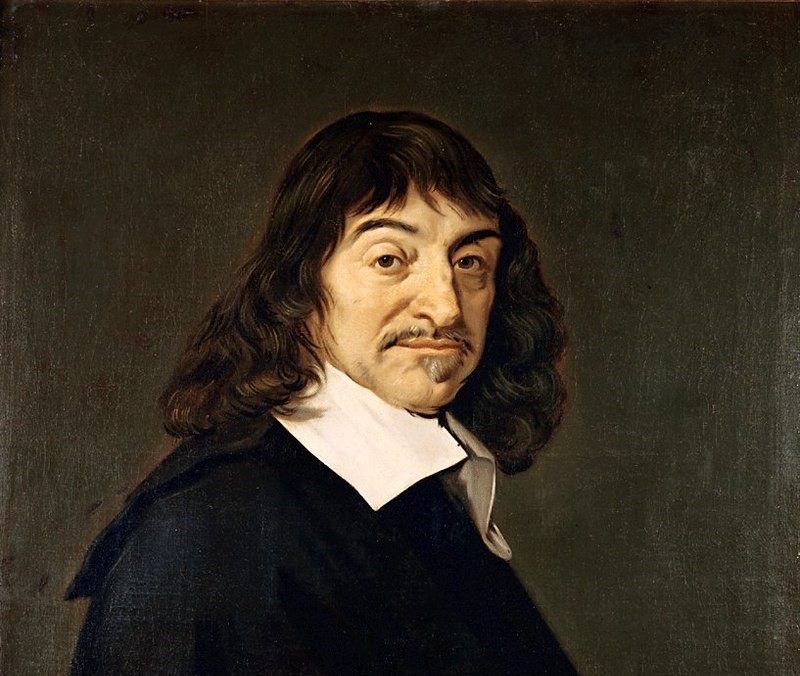
René Descartes (1596 - 1650) is rightly called the «Father of Modern Philosophy». He was the first European philosopher after the Middle Ages to place the epistemological problem (of knowledge) in its true perspective, anticipating the whole of modern philosophy.
The same daimon that tormented Socrates presented itself to Descartes as a light so intense that it was impossible to bear it. This light was followed by the project of an admirable science. These events were so remarkable that Descartes came to accept that he had been inspired by the Spirit of Truth.
When one speaks of Descartes, one immediately thinks of the expression «cogito ergo sum» (I think therefore I am). This postulate, not susceptible to demonstration, on which he developed his entire philosophy of Cartesian thought, which he himself created, can be summed up as: prove, analyse, synthesise and enumerate.
The first proof is the idea of perfection, existing in the cogito, the God in us; the second comes from the very evidence of the existence of the soul; the third is the principle of causality which, applied to the first two, logically proves the existence of God.
In this way Descartes assures the passage from the self to the world, because he assures us that the potentiality of knowing exists in man. If God wanted to deceive us, he could deceive us, but then he would not be God but an imperfect evil genius.
For René Descartes, the objective world consisted of two substances, a «res extensa’ (body) and a ‘res cogitans» (soul). For Descartes, as for Aristotle, matter is quantity and force is quality.
The Cartesian division between spirit and matter, coupled with the trauma of the medieval persecutions, led to the perception of the universe as a mechanical system, made up of separate objects, whose mechanistic theory is at the basis of all modern science.
Descartes, the brilliant mathematician, said: «All science is certain and evident knowledge. We reject all knowledge that is merely probable and consider that we should believe only in those things which are perfectly known and about which there can be no doubt».
In fact, the doubt about the world pre-existing the world of the time was demonstrated by another French philosopher at a different time. Allan Kardec (1803 - 1869), knowledgeable in arithmetic, chemistry, physics and astronomy, using the same Cartesian method created by Descartes, starting from the abstract (spiritual) world towards the concrete (physical), codified the most beautiful works of the existing trilogy: Philosophy, Science and Religion.
Allan Kardec, by codifying the Spiritism Doctrine, completely transformed the perspective of the future. The future life is no longer a hypothesis, but a reality. The state of souls after death is no longer a system, but the result of observation. The veil has been lifted; the spirit-world is presented to us in the fullness of its practical reality; it was not men who discovered it by the effort of ingenious conception, it is the inhabitants of that world themselves who come to us to describe their situation.
In his last work on Spiritism, he described it as follows: «As a means of elaboration, Spiritism proceeds in exactly the same way as the positive sciences, applying the experimental method. New facts are presented which cannot be explained by known laws; it observes them, compares them, analyses them, and, tracing back from effects to causes, arrives at the law which governs them; it then deduces their consequences and seeks useful applications». He established no preconceived theory; thus he did not hypothesise the existence and intervention of spirits, nor the perispirit, nor reincarnation, nor any of the principles of the doctrine; he concluded the existence of spirits when that existence was evident from the observation of facts, and he proceeded in the same way with the other principles. It was not the facts that subsequently confirmed the theory: it was the theory that subsequently explained and summarised the facts. It is therefore strictly accurate to say that Spiritism is a science of observation and not a figment of the imagination. The sciences have only made significant progress since their studies have been based on the experimental method; until then it was believed that this method was only applicable to matter, whereas it is also applicable to metaphysical things.
 English (UK)
  Español
  Deutsch
  Português do Brasil
  Français
  Русский
  Türkçe
  Italiano