Auta de Souza
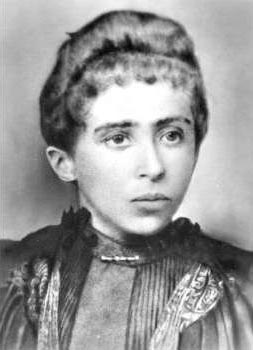
She was born in Macaíba, later Arraial, a city in Rio Grande do Norte, on 12 September 1876. She was slim, calm, fair-skinned and dark-skinned, as sweet to the eye as velvet to the touch. She was the daughter of Eloi Castriciano de Souza, who died at the age of 38, and of Dona Henriqueta Rodrigues de Souza, who died at the age of 27, both of whom had tuberculosis. Before the age of three, she lost her mother and her father at the age of four. Her life on earth was marked by severe suffering. She was orphaned at a very early age and, when she was ten years old, she witnessed the death of her beloved brother Irineu Leão Rordigues de Souza who died in a fire caused by the explosion of a paraffin lamp on the night of 16 February 1887.
Auta de Souza and her four siblings were raised in Recife, in the old sobrado do Arraial, in the large hamlet, by her maternal grandmother Dona Silvina Maria da Conceição de Paula Rordigues, commonly known as Dindinha, and her husband Francisco de Paula Rodrigues, who died when Auta was six years old.
Before she was 12 years old, she was enrolled in the São Vicente de Paulo School, in the Estância district, where she received a warm welcome from the French nuns who ran it and offered her an excellent education: Literature, English, Music, Drawing and she also learned to master French, which enabled her to read in the original: Lamartine, Victor Hugo, Chateubriand, Fénelon.
From 1888 to 1890, the young Auta studied, recited, wrote verses, helped the sisters in school and refined the beauty of her faith by constantly reading the Gospel.
At the age of 14, still at the Estância School, in 1890, the first symptoms of the disease began to appear, which robbed her of her youthful glow and was the cause of her death, which occurred in the early hours of 7 February 1901 - Thursday at 1.15 am - in the city of Natal, at the age of 24 years, 4 months and 26 days. The doctors could do nothing and Dindinha returned with everyone to the land of Rio Grande do Norte. Here they are all in Macaíba. She was buried in the cemetery of Alecrim and, in 1906, her remains were transferred to the family tomb in the Church of Nossa Senhora da Conceição, in Macaíba, her hometown.
Her strong religious feelings and even her illness did not prevent her from leading an absolutely normal life in society.
She was Catholic, but not submissive to the clergy. She did not macerate, she did not wrap her skin in sackcloth, she did not fast and she never cloistered herself. She was communicative, cheerful and sociable. Her religiosity was deep, sincere, heartfelt, but not ascetic, mortifying or mystical. Her love for Jesus Christ, her Guardian Angel, did not keep her from all the dreams of the maidens: love, home, maternal mission. At the age of 16, revealing her unusual poetic talent, she fell in love with the young prosecutor of Macaíba, João Leopoldo da Silva Loureiro, for only a year and a few months. Gifted with an acute sensitivity and a fiery imagination, she devoted deep love to her boyfriend, but tuberculosis advanced and her brothers persuaded her to leave him. The separation was cruel, but only for Auta. The Promoter did not show the slightest reaction.... It is true that he liked to listen to her at parties, to declaim with his beautiful velvety voice and to dance with her quadrilles, polkas and waltzes, but he was not the right man to love such a delicate and dreamy soul as Auta de Souza. He lacked the spiritual refinement to realise the feelings that flowed from the sweet eyes of the great poetess.
This succession of painful blows deeply marked her soul as a woman, characterised by a crystalline purity, an ardent faith and a deep feeling of compassion for the humble, whose misery so moved her. She was seen reading to poor children, humble women of the village or old slaves, the simple and naive pages of the ‘History of Charles Magnus’, a booklet that covered the backwardness, written in the popular taste of the time.
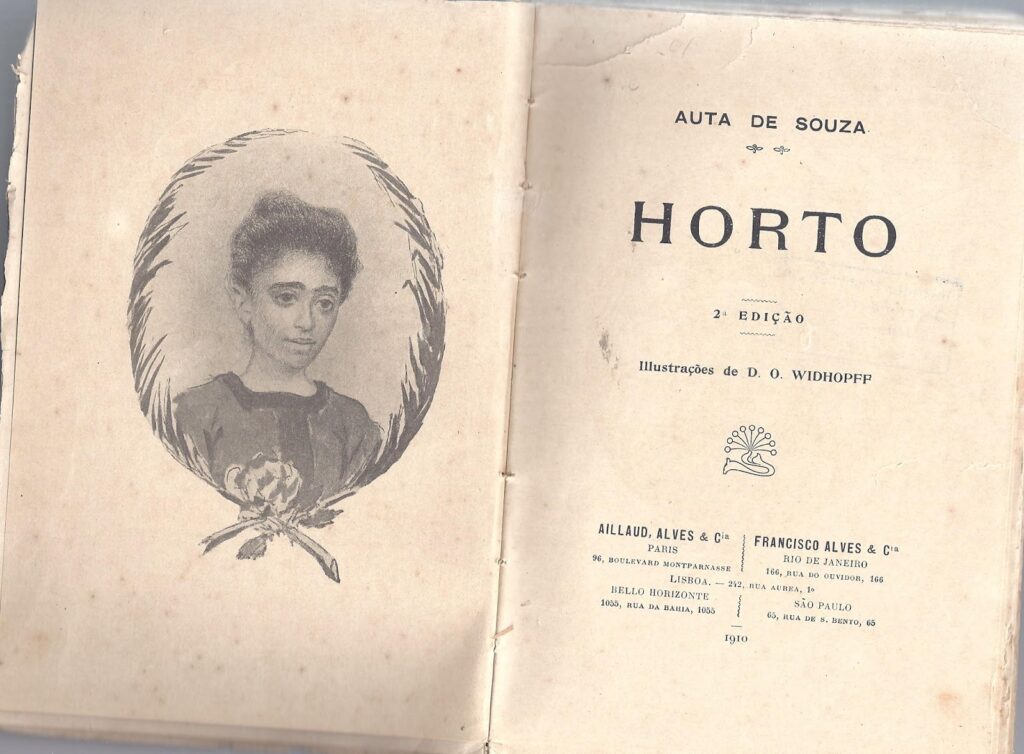
The poet's childhood orphanhood, the tragic death of her brother, a contagious disease and frustration in love: these four factors, together with Auta's strong religiosity, led her to compose a unique work of poetry in the history of Brazilian literature. "Horto", her only book, is a hymn to pain, but also to Christian faith. The first edition of Horto was published on 20 June 1900.
Suffering honed his innate sensitivity, which overflowed in poignant and tender verses, sometimes ardent, sometimes sad, written in the shadow of illness, in the desolate backwaters of his homeland.
On 14 November 1936, the Academia Norte-Rio Grandense de Letras was established, with the XX seat dedicated to Auta de Souza.
Freed from her body, totally exhausted by illness, Auta de Souza, radiating her own light, lucid and glorious, took flight towards the Greater Spirituality. But the compassion she always felt for those who suffer made the poetess, in the company of other charitable spirits, constantly visit the earth's crust. It was through Chico Xavier that she revealed her identity for the first time, transmitting her poetry in 1932, in the first edition of "Parnaso de Além Túmulo" (Parnassus of Ultrarumba), launched by the Brazilian Spiritist Federation.
In her physical existence, Auta de Souza was the Native Bird that sang of her longing for freedom; the resigned heart that sought in Christ the consolation of the beatitudes promised to the afflicted of the earth. Beyond the grave, it is the liberated and happy bird that, having returned to the nest of ancient misfortunes, comes to bring people the message of goodness and hope, the call to Faith and Charity, indicating the right direction for the conquest of true life.
The Campaign of the Auta de Souza Fraternity, conceived by the companion Nympho de Paula Corrêa and approved on February 3, 1953 by the Department of Social Assistance of the Spiritist Federation of the State of São Paulo, then directed by the late José Gonçalves Pereira, is a beautiful homage to our dear poetess Auta de Souza.
 English (UK)
  Español
  Deutsch
  Português do Brasil
  Français
  Русский
  Türkçe
  Italiano