Ralph Waldo Emerson
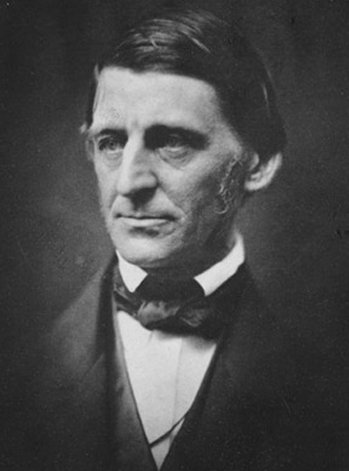
American essayist, poet, and philosopher. Descended from Puritan settlers and clergymen, he studied at Harvard University in order to become, like his father, a minister of religion. He served as pastor and preacher of the Second Church of Boston, but abandoned this activity because of doctrinal disagreements concerning the Eucharist. He resigned from the ministry in 1832, after the death of his wife, though he retained the spirit of his sect (which denied the doctrine of the Trinity). In 1833, while travelling through Europe, he came into contact with Thomas Carlyle, Samuel Taylor Coleridge, and William Wordsworth, subsequently embracing German transcendentalist and idealist thought, combined with Neoplatonism, the mysticism of Emanuel Swedenborg, and the scepticism of Michel de Montaigne. Throughout his life he kept a journal that served as the basis for his writings, sermons, and lectures. Upon returning to the United States, he began to develop his “transcendentalist” philosophy, set out in works such as Nature, Essays, and Society and Solitude.
He devoted himself thereafter to teaching and lecturing. In 1835 he settled in Concord, a village near Boston and the land of his ancestors, where he married for a second time and associated himself with the group of transcendentalists: Henry David Thoreau, Nathaniel Hawthorne, Bronson Alcott, and Margaret Fuller. For Emerson, transcendentalism was an effort of methodical introspection through which one moves beyond the superficial self to the deeper self, the universal spirit shared by all humankind. His first book, Nature (1836), contains the essentials of his philosophy, later developed in the two series of Essays (1841–1844). A series of lectures was collected in the volume Representative Men (1850), followed by other books.
His work is extensive and stands at the core of transcendentalism, through which Romanticism found expression in the United States. His system, however, is not entirely coherent, for it combines Puritanism with the power of instinct, faith in the “inner light”, optimism, and hope as guides for thought and life. He remains one of the most celebrated figures of American intellectual life, with worldwide influence. The transcendentalist club of Concord, to which among others Henry David Thoreau and Margaret Fuller belonged, and whose official publication was the magazine The Dial, exerted a major influence on nineteenth-century American intellectual life.
 English (UK)
  Español
  Deutsch
  Português do Brasil
  Français
  Русский
  Türkçe
  Italiano