History of spiritism in Poland

During the partitions, occult practices were forbidden in the territories formerly belonging to Poland. As in other areas of life, it was more difficult during the Russian partition. In the salons of the Warsaw aristocracy, spirits were spoken of only in whispers. Greater freedom reigned in the Austro-Hungarian Empire. This is probably why the Kraków Czas was the first newspaper to report that in America the spirits of the dead spoke to the living through the tables: «As various reports prove, one hears knocks as if coming from inside the table».
The fashion for communicating with the beyond also reached Europe. All German newspapers reported on mysterious experiments. The Spiritism sessions were held almost everywhere. In the homes of rich and poor. In the cities and in the countryside. Tables set in motion by an unknown force jumped, tapped their feet, spun and even floated in the air. They also happened to hit the answers to the questions put to them. The scuffling between the tables often resulted in broken legs. The carpenters were particularly happy.
The reports in ‘Czas’ about spinning tables aroused great interest. An article on 14 April 1853 inspired Professor Antoni Sławikowski, a respected ophthalmologist and professor at the Jagiellonian University. Sławikowski invited a group of distinguished guests, academics with their wives and personalities. A cheerful atmosphere reigned in Sławikowski's flat and all attempts to set the salon table were unsuccessful. There was much laughter and the guests continued to enjoy themselves. But there was no shortage of scientists in the company who were not satisfied with just playing around. At around five o'clock in the afternoon, Professor Stefan Kuczynski, a physicist, invited a few of them to a smaller room to play a joke or conduct an experiment. At the oval walnut table sat the host's wife, Mrs. Slawikowska, two young women, daughters of the well-known Cracovian bookseller Józef Czech, and two professors from the Jagiellonian University: the chemist Emilian Czyrniański and the dean of the Faculty of Law, Edward Fierich. The participants placed their hands on the tabletop so that their little fingers were touching. In this way, they formed a closed circle.
After 10 minutes, Kuczynski felt a puff of air pass from his back to the palms of his hands, and then a warmth invaded his hands. This was accompanied by a slight trembling of his muscles. Weak at first, the heat and trembling became more and more pronounced. At one point they intensified and at another they weakened. The other participants also felt similar symptoms and began to exchange comments in whispers. Fifteen minutes passed and then the table twitched. One of its legs moved an inch with a loud clatter. It wasn't long before another creak came from inside the piece of furniture. The other legs moved as well. The tabletop trembled, and with it the hands of those gathered. It seemed as if the table wanted to detach itself from the legs and urge them to rotate. Which, by the way, happened slowly. Finally, a quarter of an hour after the start of the session, the table turned with all its might. Those present rose from their chairs, but the circle was not interrupted. The table turned, and with it the surprised guests.
The movement was so great that the rest of the company rushed into the hall. All beheld the astonishing spectacle. The table seemed to dance, and one of the observers exclaimed that it was spinning while standing on one leg. The room was narrow, and as it spun, the table toppled one of the men onto the sofa, which supported him. The legs began to creak, and a moment more... and they would have broken. But the furniture, pushed back by the leg, released the man and began its dance again. After three more complete rotations, one of the legs finally broke and the circle broke. The dance stopped and the participants, unable to contain their excitement, sank back into their chairs.
Three days later, «Czas» published a letter from Professor Kuczyński describing the whole event. He had no doubt that there had been no trickery or manipulation. The description of the experiment was also confirmed by the other guests, whose academic qualifications ruled out without a doubt that it could be a circus act.
But even before Kuczyński's letter was published in the newspaper, news of the sensational table dance had already spread by word of mouth throughout Kraków. The next day, the people of the city were talking almost exclusively about what had happened at Professor Slawikowski's house. Further attempts were immediately made. In the section ‘Local and Foreign Chronicle’, one wrote: ‘There is no meeting so small at which the strange experiment which is causing such a stir in America and Germany has not been tried. Yesterday, at nearly one o'clock, an experiment was made in the two resorts here. In the old tavern the experiment was unsuccessful, whether because it was old and did not contain a sufficient quantity of that mysterious liquid we do not know, but the table remained still as in the good old days, while in the public tavern the round table chosen for the dance became so boisterous that it broke a leg. The same thing happened at a meeting in a certain private house. The poor legs of the table!
Time's editor immediately recognised that sensationalism was a good way to increase sales. He wrote of the table: ‘And so we, too, opened a permanent column for it in our Chronicle, and we do not fail to keep our readers conscientiously informed of the progress of tables and table legs in the choreographic art’. Although he did not always publish truthful news, he nevertheless attracted the attention of readers. He even published pamphlets and books on the subject of tables and dancers. The Piarist priest Adam Jakubowski began to investigate. After careful analysis of the phenomena, he proposed the theory of a ‘fluid of forces’ dependent on human will. In his opinion, there were no spirits on the tables and their movement was a phenomenon comparable to dreams, premonitions or supposed visions of the future.
Subsequent sessions held at the Slavikovsky's house confirmed Father Jakubowski's assumption that the table itself had no power. It was soon discovered that the phenomena occurred when Maria Czechówna, one of the ladies who participated in Dr. Sławikowski's successful experiment, sat in the circle. She was soon hailed as the first medium from Kraków or even the first Polish medium. Newspapers wrote about her and proved that she was rich in ‘magnetic fluid’, which not only set heavy tables in motion, but also ‘moved from one place to another heavy iron coins filled with gold bullion’.
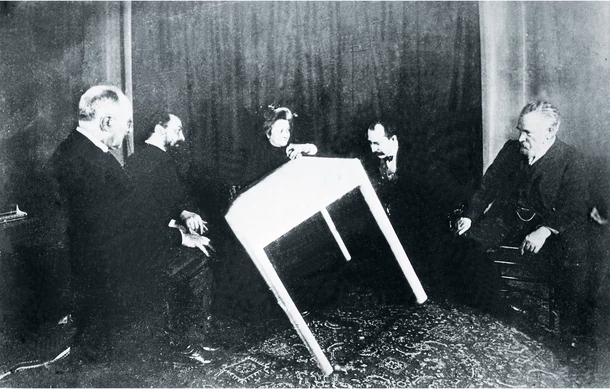
So Mrs. Chekhov began a spiritism séance in which she moved libraries full of books, turned tables and turned back mirrors. And the pages of ‘Czas’ were filled with reports of other table seances. But not for long. In December 1853, the column commonly known as ‘Tischkolumne’ was closed down. The reason was the protests of the church hierarchy, which from the very beginning saw impure powers and, no doubt, the devil himself as involved.
But the madness at the table could not be stopped. After Krakow, it was the turn of Lviv. And here people began to experiment with tables. Some saw them as a medium or mediator between the world of the dead and the world of the living, others mocked them. Jan Dobrzanski, editor of the Lviv newspaper Noviny, announced that he had invented a new type of table. During a spiritism séance, he placed a snuffbox on the tabletop and the table sneezed. In Warsaw, which for years claimed primacy and proved that the sensational property of tables had been discovered in the occupied capital, the new phenomenon was labelled stołomania.
Poets sat at the table. Zygmunt Krasiński attended spiritism séances at the Ordynacki Palace in Warsaw and, after travelling to Paris, began to meet with the famous medium Daniel Dunglas Home. However, the latter fled from him because Krasiński thought he was the Antichrist and tried to convert him. In letters he wrote: ‘I have realised that the form of the apparitions actually come from beyond the grave.
Adam Mickiewicz also sat at the table, which outraged Andrzej Towiański, who wrote: ‘Everything is born out of curiosity to know what happens in hell’. Antoni Odyniec, who despised table sittings in his poem ‘Szatańskie zakusy’ (Satanic Temptations), was of the same opinion. Władysław Syrokomla and Józef Ignacy Kraszewski, on the other hand, approached the subject with humour.
The tables continued to attract the attention of the church. Priests thundered from the pulpit and frightened the devil. And Father Peter Semenenko, founder and general of the Congregation for the Resurrection in Rome, sent fans of the table sessions ‘to the bottom of hell’. However, Satan's involvement was quickly dismissed. The same was true of popular theories that explained the movement of the tables by electricity, magnetism or even man's nervous or psychic powers. Most, however, were convinced that it was the spirits of the dead who spoke through the tables and wanted to communicate with the living.
The solution to the mystery of unexplained phenomena was tackled by the founder of the theory of hypnosis James Briard, the physiologist William Carpenter and the physicist Michael Faraday. All three came to similar conclusions independently. There was no supernatural force involved in the movement of the tables. Carpenter had already written a scientific report in 1852, before the events in Professor Slawikowski's flat. In it he concluded that the strange behaviour of the tables was due to involuntary muscular movements and contractions, which he described as ideomotor.
Briard was of the same opinion. In his opinion, it was the participants in the spiritism séances themselves who involuntarily produced the small movements in anticipation of the phenomena and only intensified them when they occurred. Faraday, on the other hand, ruled out the involvement of magnetism and electricity. Using simple instruments, he made the same observation as Carpenter. Involuntary movements of human muscles were responsible for the movement of the table.
In Poland, no one was interested in a scientific explanation of the phenomenon. Some scoffed, others believed in something supernatural. At the same time, news kept coming from abroad, where stocholomancy had already taken the form of a religion called spiritism. Its founder was the French scientist Allan Kardec, or rather Hippolyte Rivail. Kardec held that there was a thinking factor in every human being. In short, it was the soul, which separates from the body after death to be reborn in another being through reincarnation. However, before merging with the new body, the soul could communicate with the living. For this it needed a medium. This view quickly gained a large number of followers. In 1878, there were 14 million spiritisms in the United States. The number of mediums was estimated at 35.000.
The researches of English scientists were viewed with scepticism even in their home country. In 1867, the Dialectical Society was founded in London to re-examine all unexplained phenomena, including spiritist table seances. The methodology of scientific research was strictly applied. Experiments were carried out under controlled conditions and records and comparisons were made.
It soon became clear that the conclusions of Briard, Carpenter and Faraday did not explain everything. For example, how young Miss Chekhov moved heavy furniture. Yes, in many cases the table dances were provoked by the participants in the spiritism séances themselves. It turned out that scientists had overlooked observations that they could not explain with their theories.
One such phenomenon was a spiritism séance held in London in which the participants stood in a circle, but did not touch the table. They were separated from the table by a row of chairs about a metre apart. However, the table was moving. No one could answer the question of what caused these phenomena. It was not proven, but it was undeniable that something was happening that scientific theories could not explain.
After almost two years of research, the committee submitted its report to the leadership of the Dialectical Society. But even this report met with criticism from sceptics. Much of the scientific world continued to scoff at unexplained phenomena. Predictably, only a few researchers dared to tackle the new field.
 English (UK)
  Español
  Deutsch
  Português do Brasil
  Français
  Русский
  Türkçe
  Italiano