Stanley de Brath
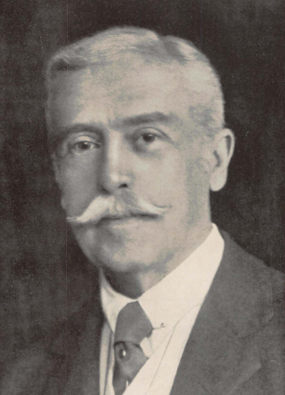
Stanley De Brath was born on 10 October 1854 in the Sydenham district of Kent, London, England. His father, Felix de Brath, was a naturalised British Spaniard. His mother, Anna Louisa Mary Gertrude Monica De Brath, was English. At the time, the Crimean War was raging. Shortly after his birth, his father travelled to Uruguay on business and did not return until four years later. Stanley had three brothers: Ernest, born in December 1858; Frank, born in Paris in 1860, where the family lived in a flat on Caminho de Versales Street, at the top of the Champs Elysées. In 1862, they moved to Cosham, near Portsmouth, Hampshire, England. In 1869, his third brother, Cyril, was born.
His early schooling was at home until he was ten years old. In 1864, he was sent to a school in Brighton, Sussex, England; however, due to bullying, his family moved him to St. Mary's Preparatory School in Harlow, Essex, England, where he also failed to fit in due to corporal punishment. From there he went on to Lancing College, from where, once again, he moved away. He eventually continued his studies until the age of nineteen at home with a tutor.
In 1874, he was admitted to the Faculty of Engineering at the Royal Indian Engineering School in Surrey, England, where he completed the Civil Engineering course. In his autobiography, he states that he came third out of fifty students. He was also awarded prizes in two different activities: one academic and the other sporting. The academic one was about training Indian clerks to work on the locomotives of the Indian Railways, and the sporting one was about the rifle shooting championship.
In 1877, at the age of 22, he was admitted as a civil engineer on the Imperial Indian Railway, as well as executive secretary to the Government of India in the Department of Labour for the Central India and North-West Frontier regions. He coordinated the construction of bridges and roads in the still inhospitable region that is now Pakistan, as well as in the ‘Indus Valley’. He took the opportunity to study ‘Hindustani’, the language of the region.
In the autumn of 1882, Stanley travelled to England and married Priscilla Sheringham, whose family came from Fakenham, Norfolk, England. Around the same time, his younger brother Cyril died of typhoid fever at the age of thirteen. Stanley's first son, Harold, was born on 21 July 1883 in Nasirabad, Rajputana, India. On 30 August 1885, his daughter Gladys was born in Simla, Bengal, India. As an engineer, he worked on the construction of the ‘Bolan Pass’ railway and was later transferred to complete the ‘Sind-Pishin’ railway, where he suffered from a fever that forced him and his family to move to England for treatment. In 1889 his son Noel was born, who died at the age of eleven months at his maternal grandparents' home in Norfolk.
In his autobiography, he reports that he was an agnostic until 1889, when a series of events changed his thinking. Until then, he had filed away information that encouraged materialism, but from then on, he sought out incontrovertible facts that would demonstrate the doctrine of the survival of the spirit. He also says that, like his friend Alfred Russel Wallace, he began as a sceptic, but eventually surrendered to the weight of evidence. In 1894, Stanley retired from his service in India and went on to receive a fairly adequate pension. He founded a preparatory school in Guernsey called ‘Honmets School’, where he could introduce a more suitable method of teaching, including religion. Later, in 1901, he moved to Bookham, Surrey, then to Charles Towers and then to Preston. At the same time, he began studying chemistry and geology.
In April 1914, Stanley sold his Preston House Preparatory School and on 2 December 1914, the First World War began. He was sixty years old and still joined the British Army. Because he was over the age allowed for combat and because of his expertise in bridge and road engineering, he was inducted as an honorary captain in the Royal Engineers.
At the end of the war, he devoted himself entirely to the so-called mediumistic phenomena which had interested him since 1889 and which now constituted his life's work. From 1918 he began to collaborate in Paris with the French scientist Gustave Geley at the International Metapsychic Institute.
During this period he translated into English the books:
– From the Unconscious to the Conscious , in 1920, by Gustave Geley.
– Supranormal Faculties in Man , 1923, by Eugèn Osty
– Thirty Years of Paranormal Research , in 1923, by Charles Richet, Gustave Geley and Stanley De Brath.
 English (UK)
  Español
  Deutsch
  Português do Brasil
  Français
  Русский
  Türkçe
  Italiano