Johann Heinrich Pestalozzi ( 1746 – 1827 )
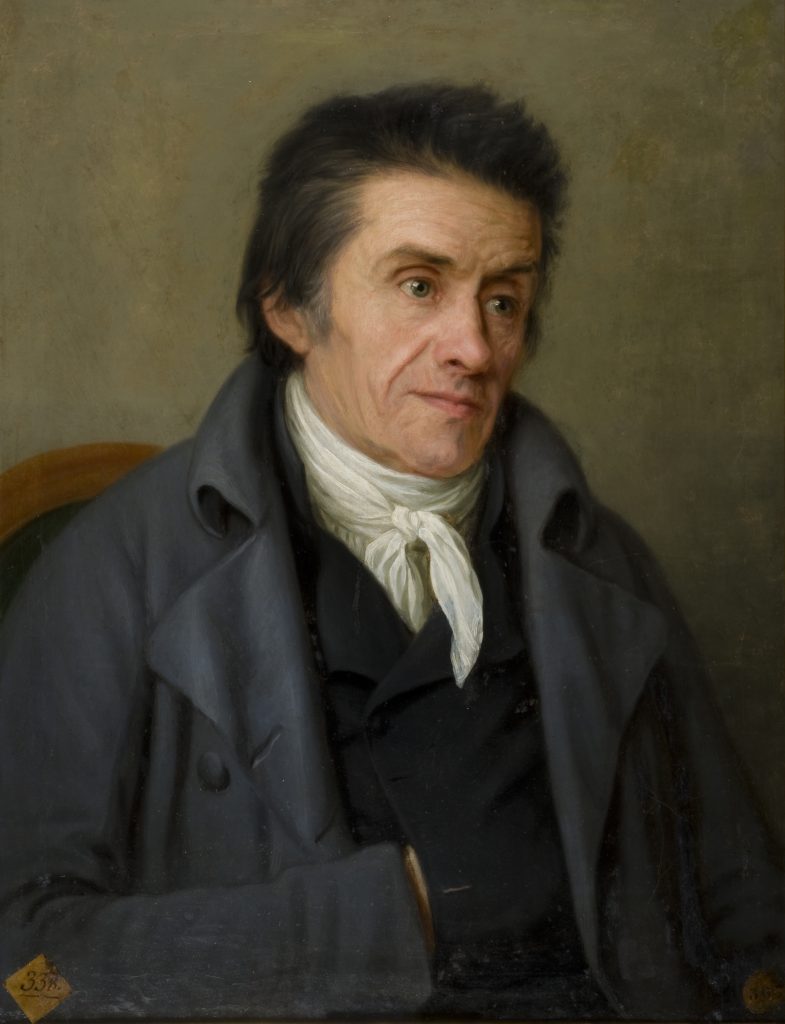
Johann Heinrich Pestalozzi, known in English-speaking countries as Enrique Pestalozzi, was a Swiss pedagogue and reformer of traditional pedagogy, who directed his work towards popular education. He was the teacher of Hippolyte Leon Denizard Rivail (Allan Kardec).
His father, a surgeon, died when he was 6 years old; thus, the child's upbringing was predominantly maternal and developed in him a sentimental and shy character.
At the age of 18, he attends the humanities college in Zurich and then begins a theology degree, but reading Rousseau makes him abandon his ecclesiastical goal. He begins studying jurisprudence and then spends a year learning agricultural techniques with an engineer.
In 1775 he opened a school for poor children in Neuhof, modelled on Rousseau's Emilie, whose pupils were not only instructed by him but also employed in remunerative work. The project failed, as did a similar one in Stans.
In 1797 he published "My Inquiry into the Course of Nature in the Development of Mankind", his most important work. He resumed his teaching practice in a castle in Bern on loan from the government, an experience he reflected in his work "How Gertrud Teaches Her Children" (1801).
After the Swiss Revolution of 1798, the Swiss government entrusts Pestalozzi (who collaborated politically with him) with the education of war orphans and poor children in the region. With this experience, which lasted for seven months, Pestalozzi was introduced to the world of education.
In Yverdon (1804-1825), Pestalozzi's educational institution reaches its fullness and international reputation, he perfects and spreads his method.
In 1811, he and his collaborators mention the Pestalozzian system under the name of "very elementary education", which consists of making the process of human development (sensitive, intellectual and moral) follow the evolutionary course of the child's nature, without artificially anticipating it. Education is seen as a "help" and educational and teaching activity as an "art". The fundamental nucleus of education is the family.
For Pestalozzi, the aim of education is to develop human abilities in their threefold activity: Spirit: intellectual life, Heart: moral life, Hand: practical life. He also placed great value on religious education, as long as it was not dogmatic or confessional in character.
There are three planes to highlight in his thinking:
1) Naturalistic Pedagogy, the child must be educated in freedom, that he/she can act in his/her own way in contact with nature.
2) One method: global intuition
3) The purpose is education
In his Naturalist pedagogy he was guided by his humanitarian spirit, his dedication to the people and the poor. He was the creator of the popular school, open to everyone, regenerated in a social spirit, neither public nor institutional.
For Pestalozzi the social function of education was to integrate poor children into social life by teaching them a trade. He believed that his own pupils – in the long run – would be the educators of tomorrow. He had a very clear concept of values, for him education had to be egalitarian, i.e. to educate marginalised people. He had full confidence in the virtues of popular education.
As a Roussonian, he put Rousseau's naturalism into practice, for example: he did not teach his children to read until the age of 11.
Regarding the intuitive method he wrote:
"I believe that we cannot dream of achieving progress in the instruction of the people until we have found forms of teaching which make the teacher, at least until the end of elementary studies, the simple mechanical instrument of a method which owes its results to the nature of its procedures, and not to the ability of the person who practises it".
Pestalozzi still has a profound influence on all aspects of education today and is known as "the educator of mankind".
As a writer, he has published the following works:
"A Hermit's Evenings" (1780)
"Leonardo y Gertrudis" (1781), a pedagogical novel
"Christopher and Elsa" (1782)
"My researches on the march of nature in the development of the human race" (1797)
"How Gertrude Teaches Her Children" (1801)
In 1803, the government published his three elementary books:
"The Book of the Mothers"
"A B C of intuition"
"The Intuitive Teaching of Numerical Relationships"
He spent the last years of his life in Neuhof. There he wrote "The Swan Song", a work in retrospect that condenses the main points of his doctrine and destinies, in which he refers to the sometimes bitter experiences of his life as an educator.
Founder of the new folk school in Yverdon, with eighty years of life dedicated to the service of the people. He died in Brugg on 17 February 1827.
 English (UK)
  Español
  Deutsch
  Português do Brasil
  Français
  Русский
  Türkçe
  Italiano