History of Spiritism in Romania

The encyclopaedist, linguist, playwright and folklorist Bogdan Petriceicu Hașdeu had mystical and metaphysical inclinations from his youth. En la historia literaria rumana, sin embargo, las prácticas espiritistas del escritor rumano sólo se han mencionado de pasada. Existe un lado cotidiano, una máscara social que el escritor original llevaba en la sociedad de su tiempo.
Bogdan Petriceicu Hașdeu held various university positions and contributed to the progress of philology at a time when the Romanian written language did not yet exist in its official version. He was commissioned by the Romanian Academy to compile the first complete dictionary of the Romanian language. A true work of linguistic construction. The lexical complexity that Hașdeu wanted to cover in a complete, almost exhaustive edition, led the academician to stop at the letter B of the dictionary, the word ‘man’. Bogdan Petriceicu Hașdeu was also elected academician, appointed dean of the Faculty of Letters and director of the Bucharest State Archives (1876-1900), and in this capacity he started pioneering work. He published copies of documents from foreign archives on Romanians, their language and history.
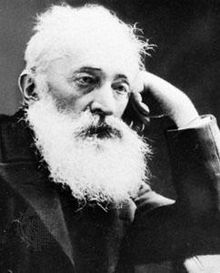
All this great intellectual and social activity, dedicated to the modernisation of Romania, was suddenly overshadowed by a family tragedy in 1888: the death of his only daughter, Iulia, who died of tuberculosis at the age of 19.
Iulia Hașdeu's death and the beginning of her father's spiritism incantations
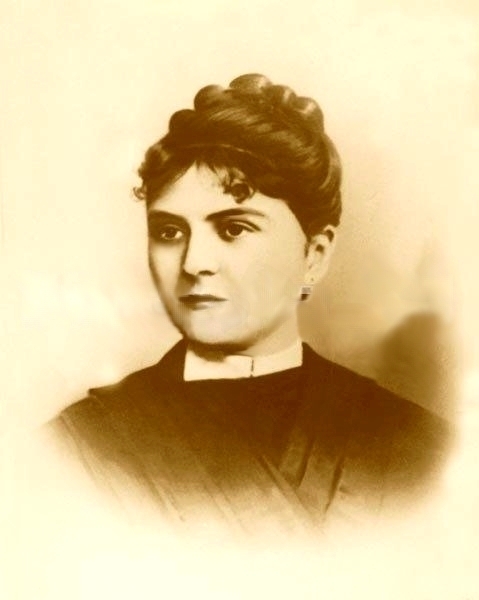
Iulia Hașdeu was known from her youth as a poet of great talent, and her poems, written in French, presaged an extraordinary literary career. In 1889, the year of Mihai Eminescu's death in Bucharest, the famous publishing house Hachette, in collaboration with the Bucharest bookshop and publishing house Socec, published Iulia Hașdeu's posthumous works in three volumes: ‘Muguri de aprilie’, ‘Medievale’, ‘Teatru’, ‘Legende și povestiri’. Hașdeu's daughter was the first Romanian woman to study at the Sorbonne in Paris.
The death of Iulia Hașdeu plunged his father into a deep existential crisis. After this tragic event, the scholar spent the rest of his life studying spiritism. The shock of losing his only daughter led the inconsolable father to turn to this occult technique to communicate with loved ones who had passed into the other dimension. He wanted to keep Julia Hashdeu's presence and dialogue with her alive beyond death through spiritism invocations.
In the preface to his book on spiritism entitled ‘Sic cogito’, published in 1892, Hașdeu expressed his belief in the existence of the so-called ‘science of the soul’ and claimed that this work had been dictated to him by his own daughter six months after her death following contact with her spirit. Now the nocturnal mask of Bogdan Petriceicu Hașdeu's personality begins to reveal itself. Although he is respected as a scholar and an illustrious man of letters, his mystical pursuits in the field of spiritism and communication with the dead lead his contemporaries to regard him as an eccentric individual shaken by a family drama.
But whoever believes that the story of Bogdan Petriceicu Hașdeu's spiritism is nothing more than a strange local story, an isolated existential episode, is mistaken. The Romanian scholar should not be seen as a personality isolated from the world, dominated by the bizarre, bordering on the pathological, because of this inclination towards practices, which is intensified by the inner drama of the loss of Juli Hașdeu. This would be a great mistake. Apart from his scientific and literary work, Bogdan Petriceicu Hașdeu, with his inclinations in this esoteric field, fitted perfectly into a spiritualist current that was part of the European culture of the 19th century. In this sense, Hașdeu fits perfectly with a certain type of metaphysical vision that prevailed at the time of late European Romanticism.
The story of Iulia Hașdeu's tomb in the Bellu cemetery
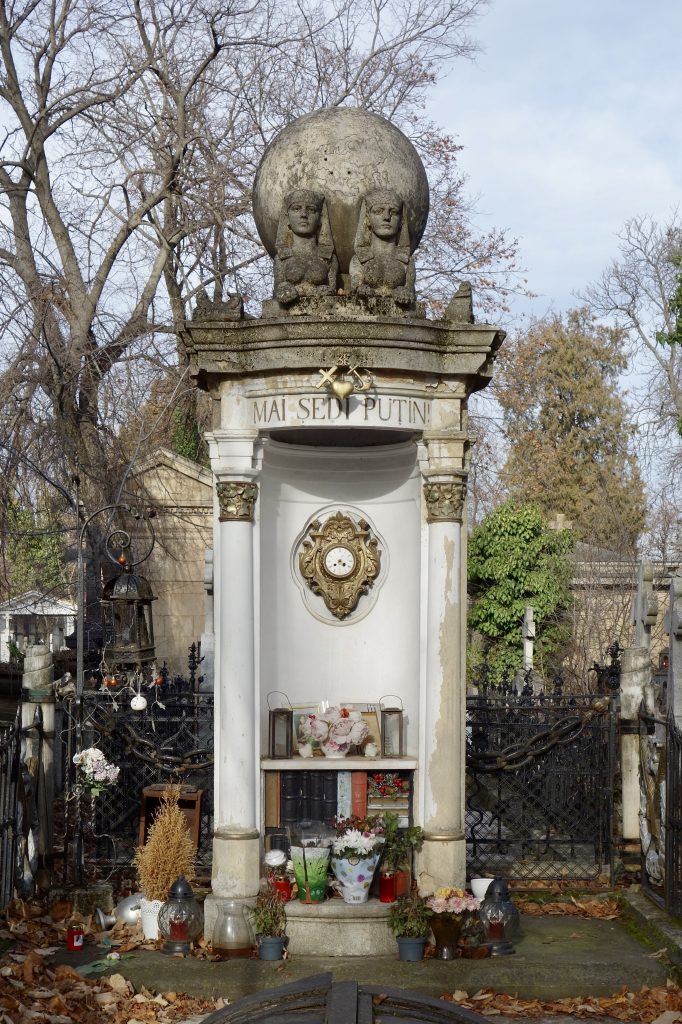
The first place of spiritual communication between father and daughter is the grave of Iulia Hașdeu in the Bellu cemetery. Here, inside the grave, the scholar set up a small spiritism temple where he began to communicate with his daughter. There he said that he had received Iulia Hașdeu's first comforting message from the other dimension in French: ‘Je suis heureuse; je t'aime; nous allons nous revoir; cela devrait te suffire’ (‘I am happy; je t'aime; nous allons nous revoir; cela devrait te suffire’). (‘I am happy; I love you; we will see each other again; that should be enough for you’).
‘Originally, Hașdeu did not intend to build a spiritism temple here. Hașdeu intended to realise the indications he received at spiritism sessions in which he invoked the spirit of his own daughter. At first, he thought that Juli Hașdeu's grave would become a monument to her memory, a very special place, a real temple dedicated to her, but not necessarily a spiritist temple. It was later that this funeral monument also became a spiritism temple,’ explains writer Adriana Ungureanu, author of the book ’Urma pașilor ei. Iulia Hașdeu between life and immortality’.
The funerary monument erected by Bogdan Petriceicu Haședu in memory of his deceased daughter was in itself a special architectural work which, through the elements installed there, hinted at something of the universe and the literary and philosophical concerns of Iulia Hașdeu. The globe is placed on the shoulders of the sphinxes. Below it, on shelves carved in stone, are the most important books of mankind: the Bible, the books of the ancient East, Plato, Descartes and Kant. Embedded in the monument is a clock that freezes the time at the exact moment of Julia Hasdeu's death. Unfortunately, the Hașdeu family memorial has often been trampled by grave robbers over the decades. They have stolen the clock hands and the terracotta busts of Jesus, Victor Hugo and Shakespeare that originally adorned the tomb. It is said that shortly after 1990 thieves smashed the tombstone and stole the skull of Iulia Hasdeu. Legend has it that they sold it for free to medical students. In order to preserve and protect the Hașdeu family gravestone in the Bellu cemetery, writer Adriana Ungureanu appealed to the public: ‘I would like to appeal to this gravestone, this spiritual and spiritist monument, which is unique in the world. The authorities and all of us should understand its significance and recognise that it is first and foremost a cultural symbol. It is part of our cultural heritage and it is very important to save it, to preserve it properly, to renew it so that we can continue to enjoy it, to admire it and to be proud of what Bogdan Petriceicu Hașdeu has bequeathed to us. Beyond its utility and beauty, this funerary monument is a work of art. We have a moral obligation to respect and preserve our values.
The castle of Iulia Hașdeu, temple of the afterlife

The second place that Bogdan Petriceicu Hașdeu dedicated to the memory of his beloved daughter is the castle of Iulia Hașdeu in Câmpina. It was built between 1894 and 1896. The first sketch of the castle dates back to 1893 and was drawn by Bogdan Petriceicu Hașdeu himself, who claimed to respect the suggestions dictated to him by his daughter's spirit from beyond the grave. The building has a strange architectural form, consisting of three towers. The central tower, larger than the others, was designed as a place of prayer and meditation.
The frontispiece of the castle depicts various esoteric and theosophical symbols (the pentagram and the seven circles, small stone thrones at the entrance to the castle, guarded by a female sphinx). Above the entrance is the symbol of the divine all-seeing eye. The building is also decorated with other mystical and religious symbols (sun, cross, crescent moon), and inside are parallel mirrors which, according to occult teachings, allow communication with the spiritual dimension beyond death.
Câmpina Castle was to become a second spiritual temple in honour of Iulia Hașdeu, in addition to the existing one in the family crypt in the Bellu cemetery in Bucharest. Room 6 of Câmpina Castle houses the famous dark room where the spiritism séances took place and where Bogdan Petriceicu Hașdeu claimed to photograph the spirits that appeared as lights during these séances.
In his essay entitled ‘Physical studies on the spirit. D. Fourtier and extra-retinal photography’, Bogdan Petriceicu Hașdeu was convinced that, under certain conditions, photographic film emulsion could capture the luminous fluidity of the presence of conjured spirits at spiritism séances. The Romanian scientist was convinced that ‘the photographic disc is more sensitive to optical impressions than the retina of the human eye, even when the eye is equipped with the most powerful instrument’ and believed that ‘obtaining spiritism photographs becomes quite natural, nothing ridiculous, nothing miraculous’. Bogdan Petriceicu Hașdeu variously called this technique of capturing light waves barely perceptible to the human eye that occur during spiritist seances: ‘transcendental photography’, ‘extra-prismatic photography’ or ‘extra-retinal photography’.
All these occupations with the techniques of spiritism communication have for Hașdeu two aims. One is a purely scientific curiosity, an intellectual search for transcendental truths obtained either directly through theosophical meditation or through the systematic study of phenomena commonly and somewhat erroneously labelled ‘paranormal’. The second purpose is to anaesthetise her anguish and, perhaps like a drug, to give her the certainty that her daughter is still alive in another spiritual dimension and that she can communicate with her uninterruptedly.
«For Hașdeu, the castle was a place to ease his pain».
The museographer Dragoș Costin Stanciu of the Bogdan Petriceicu Hașdeu Memorial Museum in Câmpina (Iulia Hașdeu Castle) has captured precisely this comforting function of the Romanian scholar's spiritistic occupation, as the communication with his daughter's spirit represents a genuine spiritual and mental anaesthesia:
Through spiritism, Hașdeu relieved his pain. This is the real reason for the existence of this castle. It is a place of pain relief. Here, Bogdan Petriceicu Hașdeu not only found the spirit of his daughter, but also communicated not only with Iulia, but also with other spirits. Not only in Romanian, but also in French, Russian, Latin and Morse code. There are even photographs of ghosts in the castle that were taken in complete darkness, without any light source. Hașdeu tried to photograph the spirits he conjured up, and he may even have succeeded. It is an esoteric place, a seemingly unusual place. Its story is truly impressive, because it is the story of pain, but also of hope, of grieving parents who found solace here.
According to Dragoș Costin Stanciu, three or four people used to participate in the spiritism séances organised by Bogdan Petriceicu Hașdeu in the castle dedicated to his daughter. One of them was the medium. The séance began with an invocation addressed to the spirit from beyond. The spirit first took possession of the medium and the latter, in a trance, wrote a message from the spirit on a manuscript, as if she were suffering from an electric shock. This spiritist message was then translated by Hașdeu. ‘The scientist treated spiritism as a science. He even wrote a book entitled ‘Sic Cogito’, which translates from Latin as ‘Thus I think’, with the subtitle ‘What is life. What is death. What is the human being'. In this book, Hașdeu approaches spiritism in a scientific style.
Mrs. Jenica Tabacu, the former director of this museum, has managed to translate all the spiritist messages of Bogdan Petriceicu Hașdeu and to publish them in five volumes. Five volumes of the spiritism archive. In all these spiritism messages, Hașdeu asked for help in life. He asked the spirits for help with various problems as if he were talking directly, face to face, with living beings.
The loss of their only daughter, Iulia Hașdeu, was a great drama for the Hașdeu couple. They tried to communicate through spiritism as if Iulia was still with them, as if their daughter had never disappeared.
It was no wonder. The 19th century, the century in which the Hașdeu family lived, was the century in which spiritist philosophy and spiritism became established in Europe. This is disputed today. It is likely that those who practised spiritism here in the castle did so out of curiosity, some out of conviction, others out of scientific passion. ‘Spiritism was fashionable in the 19th century’.
 English (UK)
  Español
  Deutsch
  Português do Brasil
  Français
  Русский
  Türkçe
  Italiano