History of Spiritism in Germany


Leibniz's writings on «Monadology»
January 1714
Gottfried Wilhelm Leibniz (1646 - 1716) - the famous philosopher and mathematician wrote essays on "Monadology" in 1714 as part of "Hauptschriften zur Grundlegung der Philosophie II". Leibniz deals with the subject of spirit, soul and transmigration. The term "monad" (from the Greek μονάς monas "unity", "simplicity") describes "a philosophically conceived natural unity of both physical and psychological significance". Monads are unspecific. They can be compared to "perisprit", as A. Kardec calls "spirit", but also to "fluidum". Leibniz tried to make what is outside the physical body more tangible, i.e. more explicable, and also what survives after the death of the body. He not only wanted to call it "consciousness", but he wanted to give the subject a transcendental and tangible character. Leibniz thus inaugurated in the 18th century the era of the philosophical and literary "German spirit", full of spirituality and the search for a profound philosophy of the most important questions of human life.

Mesmer and animal magnetism
January 1759
Friedrich Anton Mesmer (1734 -1815) - Swabian physician who practised in Vienna and Paris from 1759 and conducted research to discover and investigate a "central agent of the human organism for the control of nerves, muscles and bodily fluids". He discovered "animal magnetism", i.e. that the human being (or more precisely, every cell of a living body) is surrounded by a magnetic field, similar to the earth's magnetism. And this magnetism exerts an essential influence on our body and thus on our health, both positive and negative. Mesmer used the following methods to transfer the healing magnetic currents to those seeking help: Laying on of hands, movements in the air.
Así, Mesmer llevó a cabo la investigación básica para el Toque Terapéutico (TT), el Reiki (imposición de manos) y para lo que el Dr. R. Sheldrake llama hoy "Campos Morfogenéticos / Mórficos". Inspiró a Kardec y a mucha gente en el campo de la hipnosis, la homeopatía y es quizás incluso el pionero de los más tarde fundados "fotones celulares" y mucho más. Hoy en día, Mesmer es más conocido en el extranjero que en su Alemania natal. La práctica de la imposición de manos según el "magnetismo" de Mesmer es parte integrante de las terapias para quienes buscan ayuda, sobre todo en los centros espiritistas de todo el mundo.

Kant as metaphysician
January 1766
Immanuel Kant (1724 -1804) - Between 1765 and 1766, the famous philosopher wrote "Träume eines Geistersehers, erläutert durch Träume der Metaphysik". These were essays dealing with philosophical questions such as "Do ghosts exist, do we survive our death?" "Can we communicate with the dead? It is possible that Kant first used and introduced the term "metaphysics". At this point, we can say that philosophy was flourishing in Germany in the middle of the 18th century.

Dibbesdorf's spirit of thrashing
January 1767
1767 / 68, Dibbesdorf. A remarkable and bizarre event keeps a whole region and almost the whole country busy. "Der Klopfegeist zu Dibbesdorf" - In the weekly markets and in the daily newspapers a "ghostly manifestation" ("Kloppeding") is reported near Braunschweig. Only later was it reported in more detail. In short: An alleged spirit knocker communicated several times and did so in a loud voice. Questions were asked, which were answered with knocking sounds. It was a "media event", as one would say nowadays. The phenomenon lasted for weeks. In the newspapers (see newspaper clipping) it was reported in a very critical way that these were charlatans and that the landlords only wanted to attract guests. The family of the landlord (the Kettelhut family) of the house where the spirit communicated was accused of fraud, had to close their inn and became impoverished. After a thorough investigation by the police and scientists, there were conflicting statements about the cause and meaning of the knocks. There was some evidence for and some against the idea that it was really a "ghostly manifestation". One lawyer who investigated wrote: "We are almost out of Latin with this story".
In any case, the year 1767 in the small German village of Dibbesdorf marked the beginning of an era of ghostly manifestations throughout Europe and the world.
For us spiritists, this event is particularly remarkable. Because it occurred more than 30 years before the birth of Allan Kardec and 80 years before the phenomena with the Fox sisters in Hydesville, USA.

Lessing and the theme of «death»
January 1769
Gotthold Ephraim Lessing (1729 - 1781) - Lessing also dealt intensively with the subject of death and in his 1769 essay "Wie die Alten den Tod gebildet" ("How the ancients formed death"), he reported on representations of death and homage to the dead and their meanings. An example: Lessing was also interested in the "ghost knocking at the door in Dibbesdorf" and then visited the village of the phenomenon. Of course, we can only mention the most striking titles and works, perhaps the most outstanding, of the thousands that existed. Because very few of us in Germany are aware of their existence.

Jung-Stilling establishes pneumatology
January 1808
Johann Heinrich Jung-Stilling (1740- 1817) - The Karlsruhe scientist Jung-Stilling also dealt intensively with the question: "Does individual consciousness exist? Examples of this can also be found in his writings "Theorie der Geisterkunde - Die Pneumatologie" or "Geister, Gespenster und Hades" published in 1808. The term "pneumatology" ("pneûma "breath, respiration" and λόγος lógos "speech, sense") describes in a narrow sense when mediums hear the voices of spirits or when a spirit communicates by means of "speech". Allan Kardec describes "pneumatology" in more detail under pneumatography (writing) and with pneumatophony (voice) in the Book of Mediums.

Justinus Kerner as a spiritist
January 1829
Dr. Justinus Kerner (1786 - 1862) - German physician, poet and scholar from Weinsberg. In "The Seeress of Prevorst", published in Stuttgart in 1829, Kerner collected questions on various subjects, which were then answered by the medium by means of dream proclamations. For the first time, a series of mediumistic messages were written in German. This is very reminiscent of the works of Allan Kardec a few years later. Kerner also wrote other spiritualist books, among them "Franz Anton Mesmer aus Schwaben, Entdecker des thierischen Magnetismus" about Mesmer.

First translations of Allan Kardec's books into German
January 1866
Las primeras traducciones al alemán de la literatura espírita básica de Kardec no tardaron en llegar:
- 1866, Zurich, The Spirits' Book, C. Schmidt Publishers (only 9 years after publication of the original).
- 1890, The Heaven and Hell, Berlin, K. K. Publishers. Sigismund
- 1891, Leipzig, The Medium's Book, Publisher O. Mutze
Later on
- 2002, Munich, The Gospel according to Spiritism, Spiritismus Verlag, Munich, Germany.
- 2004, Frankfurt, The Genesis, Editorial Lichttropfen Verlag

Prof. Zöllner: Research in border sciences
January 1877
Prof. Johann Karl Friedrich Zöllner (1834-1882) - introduced this subject to the scientific circles of the time in Leipzig around 1877 with his "scientific treatises" on the "Fourth Dimension and the Occult". These were scientific treatises that dealt with the subject in a substantiated and differentiated way. As a result, it became common practice in scientific circles in Germany to discuss and deal with the spiritualistic topics of parapsychology, borderline science and life after death, etc. If one considers the three basic aspects of the Spiritist Doctrine according to Kardec - philosophical, religious-moral and scientific (see article The Three Basic Aspects of the Spiritist Doctrine ) - the scientific aspect of these Spiritist topics was already emphasised at that time in German-speaking countries, but also in other European countries.

Schrenck-Notzing and scientific spiritism in Germany
January 1886
Dr. Albert Freiherr von Schrenck-Notzing (1862-1929) was a German physician and is rightly considered a "pioneer of psychotherapy and parapsychology". He was a leading researcher of mediumistic and spiritualistic subjects and was recognised throughout Europe. Thanks to his research and scientific activities in various fields since the 1886s (founding of the Psychological Society together with Carl du Prel), he made a name for himself in the fields of hypnosis and parapsychology (e.g. with "materialisation phenomena"). His work and his sessions were already very famous in German society during his lifetime. He was very well connected and had a lively dialogue with Thomas Mann, Sigmund Freud, C.G. Jung and other thinkers of his time. He left works such as:
1914, Munich, «Die Traumtänzerin Magdeleine C., Materialisationsphänomene». Una contribución a la investigación de la telepatía mediúmnica.
1922, Munich, experiments on remote movement (telekinesis) at the University of Munich.

Carl du Prel as transcendental philosopher
January 1893
Baron Carl du Prel (1839-1899), German philosopher and writer, only belatedly became convinced of the existence of a spiritual world, but for decades he researched and wrote in depth about the philosophical consideration of these topics, such as "Spiritualism" in Munich/Leipzig in 1893. Later he wrote "How I became a spiritualist" as part of his confession.
Du Prel wrote numerous valuable books, such as: "Die Psyche und das Ewige. Grundriss einer transzendentalen Psychologie", (The Psyche and the Eternal. Foundations of a transcendental psychology), Pforzheim 1871.

Aksakov writes «Animism and Spiritism»
January 1898
Alexander Nikolayevich Aksakov (1832-1903) - was a Russian scientist who lived in Berlin. It is significant that he wrote about the history of spiritualism in Germany and Europe in his booklet "Precursors of Spiritualism". Thus, the term "spiritualism" was introduced and used throughout Europe at that time to describe all subjects and phenomena related to spirit, soul and reincarnation. Last but not least, Kardec's books also contributed to this. Animism and Spiritualism" Volumes I and II were published by Aksakow in Leipzig in 1898. These works are bestsellers among spiritualists all over the world and have been translated into many languages. They discuss and study the central question of sensitive people, which is still very important today: «Do these sensations and images come from myself (animism) or do I receive them as a message from the beyond (spiritualism)»?.
It was interesting to note that Aksakov had written these books as a counter-argument or refutation to v. Hartmann's books and theses.

Spiritualist doctrine in the 19th and 20th centuries
January 1900
The spiritist teaching reached its peak in Germany in the late 19th and early 20th century and spread positively throughout Europe to all sections of the population.
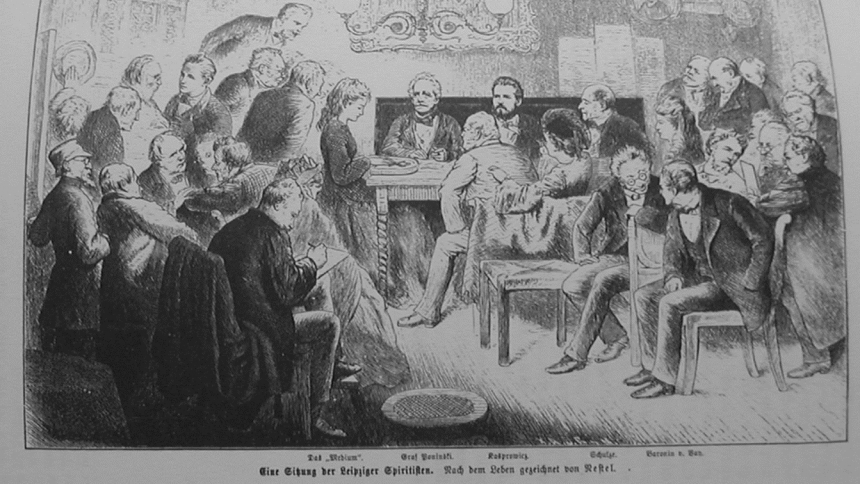
«In spite of these periodic exhibitions of mediums, spiritism in Germany lost the character of a private passion of a few petty bourgeois, bourgeois and aristocrats after 1881. It became a movement whose adherents numbered in the thousands», wrote Dr. Sawicki.
There were also many people who practised purely negative and obscure work under the name of " spiritism ", who also acted in a fraudulent and purely commercial manner. These negative effects were often equated with spiritism itself, which is why the whole teaching fell into disrepute in society.
But numerous scientists, courtiers, educated bourgeois and also ordinary people recognised the goodness and importance of this doctrine. Particularly between 1750 and 1940, these fundamental questions were a major topic of discussion in German society. The spiritualist themes were therefore absolutely dominant at that time.
Cover image: «Relations with the spirit world in a bourgeois environment: German protagonists of Kardecian spiritism» Image of an encounter and mediumistic session with a related Hungarian visitor: Adelma von Vay. (Image copyright "Living with the dead", Sawicki).
Adelma von Vay wrote the book "Geist, Kraft, Stoff" (Spirit, Power, Substance).

Spiritualism saxon
January 1901
From the second half of the 19th century, there were also several magazines spiritualists who reported on the meetings and conferences of associations spiritualists, as well as the publication of books during this period from the 1870s to around 1910. It is also organized and represented regionally, as here in "Sächsischer Spiritismus".
Copyright of the image of "Living with the dead", Sawicki

We would like to highlight other works and their authors in this wonderful period of the late 19th century and early 20th century.
1937, New York, Johannes Greber (1874-1944), "Der Verkehr mit der Geisterwelt Gottes"(Communication with the spiritual world of God) (Note: As spiritualists, we cannot support all of the claims and methods of Greber in his books. However, Greber has been historically a very strong influence on the spiritual movement in the German-speaking countries in general).
1905, Munich, general of division withdrawn Joseph Peter"Der Spiritismus und seine Phänomene" (spiritualism and its phenomena)
1920, Hofrat Prof., Max Seiling, "Die Kardinalfrage der Menschheit.Für die spiritualistische Frage vom Fortleben nach dem Tode (The question of the cardinal of humanity. In favor of the question spiritualist of survival after death)" or "Goethe als Okkultist" (Goethe as an occultist).
1921, Leipzig, President of the Court Georg Sulzer, among others, "Bleibet Christen! Ein Mahnruf an alle Spiritisten" ((Still a christian. An exhortation to all spiritualists) and "Truggeister im Spiritismus" (deceiving Spirits in the spiritism) (Note: Sulzer warns in the book of germans who do not consider the spiritist doctrine of a purely scientific. It is also important to remain christian. As in the case of Kardec, it is important to always consider the philosophical aspects and of christian morality. In this time, it developed even two movements in Germany. A movement was driven more by the spiritualism purely scientific. The other movement was more philosophical religious and more associated with Allan Kardec).
Other personalities were engaged with spiritism
January 1905
Many personalities and valuable citizens were involved seriously in the topic and worked on a voluntary basis to make known the teachings espíritas in the countries of the German language.

➛ Carl von Rappard
➛ Bernhard Cyriax
➛ Graf Adolf Lodzia Poninski
➛ Immanuel Hermann Fichte
➛ Chrn. Acts. Wilhelm Feller
➛ Maximilian Prop Erty
➛ Gregor Constantin Wittig
➛ Johann Kaspar Lavater
➛ Fritz Feilgenhauer, Editor of the "Zeitschrift für Spiritismus und verwandte Gebiete" (Journal of Spiritualism and related fields)
Editorial espíritas around 1920
January 1920
During this period-particularly in Leipzig, Munich, Zurich and Vienna-around 1920, were created many publishers dedicated primarily to the topics spiritualists. Often published valuable works and wonderful (despite the strange titles such as "Occultism...", etc).
Editorial espíritas around 1920: Oswald Mutze, Karl Sigismund, Caesar Baudi Ritter von Vesme, Cäsar Schmidt etc...
But they also had a commercial interest in reaching the largest possible number of readers. This meant that many titles had a questionable content and terrifying. This also reflected the demand and the society. To be able to assess these books, it is useful to apply the "Prüfung der drei Säulen" (Review of the three pillars) (namely, the philosophical, the religious-moral, and scientific).
Equally as interesting and worthy of reading are the contraescritos well-researched that question the basis spiritualist (existence of the soul, life after death, reincarnation, communication with the beyond, etc). For example, the writings and books of Eduard von Hartmann. He was a representative critical of animism to the phenomena spiritualists and was called "the philosopher of the unconscious". And this is precisely what Aksakov wrote his against-theory entitled "Animism and Spiritism".

Hinrich Ohlhaver
January 1930
In 1930, the entrepreneur from Hamburg Hinrich Ohlhaver published the book "Die Toten leben" (The dead are alive), in which he recounted his experiences with the medium Elisabeth Tambke. He travelled throughout Germany and held spiritual gatherings, conferences, and sessions with the medium. He wanted to seriously raise awareness of the issue. I also wanted to help people through spiritual communication through the lady Tambke.
At this time, the repression grew due to the ideas of national socialists. The spiritualists were also persecuted during the era of national socialism. It can be assumed that Ohlhaver was also a victim of the nazi regime. Never came home from one of his trips....

The burning of books spiritualists
January 1933
The burning of books at the beginning of the national socialist Germany: also burned books spiritualists. The spiritualists after Kardec had to keep hidden his books, his work in the association and on the editorial at the beginning and then to give them up completely. Some men and women are very brave lost their lives by not being able to hide their beliefs to state authorities.

What the nazis also were spiritualists?
January 1934
What were some nazis, the followers of occultism or spiritualism?
"There seems to be a slight misunderstanding as to whether the nazis themselves were devotees of the occult. Many of the articles report that the findings suggest that these libraries spiritualists rediscovered were libraries nazis. This is a big misunderstanding. In the vast majority of cases, it was rather the opposite."
The reason why the nazis were collected works of parapsychology and spiritualism, etc, it was not because they believed in them. Rather, some of the nazis believed that these works, and, therefore, the ideas represented a potential danger to national socialism. After all, they had their own ideologies, which were often very liberating, positive, and enlightening (see the doctrine of reincarnation). So the books, their authors, readers and members of the societies in question were on the list of potential enemies. (...) In the eyes of the security services, it was enough to belong to a masonic lodge or to an occult group to enter in the black list. Watched all those groups and one day gave a coup and took all their material. So my interpretation is the opposite of the assumption popular that the nazis coleccionaban these things because they themselves were early occultists. I think that coleccionaban those things because they saw potential enemies in these groups.

Rudolf Passian – Ambassador to the spiritual life.
January 1971
Rudolf Passian (1924-2018) The friendly and cosmopolitan Passian was a writer and lecturer very much engaged in the field of reincarnation, life after death and mediumship human. Since the 1970s, gave way as anyone to the investigation of the so-called "PSI phenomena" in the countries of the German language.
Passian collected many books over the years and left behind the library, spiritual, spiritualist and parapsychological more comprehensive in German language.

A German physicist who established the immortality of the soul
January 1975
Prof. Dr. rer. nat. Werner Schiebeler, physical (1923 – 2006) was a researcher and parapsychologist committed investigated in an open and credible phenomena of highly sensitive people (the so-called mediums) from the perspective of a physicist. Examples of his books:
1983, Ravensburg, "Das Fortleben nach dem Tode" (life after death) on parapsychology and parapsicofísica (term: parafísica)
1989, Neuwied, "Zeugnis für die jenseitige Welt" (Witness for the world beyond)

First meeting of spiritualists germans of the modern times
January 1990
From the decade of 1990, also began to emerge the first groups of spiritualists in the postwar period, which was practiced by the studies and works spiritualists according to Allan Kardec, founded mostly by immigrants, brazilians (during the war, the teachings spiritualists according to Kardec, were developed with particular force in the countries of south america, especially in Brazil). The first groups were founded in Cologne, Berlin and Munich. The groups met then in the so-called "Brüderliche Treffen" (Encounters Fraternal) and came up with the "DSB" – "Deutsche Spiritistische Bewegung" (Movement spiritist German).
1996, I Encounter a Fraternal Groups Spiritualists in Germany
1996, Creating the first web page spiritist German: "www.bsoes.de"

First conference of Divaldo Pereira Franco in Germany
1993
In 1993 took place in Germany in the first lectures of the famous orator and medium brazilian Divaldo Pereira Franco.

Publication of the book "Leben mit den Toten" (Living with the dead)
January 2002
The book "Leben mit den Toten – Geisterglauben und die Entstehung des Spiritismus in Deutschland 1770 – 1900" (Living with the dead – The belief in spirits and the rise of spiritualism in Germany 1770 – 1900) by Diethard Sawicki gives a good overview of the practice spiritualist in Germany during the last few centuries.
Although Sawicki is very sceptical about this, he has researched and published meticulously the history of the movement and the work espíritas in the Germany of the time.

The Gospel according to Spiritism is published in German
January 2002
In 2002, The Gospel according to Spiritism, and was published in Munich by the newly founded publishing house "Spiritismus Verlag".

Foundation of editorial espíritas
June 2002
- Editorial Spiritismus Verlag
- Editorial Lichttropfen Verlag
- Editorial Perisprit Verlag
- Editorial EDICEI

Berlin Foundation of the "Vereinigung der Deutschen Spiritistischen Gruppen" (Association of Groups Espíritas German)
October 2003
On October 26, 2003) was founded in Berlin the "Vereinigung der Deutschen Spiritistischen Gruppen" (Association of Groups Espíritas German), with the aim of better coordinating the work of the groups espíritas and collaborate in the work of public relations of the teaching spiritist in Germany.
Bonn, October 18, 2005, renamed in "Deutsche Spiritistische Vereinigung (D. S. V.)" (Association of Spiritist German).

In Germany it is formally found numerous associations spiritualists.
- 2004, Stuttgart, the first association officially founded in post-war "Spiritistischer Studienkreis Allan Kardec" – Gruppe S. E. E. L. E. and.V.
- October 21, 2005, Munich, the foundation of the "Münchner Spiritische Studiengruppe Allan Kardec" – GEEAK e.V.
- 2005, Northeim, the foundation of the "Allan Kardec Studien - und Arbeitsgruppe" e.V. – ALKASTAR
- 07.02.2007, Berlin, foundation SAJA e.V. – "Die Studien - und Arbeitsgruppe Joanna de Angelis"
- 31.01.2012, Düsseldorf, Freundeskreis Allan Kardec – Düsseldorf e.V. – non-profit association
- 2013, Würzburg, the foundation of the Freundeskreis Allan Kardec Würzburg e.V.
- 01.01. 2018, Munich, foundation of the association Weg der Nächstenliebe e.V.
Other foundations of associations espíritas between 2005 and 2010:
Berlin, the foundation of the Studienkreis Allan Kardec – Berlin e.V.
Frankfurt, the foundation of the Freundeskreises Allan Kardec - Frankfurt am Main e.V.
Mannheim, foundation Freundeskreises Allan Kardec - Mannheim e.V.

The Genesis is published in German
January 2004
In 2004, the publishing house "Lichttropfen Verlag" published in Frankfurt-am-Main the book "The Genesis" of Allan Kardec.
History of Spiritism in GermanySources: www.kardec.de
 English (UK)
  Español
  Deutsch
  Português do Brasil
  Français
  Русский
  Türkçe
  Italiano