Caírbar Tavares de Souza Schutel – el padre de los pobres
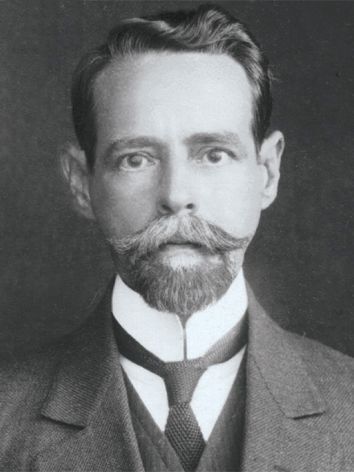
Caírbar Tavares de Souza Schutel, better known as Caírbar Schutel, is one of the most outstanding spiritism personalities in Brazil and in the world. For this reason and as a tribute to him, hundreds of Brazilian Spiritism Centres and Assistance Departments bear his name.
He was born in Rio de Janeiro on 22 September 1868 and died on 30 January 1938 at the age of 70, in Matâo, São Paulo. He was the son of a merchant, Anthero de Suoza Schutel, and Rita Tavares.
When he was 9 years old, his father died and six months later his mother died, leaving him in the care of his grandfather, Dr. Henrique Schutel, a doctor, who had him study at the Imperial College Pedro II. Two years later, he left the College and his grandfather's house to work as a trainee in a pharmacy. His uncle Duarte Schutel, a doctor and journalist, also offered him another occupation with better prospects, but he did not accept because he wanted to develop independently, without any kind of tutelage, perhaps obeying the voice of his destiny.
At the age of 17 he moved to the State of São Paulo, where he worked in the city of Piracicaba. There he ran a pharmacy. Shortly after, he moved to Araraquara and later to Matão, where he founded a pharmacy, something that impressed the inhabitants, since the place was still only a district. In 1898, he obtained, through a project of the Deputy Francisco de Toledo Malta, the creation of the municipality of Matão, being its first mayor and, therefore, one of its founders.
He lived there for 42 years, working hard for the progress of the town and for some years he was the main political figure of the place. The town of Matão owes much to the illustrious figure of Schutel, which led to the naming of one of its main streets after him.
Being a Roman Catholic by tradition, he did much to shine in that religion, with the same sincerity that characterised Saul of Tarsus. Catholicism, however, did not correspond to his innermost expectations.
His conversion to Spiritism came about through the father of a friend of his, a well-known and respected spiritist, whom he asked to allow him to attend mediumistic séances, but these had been suspended two years ago because of the low level of communicating spirits. Caírbar was not discouraged by this and expressed his desire to witness a mediumistic work. Mr. Calixto Prado agreed, receiving on that occasion a communication so elevated that it enthused the future apostle of Spiritism.
Some time later, he received messages by knocking on the table, which convinced him of the existence of extraterrestrial beings and, later, different mediumships emerged in him, including psychography, and he received a message from his father, which proved his survival.
At that time, he resolves to study all the basic works of Allan Kardec, as well as the subsidiary works published to date in Portuguese. Joining theory and practice, on July 15, 1905, he founds the Spiritist Centre "Amantes de la Pobreza" (Lovers of Poverty), which continues to work until our days in the city of Matâo. On August 15, 1905, he launched a new spiritism weekly, entitled ‘O Clarim’. In a short time, thanks to his brilliant style and the strength of his argumentation, he reached the appreciable number of 10 thousand subscribers.
Despite the hostilities he was subjected to, he distributed hundreds of propaganda leaflets and travelled around nearby towns giving lectures.
He was involved in numerous controversies with religious representatives and scientists from various sectors, campaigning for the separation of church and state, rejecting compulsory religious education in public schools.
Encouraged and financially supported by his friend Luís Carlos de Oliveira Borges, he founded on February 15, 1925, the "Revista Internacional do Spiritism" (International Review of Spiritism) of philosophical and scientific studies, with circulation in Brazil and abroad. This remarkable monthly magazine had the collaboration of eminent world personalities such as Arthur Conan Doyle, Oliver Lodge, Charles Richet, Gabrielle Delanne, Ernesto Bozzano, Gabriel Gobron and others, with whom he corresponded.
He created the publishing company O Clarim, with its own workshops, publishing the two newspapers mentioned above, as well as books by spiritism writers and his own.
He wrote a series of books on a wide variety of subjects, which are considered classics in Brazil and are reprinted to this day. Among them are the following:
Spiritism and Protestantism, 1911
Hystericism and Psychic Phenomena, 1911
The Devil and the Church, 1914
Mediums and Mediumship, 1923
Genesis of the Soul, 1924
Materialism and Spiritism, 1925
Parables and Teachings of Jesus, 1928
The Spirit of Christianity, 1930
Life in the Other World, 1932
Life and Acts of the Apostles, 1933
Caírbar Schutel was the forerunner of the dissemination of spiritism doctrine by means of radio in the world. In 1936 he gave a series of lectures on Radio Cultura de Araraquara. These lectures were published in the book Conferencias Radiofónicas (1937), of 206 pages.
Besides being a man of faith, a tireless worker and a doer, he was also a convincing speaker. As a journalist he wrote extensively, writing chronicles and reports in various organs of the secular press.
Schutel was aware of the importance of mediumship in demonstrating the survival of the human soul, among others, that of photographic mediumship, as well as the service work it can perform in the treatment of obsessions, and his house became an emergency mental sanatorium where obsessors were fraternally cared for. As the number of obsessives increased considerably, she rented a large house in 1912, where they could count on more possibilities and resources to attend to the sufferers.
The very enemies of Spiritism did not dare to attack him. Such was the moral authority he had among the people, that his thought and his work inspired respect and admiration, to the point of qualifying him among the profane as The Father of Poverty, in recognition of the tenacity and ardour put into his work of solidarity with the needy in body and spirit, typical of a true Christian.
He married Maria Elvira da Silva, popularly known as Mariquinha. She was an example of dedication and love, who died some time after their marriage, a victim of leprosy.
His disincarnation took place in the midst of his work and after a short illness. The people of Matâo had physically lost an apostle, as he was considered to be. His burial showed the general feeling of the people, with commerce closing its doors and industry paralysing its activities. The authorities also decreed that the national flag be flown at half-mast with a ribbon as a sign of mourning. In the Municipal Theatre of Araraquara and in a large number of Brazilian cities, solemn sessions were held in his memory, and the profane of Rio de Janeiro, São Paulo and Bahia, including foreigners, echoed this with heartfelt and important articles.
Gabriel Gobron, the great disciple of Léon Denis, wrote in the Revue Spiritie Belge, May 1938, a remarkable commentary entitled:
"A great example to imitate". At the end of it he said: "Caírbar Schutel: my sweet and great brother, you were one of those rare spirits who can be recognised not by the torrents of their beautiful words, but by the gestures and actions they practise in the service of others".
The last writing of Caírbar Schutel, a remarkable synthesis of the consequences of the Spiritist Doctrine, published in his "Revista Internacional do Spiritism", said:
"The Spiritism came to bring about a world-wide reformation".
"His Doctrine, highly philosophical, embraces all the vital needs of humanity".
"His principles, based on the supra-normal facts of animism and on the so-called spiritistic phenomena relating to the manifestations of the “dead”, have come to solve all the problems which, like the devouring sphinx, have defied the wit and wisdom of the greatest philosophers of all times".
 English (UK)
  Español
  Deutsch
  Português do Brasil
  Français
  Русский
  Türkçe
  Italiano