Emanuel von Swedenborg
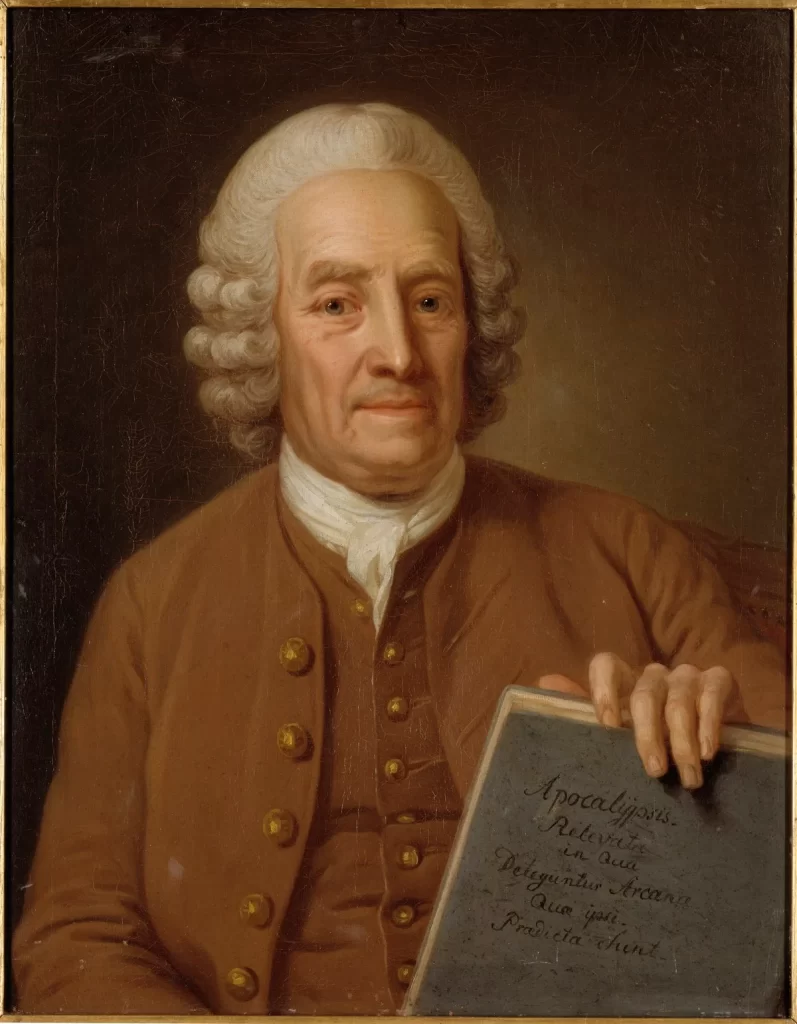
Arthur Conan Doyle referred to him as the greatest and highest human intelligence. In fact, Emanuel von Swedenborg, born in Stockholm on 29 January 1688, the son of a bishop of the Swedish Lutheran Church, lived in an austere evangelical environment for some years of his life. He was a profound biblical scholar.
He studied in Uppsala and visited Germany, France, Holland and England to broaden his knowledge of mathematics, mechanics, astronomy, geology and mineralogy.
At the age of 22 he published a volume of Latin verse and at 28 was appointed mining adviser to the Swedish government. As versatile as Leonardo da Vinci, he created mechanical devices for transporting ships over land, analysed the economics of currency, the production and cost of alcohol, the application of the decimal system, the relationship between imports and exports, and the national economy.
In his early 30s, he turned to palaeontology, geology, the study of fossils and even developed an advanced theory of nebular expansion to explain the origin of the solar system. He also devoted himself to the study of medicine and physiology. He was fluent in Latin, Greek and English, in addition to his mother tongue, and even studied Hebrew to undertake a reinterpretation of the Old and New Testaments.
The first part of his life was focused on his intellect. However, although he continued to have visions as a child, it was in April 1744 that he began a new phase, that of research in search of knowledge of the human soul in relation to God and the Universe within the framework of the Christian idea.
In his words, ...the world of spirits, of heaven and hell, was convincingly opened to me, and there I met with many acquaintances and people of every condition. From then on, the Lord opened the eyes of my Spirit every day to see, perfectly awake, what was happening in the other world and to converse, in full consciousness, with angels and spirits.
Considered one of the forerunners of spiritualist ideas, in his works Heaven and Hell, The New Jerusalem and Arcana Caelestia he described the process of death and the world beyond, detailing its structure. He spoke of houses where families lived, temples where they worshipped, auditoriums where they met for social purposes. He described various spheres, representing the degrees of luminosity and happiness of the spirits. He asserted that there were no angels or demons, but simply human beings who had emerged from the flesh in a retarded or highly developed state. He dismissed the possibility of eternal punishment.
His claims of spirit contact and psychic experiences, including double vision, brought him friends and adversaries. His long-distance visions, such as the one that took place on 19 July 1759 in the city of Gothenburg, 300 miles from the Swedish capital, were investigated in detail. That night, Swedenborg dined with the family of William Castell, along with some fifteen other people, and described, pale and alarmed, the fire that had broken out at three in the afternoon and was brought under control at eight in the evening, three doors away from his own house. That day was Saturday and it was not until Tuesday that an actual message confirmed the facts, including the detail that it had been extinguished at 8pm.
This extraordinary man, energetic as a child and affable in his old age, was kind and serene. Practical and hard-working, he was tall, slim, blue-eyed and always impeccable in his shoulder-length wig, dark clothes, short trousers, buckled shoes and walking stick.
He died on 29 March 1772 in London, the city where he lived for many years and where he began his mediumship. 72 years later, one afternoon in March 1844, he introduced himself to a young man named Andrew Jackson Davis as one of his mentors, along with the Spirit Galen, and began to advise him in his mediumistic journey.
In the Spiritist Codification, his name appears in the Prolegomena, attesting his effective participation as a member of the Spirit of Truth team, contributing to the installation of the Third Revelation among men.
 English (UK)
  Español
  Deutsch
  Português do Brasil
  Français
  Русский
  Türkçe
  Italiano