Francisco de Asís
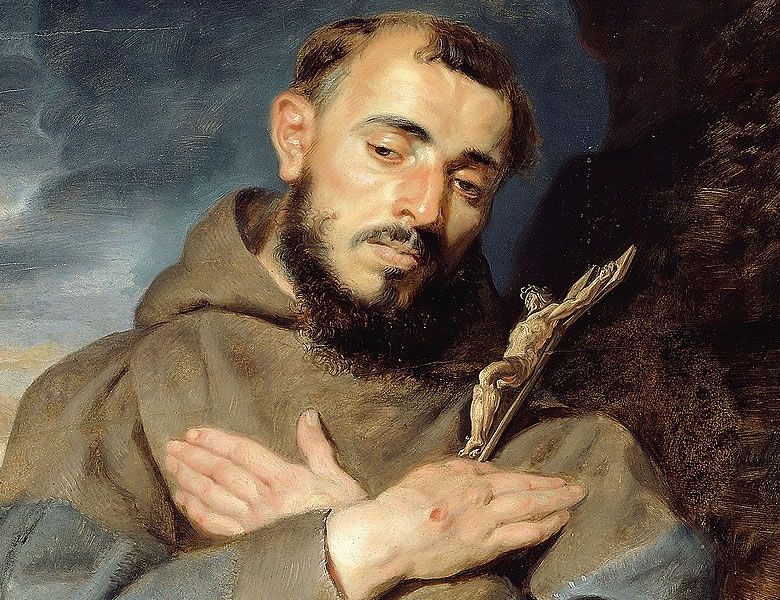
Francis of Assisi was born Giovanni di Pietro Bernardone on 26 September 1181 in Assisi, Italy. He was the son of the Italian merchant Pietro di Bernardone dei Moriconi and Pica Bourlemont, and had French origins. The family was part of the wealthy bourgeoisie of Assisi and enjoyed prestige because of its name and financial holdings.
In Assisi, the boy was known as François, or ‘the little Frenchman’. As a young man, he took part in the activities common to men of his age. In 1202, he enlisted as a soldier in the Assisi war against Peruggia. He was captured and spent about a year in prison, awaiting ransom.
The story goes that as a young man, entering a dilapidated Catholic church, he had a vision of Jesus, who said to him: Francis, restore my ruined house’. Taking the words at face value, he set about renovating the little church, but then failed to grasp Christ's momentous message about the sorry state of Christianity («my house»).
He experienced a sudden conversion in his youth from being a worldly young man to a religious life of complete poverty. He renounced the privileges afforded by his family situation to live in huts. His vivacity attracted other followers and later gave rise to the Order of Friars Minor, known today as the Franciscans.
Francis, known as «Il Poverello» (The Poor Man), is biographed as a simple and humble man who looked to Christ as a model. He exemplified Christian principles throughout his life: he cared for his neighbour and turned away from vanity and pride. He rejected possessions, which justifies his renunciation of ecclesiastical orders and sacred promotions, without ever becoming a priest.
Together with his «sons», Francis renewed the way Catholicism was lived at the time, maintaining the custom of walking through the villages, preaching and living entirely on the donations they received. For Francis, the Gospel had to be followed to the letter, with the utmost rigour, imitating the life of Jesus. He praised the gift of charity, preaching love for God's creation, for nature, for animals and, above all, for human beings, especially the poorest. He called all creatures «brothers» and considered himself the least of them.
Some mediumistic sources mention that the apostle John the Evangelist was Francis in a previous reincarnation. The evangelist was present at all the important events connected with the Master, including the crucial moment of His crucifixion. The biblical account tells us that, at the Last Supper, he was seated next to Christ, in a privileged position (in his last moments in the flesh, Francis asked to have the gospel texts of the Last Supper read to him).
It was John who remained at Mary's side after the death of Jesus, which would explain Francis of Assisi's adoration of the Master's mother. The evangelist also took an active part in the apostolic college, being the last to die. He wrote five of the books of the New Testament: the Fourth Gospel, three epistles and the Apocalypse.
Francis of Assisi, having been John the Evangelist, was one of the most outstanding spiritual benefactors of the Codification systematised by Allan Kardec, and he left us some very profound messages, such as the one published in the Spiritist Magazine of December 1864 (Commemorative Session at the Paris Society):
«Love is the law of the Spiritism; it enlarges the heart and makes one actively love those who disappear in the vague gloom of the grave. Spiritism is not a vain sound which falls from mortal lips and which a breath carries away; it is the strong and stern law which Moses proclaimed on Mount Sinai, the law which the martyrs, drunk with hope, affirmed, the law which the restless philosophers discussed and which, at last, the Spirits have come to proclaim. Spiritists! The great name of Jesus must float like a banner over your teachings. Before you, the Saviour bore in His bosom revelation, and His word, prudently measured, indicated each of the stages through which you will pass today. Mysteries have crumbled before the prophetic breath which shakes your intelligences, as once did the walls of Jericho».
In the Spiritist Review of 1863, Apostle John emphasised that ‘the time has come when Spiritism must rejuvenate and vivify the very essence of Christianity’. He did so when he experienced the firm and resolute personality of Francis of Assisi.
Francis of Assisi, through the mediumship of Chico Xavier, left the following message on 17 August 1951, in Pedro Leopoldo (MG):
The Master's trial was not only arid and rough... Out of the stony and sad mountain sprung springs of living water which have nourished the souls of the ages. And the flowers that blossomed in the understanding of the thief and in the anguish of the women of Jerusalem have passed through time, becoming blessed fruits of joy in the garner of the nations.
Gather the roses of the path from the thorns of testimony... Accumulate the invisible coins of love in the temple of the heart... Temper your manly spirit in contact with the divine current of gratitude and kindness!... But do not stop. Walk! It is necessary to ascend.
The path of elevation is indispensable, with self-denial as the norm of every moment. Remember, he was alone! Alone he announced and alone he suffered. But elevated, in complete solitude, on the sorrowful tree out of devotion to humanity, He became the Eternal Resurrection.
Take no other path than the usual one. Descend, helping, to ascend with the exaltation of the Lord. Give all in order to receive abundantly. Ask nothing for our exclusivist self, that we may find the glorious WE of immortal life. To be concord for separation. To be light for shadows, brotherhood for destruction, tenderness for hatred, humility for pride, blessing for curse....
Love always. It is by the grace of love that the Master persists with us, the beggars of the millennia, pouring the sublime clarity of heavenly forgiveness where we have created the hell of evil and suffering.
When the silence grows heavier around your steps, sharpen your ear and listen. His voice will resound again in the acoustics of your soul and the great words, which the centuries have not erased, will return more clearly to the circle of your hope, so that your wounds may become roses and your weariness transubstantiate into triumph.
The afflicted and tormented flock cries out for refuge and safety. What will become of the ancient human Jerusalem without the providential staff of the shepherd who watches the movements of heaven for the defence of the sheepfold?
The fire of the cross must be rekindled, the radiance of truth must shine again, the paths of decisive liberation must be traced. Intelligence without love is the infernal genius that drags the peoples of today into the dark and terrifying currents of the abyss. The sublimated brain finds no succour in the stultified heart. The misguided culture of our time, consigned to affliction, threatens all the services of the Good News in its innermost foundations. Frightful ruins will surely smoke over the luxurious palaces of human grandeur, which lack humility, and the cold wind of disillusionment will blow with force over the dead castles of domination, which display themselves without regard for the imperishable and supreme interests of the spirit.
Ascension is essential. True light comes from above and only those who settle on the higher plane, even when covered with wounds and gnawed by worms, can rightly clarify the redemptive path that deluded generations have forgotten.
Refresh your exhausted energy and return to the home of our fellowship and of our thoughts. The faithful worker perseveres in the sanctifying struggle to the end. The lighthouse on the raging ocean is always a star in the loneliness. It lights the way, seeking the lamp of the Master who has never failed us.
«Go ahead... Let's move forward...
«Christ in us, with us, for us and on our behalf, and the Christianity we need to revive in the face of the storms out of whose darkness the splendour of the Third Millennium will be born.
«Of course, the apostolate is everything. The task transcends the framework of our understanding.
«Let us not demand clarification. Let us try to serve. We have only to obey until His glory is forever enthroned in the scourged soul of the world.
«Follow, then, the bitter path of passion for the divine good, commending yourself to unceasing sweat for the final victory.
«The Gospel is our Eternal Code. Jesus is our Imperishable Teacher. Let us climb, in his company, on the hard and rough road.
«Now it is still the night that tears us apart in thunder and shadow, frightening, tearing, torturing, destroying....
«However, Christ reigns, and tomorrow we shall behold the heavenly awakening’.
Francis of Assisi died on 3 October 1226. In 1979, Pope John Paul II proclaimed him Patron Saint of Ecologists.
 English (UK)
  Español
  Deutsch
  Português do Brasil
  Français
  Русский
  Türkçe
  Italiano