Cosme Mariño – the Argentinian Kardec
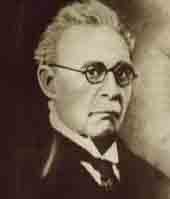
He was a key man for the spreading of Spiritism in the Rio de la Plata, especially in Argentina. He was called "The Argentinean Kardec". His struggle was longer and more violent than that of Kardec. He had to work for half a century to conquer and consolidate the positions he bequeathed to us. He was assaulted not only in words and in writing, but also with a firearm. However, nothing discouraged him, nothing intimidated him, because he was a great missionary, conscious of his power, sure of the immense value of the idea he defended at the risk of his own life.
He was born in Buenos Aires, capital of the Argentine Republic, on 27 September 1847, and disincarnated on 18 August 1927. His father was a military officer (an artillery officer) and his mother was a housewife, sometimes doing sewing work. In a "poor but honest home", in his own words, he was brought up in the principles of the Catholic Religion and, from an early age, he felt inclined towards the priestly life. He thought that this would be the way to exercise his need to serve others. He attended his first studies in the church of St. Nicholas and then a year of Latin at the Convent of St. Francis. He then realised that his vocation did not lie in priestly training. From the second to the fourth year, he continued with the Preparatory Studies at the University (currently secondary school) and in the fifth year he went to the National School, recently founded by President Bartolomé Mitre. He then entered the Faculty of Law.
Around the age of 20 he wrote his first essays and literary articles, published in newspapers of the time, such as "El Inválido Argentino" (The Argentinian Invalid), organ of the "Sociedad Protectora de Inválidos" (Society for the Protection of Invalids), a new centre of attraction for his spiritual concerns. There he came into contact with another young man, José C. Paz, which sealed his inclination towards journalism.
In 1869, Argentina was in a process of evolution. Domingo Faustino Sarmiento was the president of the Republic. Mariño, together with his friend José C. Paz, founded the newspaper "La Prensa". Paz was 27 years old and Mariño 22. They did not have the money to afford this enterprise, so they issued shares among their friends and embarked on a healthy journalism, reporting with clarity and high standards. Let us say in passing that the newspaper ‘La Prensa’ of that inaugural period bore little resemblance to the publishing company it later became. Mariño devoted himself body and soul to this activity, and did not even have time to sleep at home. He did so in any corner of the printing house. The following year, his older brother, Gervasio, seeing that the situation was unsustainable, paid off the debt and asked Cosme to leave the business. He began to work as a solicitor in a firm in Buenos Aires.
In 1871 he took an active part in the fight to overcome the yellow fever epidemic that devastated the city of Buenos Aires. He was infected, but managed to survive. He was decorated with the Iron Cross, together with the printing of posters with his name and the gratitude of all the people of Buenos Aires. He also received a gold medal for his courage and spirit of service. Due to the reputation he acquired and his advanced university career, he obtained an important clientele in judicial matters (ranchers in the south of the province of Buenos Aires), which would have a favourable influence on his profession from then on.
In 1872, at the age of twenty-five, Cosme joined the Chile Relief Committee, chaired by the rector of the National University, as secretary. Chile was suffering a terrible smallpox epidemic. He was able to send a lot of money to the neighbouring country. The Municipality of Santiago de Chile and the Junta de Lazaretos of that country awarded him gold medals in recognition of his selfless support. He was in his last year of law school, but he never took his final exam because from then on he was totally absorbed by his many professional and later spiritism activities.
In 1873 he travelled to Chascomús - a city one hundred kilometres from the Federal Capital - to ask Mercedes Milani to marry him. He returned to Buenos Aires for the preparations. He returned to that city, married in 1874 and moved to Dolores. Mercedes Milani was a descendant of the founders of Chascomús. Cosme Mariño met her when she was only 16 years old. A fortuitous circumstance led the couple to meet again some time later in Buenos Aires, where they began a brief love affair that ended with their marriage. They had six children. The union lasted only 18 years, until Mercedes' disembodiment in 1892.
In addition to raising their children, this well-matched couple, in a kind and selfless way, took in charge six more children, orphaned and abandoned, who lived under the roof of their home, as their own children. The day before his departure, he said goodbye to his childhood friend, Dr. Aristóbulo del Valle, then Minister of Government of the Province of Buenos Aires, who appointed him to represent the government before the Southern Courts of the Province of Buenos Aires, based in Dolores, which had just been created. He was part of a commission to inspect the works of the House of Justice and Prisons and Del Valle also gave him the post of Justice of the Peace, to be exercised from 1875. Mariño also had letters of recommendation from prominent law firms in the Capital. He set up his own law firm in Dolores (period 1874-1879) and, in this way, managed to secure his economic situation.
He took over ad honorem the presidency of the San Roque Hospital Commission, which was among the most precarious. With his dynamism, charisma and ability, he put the hospital in working order and out of debt. He was also appointed a member of the School Council Committee, which he served selflessly, contributing ideas and resources. He even donated some of his own land for the establishment of a school. On a certain occasion, Cosme Mariño called the engineer Rafael Hernández for a land survey. They ended up talking about Spiritism. This is how Rafael initiated Cosme in the reading of Allan Kardec's texts, starting a friendship that lasted for many years, becoming determined and valuable companions in important actions in favour of Spiritism.
The spiritism meetings were held in the house of Dr. Pedro Bourel. The names of Justo Ortiz, Enrique Becker, Felipe Aristegui, Alejandro Villabrile were linked to this fact. But the one who played a preponderant role in this group was none other than the engineer Rafael Hernández, the founder of several cities in the province of Buenos Aires, politician of note, senator, deputy; also, brother of the illustrious author of "Martín Fierro", Don José Hernández. In 1879, Mariño returned to Buenos Aires to work in one of the most important law firms in the Capital, with doctors Aristóbulo del Valle and Mariano Demaría. In 1895, he joined the Banco Nacional de Préstamos as head of the Legal Office.
Back in 1879, Mariño joined the Constancia Society, the first spiritism society founded in Buenos Aires in 1877. He soon became a member of the board of directors and became the editor of the Constancia Magazine, a pioneer among the spiritism periodicals (period 1881-1927). In 1881 he was appointed vice-president and, on taking up the post, he proposed the holding of public and internal conferences, becoming their main manager and organiser. He also founded a social library, in order to provide adequate enlightenment for the followers who were only attracted by the phenomenon. In 1883, the General Assembly confirmed him as president and the Society began to acquire a new rhythm.
From his position as a journalist, he faced great controversy in favour of spiritism. He campaigned against quacks and false mediums, who wrongly assumed the title of spiritism. He was persecuted and discredited for this. The Jesuits were his most violent enemies, defaming him in public. He always responded with loftiness, elegance and, above all, with much knowledge.
In 1892 he was the victim of an attack. A religious fanatic attacked him with a gun, injuring him, but without major consequences. It was a time of great fanaticism and religious intolerance.
He wrote several books and many newspaper articles, all of great value:
• Spiritism (1881)
• Spiritism in the Face of Science (1882)
• Catechism of Morals and Religion (1883)
• The ideal is the real (1893) drama.
• Guide for the formation and support of spiritism groups and societies (1894).
• Bases that could be used to found a liberal association and party (1895).
• Spiritism within everyone's reach (1902)
• Snapshots (1907)
• Conclusive Proofs for the Existence of the Soul (1909)
• Letters from Julia (1911) (Translation)
• Spiritist Concept of Socialism (1913)
• Memoirs of a mediocre man (1918) (1924)
• The First Swallows (1922) novel
• Spiritism in Argentina (1924) published in 1932.
On 14th June 1900, the Argentine Spiritism Confederation (CEA) was founded, which groups together most of the spiritism societies in Argentina up to the present day, and Cosme Mariño assumed the presidency. He was vice-president of the Sociedad Protectora de Niños Desvalidos, acted to repeal the death penalty, and in 1925 inaugurated El Asilo Centenario, in the town of Villa Lynch (province of Buenos Aires), for orphaned children.
Cosme Mariño was active in Spiritism for almost 50 years.. He was president of the C.E.A., permanent president of the ‘Constancia’ society (1883-1927), director of the magazine of that institution, writer, journalist, orator and director of mediumistic séances. His close friends were great figures in politics, art and literature. He became acquainted with Pancho Sierra, who, while passing through the capital, came to the Constancia Society, attended some of its sessions and later became a member. He corresponded with Amalia Domingo Soler and with spiritisms from all over the world. He was affable, simple in his way of being, as well as energetic and decisive when it was necessary to defend a position in which he was supported by his knowledge and his morals.
The motive for everything I have done and have been able to express has always been altruistic. When I believed that an idea was a good one, I always tried to give it prestige and propagate it within my limited aptitudes. I have never stopped at a selfish consideration or mere personal interest, when, with the sincerity that characterised me, I have come to discover an idea or a doctrine that could serve the moral progress of mankind. As is public and notorious, I have sacrificed all personal and utilitarian considerations, and even the good opinion I could inspire in others, when I have glimpsed a more upright and safer way to reach the truth, because I consider that truth, sincerely felt and practised, is the only thing that makes one love life, because of its dedication to individual and collective progress’ (Cosme Mariño - “Memoirs of a mediocre man”).
 English (UK)
  Español
  Deutsch
  Português do Brasil
  Français
  Русский
  Türkçe
  Italiano