Saint Catherine of Genoa

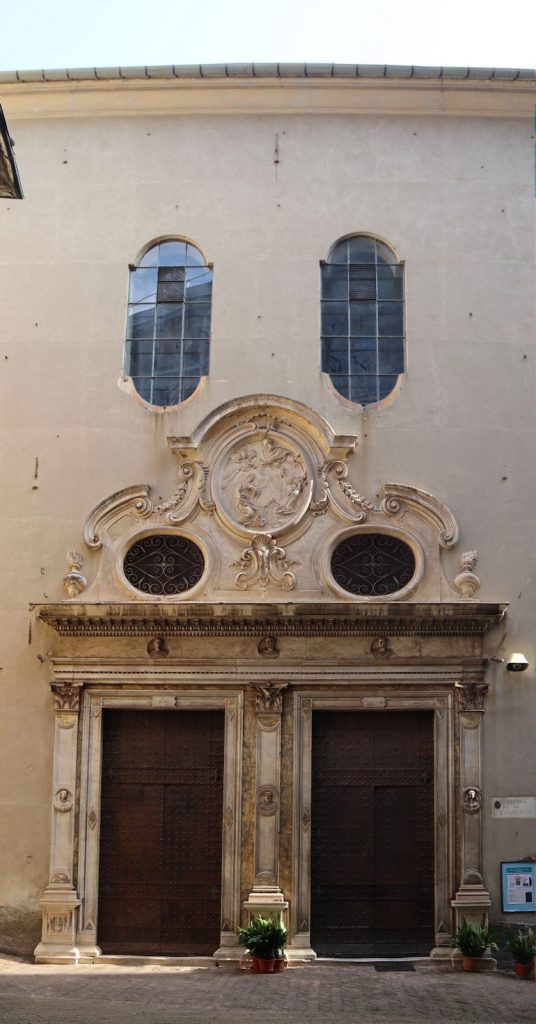
Catherine was the daughter of the noble family Fieschi, from which also the two popes Innocent IV. and Hadrian V, whose palace is in the church of the family Santa Maria in Via Lata; his father was viceroy of Naples. At 16 she was forcibly married to the Genoese nobleman Giuliano Adorno. After ten years of bad marriage, during which he often closed in prayer and lived also sometimes outside in pleasures, he visited his sister in a Franciscan convent. There in 1474 he met the first illumination and appearance of the crucified Christ; he now lived in chastity and asceticism, moved to a house near the old hospital of Pammatone - which was on the site of the current palace of justice - in Genoa, was flogged, took care of the poor and sick, and in 1479 joined the Franciscan order as a tertiary. from his house became in 1488 a Franciscan monastery with the church Santissima Annunziata di Portoria - today also named after her as the church of Santa Caterina.
Catherine took care of the sick in the old Pammatone hospital, where she was head of the women’s department in 1489. During two epidemics of the plague, he worked tirelessly for the sick and dying. Under his influence, the Communion of Divine Love became a nursing community. She punishes herself, during Lent she feeds only on communion, and receives mystical gifts.
After losing all her possessions, her husband followed Catherine’s example in the last years of his life and joined the Franciscan order until his death in 1497. Now the spiritual guide of Catherine began to record her life history and her spiritual experiences and teachings: in 1551 appeared this Book of the Vita mirabile e dottrina santa di S.Caterina Fieschi, the book of the wonderful life and sacred teachings of Saint Catherine Fieschi. His revelations are contained in the two books Dialogue of Divine Love, Dialogue of Divine Love, and Treatise on Purgatory. Purgatory is for them a place of suffering, but the souls are there full of joy because they know that they are guided by God, therefore, the pain intensifies, but also the joy, the closer the moment of their redemption.

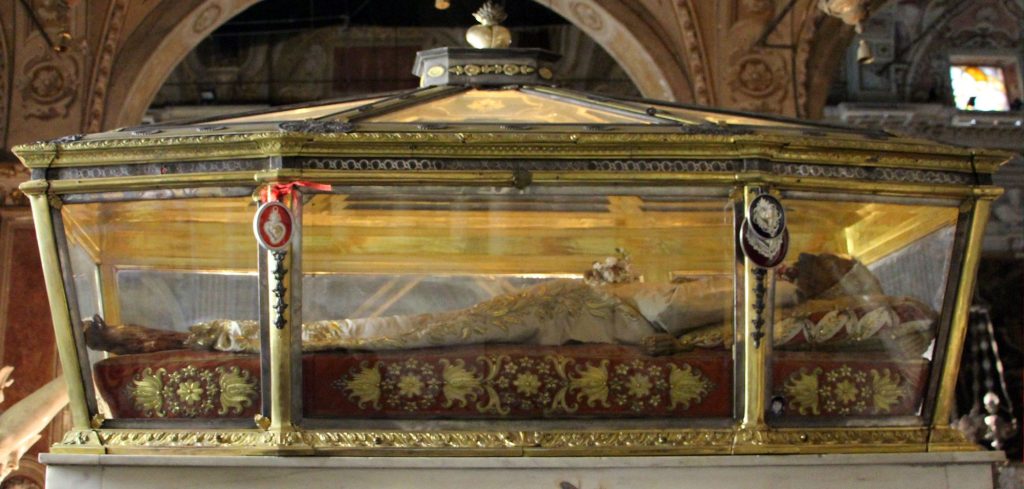
Catherine was buried in the church of the Santissima Anunciación in Portoria, Genoa.
Canonization: Catherine was beatified on 6 April 1675 by Pope Clement X and on 16 June 1737 by Pope Clement XII. In 1944, Pope Pius XII named her second patron of Italian hospitals. In 2004 it was reported that Catalina might be named as the fourth woman in history and the first married woman to become a church teacher.
Words of the saint
The three ways of human love for God:
"It is said that works are done for love, when man does everything he does for the sake of God, for that love that is given to him by God with the desire to make salvation for himself and his neighbor. In this first stage of love, God makes man perform many and different useful and necessary works, with a feeling of pious affection and merciful benevolence.
The works of the second state of love are done in God. They are those works that are done without taking into account the benefit of oneself or neighbor, but which remain in God without any other purpose of who has performed them. [And because of the habit that man has acquired of doing good, he remains in work, though God has deprived him of his own part, which before helped him and pleased him. For this reason, such a work is more perfect than the first works, because man in the first stage had many purposes that satisfied body and soul. The satisfaction of one’s own good works is taken away. ]
Works done by love are, in the end, more perfect than those of the other two types, because they are done without the participation of man. Love has overcome and conquered man in such a way that, so to speak, he has sunk into the sea of love without knowing where it is. He is completely destroyed in himself and is not able to do anything; in this case, it is love that does its work in man. Its effects are works of perfection, because they are carried out without the action of man. They are works of grace that God accepts all. This sweet and pure love has taken man and has completely attracted him within himself, totally freeing him from his being. She has possessed him completely. [He acts continually in and through this person, only for his benefit and benefit, without himself interfering. ]"
 English (UK)
  Español
  Deutsch
  Português do Brasil
  Français
  Русский
  Türkçe
  Italiano