Angel Aguarod
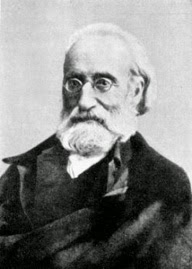
Ángel Aguarod was born on 2 October 1860 into a modest household in the village of Ayerbe in the province of Huesca in northern Spain, the son of Don Juan Aguarod and Doña Juana Torrero. Growing up in a Catholic home, he naturally received a Catholic education from his maternal uncle, Don Pablo Torrero, who was a priest and parish priest in the village of Novales in the same province of Huesca. He was eleven years old when he left his home province to settle in the populous and bustling city of Barcelona. It was in this city that his spirit of progress developed. In the bustling Catalan capital, he emancipated himself from Catholic tutelage. The ideas of liberty, equality and fraternity penetrated his soul and took hold of him.
Coming from a modest background, he had to take his first steps in material life among the working class. As a worker, he joined his class's trade union and, at the age of 17, was already its general secretary and delegate to the Centro Federativo de las Sociedades Obreras (Federation of Workers' Societies) in Barcelona. At that time, in 1877, Dom Antonio Tudury y Pons launched a movement for secular education in the capital of Catalonia, which he enthusiastically joined and even founded a school, which he ran and maintained until 1905, when he settled in Argentina.
In order to run and manage this school, which was named Sócrates, he studied at the Escuela Normal de Barcelona and attended evening classes, as he had to earn a living for himself and his family during the day. In 1880, his restless mind became interested in spiritualist teachings, to which he devoted himself wholeheartedly. He took his first steps in the field of spiritualism at ‘La Cosmopolita’, a society composed of genuinely rationalist elements with liberal and universalist tendencies. He soon moved to the ‘Centro Barcelonés de Estudios Psicológicos’ (Barcelona Centre for Psychological Studies), of which he was one of the founders, as well as to the Unión Espiritista Kardeciana (Kardecian Spiritist Union) and the centres Sócrates and Amor y Ciencia (Socrates and Love and Science), which he chaired for several terms with outstanding achievements.
It can be said that until 1905, when he moved to Argentina, there was no festive event promoting spiritualism in Spain in which he did not participate, in many cases together with Amalia Domingo Soler, Belén Serraga de Ferrero, Vicomte Antonio Torres Solanot, Dr. Manuel Sanz Benito, Miguel Vives, Quintín López Gómez, Fabián Palasi and many other pioneers of the Spanish spiritualist movement. In 1905, he settled in the Republic of Argentina and soon began working at Constancia and La Fraternidad. Shortly afterwards, he founded the Centro Amor y Ciencia (Centre for Love and Science) and the Liga Espiritista Kardeciana de Propaganda (Kardecian Spiritist Propaganda League), institutions of which he became president, and also directed the Sunday school that operated at the Centro Amor y Ciencia. He also directed the original magazine El Espiritismo (Spiritism), which he founded as the official organ of the League. He was one of the most outstanding speakers of the team organised by Constancia, taking turns on the podium with Cosme Mariño, Dr. Ovídio Rebaudi, Francisco Durand and several other luminaries of oratory. He travelled several times throughout the interior of Argentina, giving lectures and helping to establish Spiritist centres and societies. He returned to Spain and shortly afterwards went to Uruguay, where he stayed for several months before settling in Paraguay, where he devoted himself actively to propaganda work. There, however, his spirit suffered a severe blow with the tragic death of his beloved grandson, who was killed in a traffic accident.
He returned to his homeland for a short time and then came back to South America in 1915, where he decided to settle in Porto Alegre. Once there, he became actively involved in Brazilian Spiritism, joining various societies and contributing to the magazine Eternidade, the organ of the Dias da Cruz and Allan Kardec societies, which he later took over until its final publication. In this magazine, he launched an intensive campaign for the unification of the Spiritists of Rio Grande, which was crowned with success with the founding of the Spiritist Federation of Rio Grande do Sul on 17 February 1921, of which he was president until 1927. During his tenure and afterwards, he undertook numerous propaganda trips, which led to the establishment of new societies and study centres in the interior of the country. He founded the Paz group in Porto Alegre in 1921 and the Paz y Amor society in 1922, and was elected president of both, a position he held until his death. Aguarod was not only active as a member of associations in the field of Spiritism, to which he always devoted his greatest enthusiasm.
His work as a spiritualist publicist was enormous. He founded and edited newspapers and magazines such as El Espiritismo from 1905 to 1912 in Buenos Aires, Nueva Era in Barcelona, La Unión Espiritista, also in Barcelona, Fraternidad in Alcoy (Alicante) and La Antorcha del Progreso in Badalona, Eternidad and Boletín de la Federación Espiritista de Rio Grande do Sul, and collaborated on many others, including Luz y Unión, La Luz del Porvenir in Barcelona, Constancia and La Fraternidad from Buenos Aires, Reformador from Rio de Janeiro, El Espiritismo and Luz y Vida, also from Buenos Aires; Rosendo from Cuba, as well as countless articles requested by other publications in Europe and America, which he willingly sent without ever receiving any remuneration for his work, even though he earned his modest living throughout his life through honest work and employment, sometimes as a labourer, sometimes as an educator. Given these many activities, who would have thought that he would still have time for other work alongside his varied daily occupations? Nevertheless, he still found time to write several works for the dissemination and promotion of Spiritism, such as ‘Los Mensajes de Abuelo Pablo’ (The Messages of Grandfather Pablo), Orientado hacia las Cambres (Oriented Towards the Chambers), Del Maestro al Discípulo (From Master to Disciple), Confidencias Espirituales (Spiritual Confidences), Grandes y Pequeños Problemas a la Luz de la Nueva Revelación (Great and Small Problems in the Light of the New Revelation) (in Spanish), published in Portuguese translation (1932) by the FEB (Spiritist Federation of Brazil), ‘Vozes de Além-Túmulo’ (Voices from Beyond the Grave) (in Portuguese), ‘La Verdad a los Ninõs’ (Truth for Children), works to which he attributed spiritual origins, as Aguarod believed he possessed intuitive mediumship through which these works had been dictated to him. The important work El Sermón de la Montaña (The Sermon on the Mount) remained unpublished.
On 13 November 1932, the tireless champion of the Spiritist movement passed away in Porto Alegre at the age of 72.
 English (UK)
  Español
  Deutsch
  Português do Brasil
  Français
  Русский
  Türkçe
  Italiano