Léon Denis – the successor of Allan Kardec
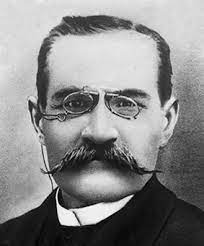
Léon Denis was the unquestioned successor of Allan Kardec's work and a tireless disseminator of the Spiritist Doctrine. He was born near the town of Toul, France, on January 1, 1846. His parents were humble but very spiritualised people, especially his mother, Dona Ana Lucia Denis, a woman of incredible qualities who transmitted to him the love of God and the respect for fellow men.
From an early age he had to work hard to help support the modest household. He also felt from an early age the company of invisible friends who helped him in difficulties and who would never abandon him. He was a self-taught man, training himself intellectually like few other men. He took advantage of every spare minute to read and inform himself, studying and seeking knowledge with a true appetite for wisdom. He divided his time between hard work and reading. He was a quiet, shy and very reserved young man. From an early age he had problems with his eyesight that would later bring him painful moments. He loved music and the arts and was a very sensitive being, always connected with the force of the Greater World.
One day, at the age of eighteen, he found Kardec's book "The Spirits' Book" in a bookshop, and from then on he defined his life, assuming the spiritual commitments he had acquired before reincarnating to spread Spiritism, the Good News sent to us by the Master Jesus. He threw himself into the work and never rested. In 1880 he met Allan Kardec when the latter was visiting his hometown, giving lectures and opening reading circles to promote the systematic study of the Doctrine. This meeting was vital in his life and work.
In 1882 he began to write marvellous texts in which he explained with simplicity the aims of Spiritism, and at the same time he became the champion of the Doctrine, giving lectures and talks in all the towns of France. At that time he faced cruel persecutions from the Catholic Church and from the materialist and positivist groups, the fashionable philosophies of the time. The former called him the son of the devil and threatened him with eternal hell, while the latter mocked his new ideas about the survival of the soul and life in the Spiritual World. Léon Denis always responded confidently and calmly, never returning the offences received, as Jesus taught us to do.
Léon Denis wrote many wonderful books, all of them of a spiritualist character, among which we shall name:
• “The because of Life" (1884)
• «After death (1890)”
• “The Problem of Being, Fate and Pain" (1905)
• “Christianity and Spiritism" (1898)
• “Invisible World" (1903)
• “The Great Enigma : God and the Universe" (1911)
• “The Celtic Genius and the Invisible World" (1927)
He was also a writer, journalist, lecturer and director of study groups, President of the "French Spiritist Union", correspondent of the most famous magazine of his time, "Revue Spirite" (Spiritist Magazine), where he wrote innumerable articles on Spiritism; he actively participated in all the Spiritist congresses in Europe that were beginning to be organised at that time. From 1910 onwards his eyesight worsened considerably, almost to the point of blindness. He was not discouraged and, like the great spirits, endured the difficulty with stoicism and full faith in the Spiritual World, which acts by ways unknown to us, with the sole purpose of making us grow and carving our souls to become beacons of the Christic Light.
He continued to write with the help of friends and learned the Braille system of writing (a method for the blind). In this way he was able to continue correcting his works, writing and bringing the words of hope of the Good News to every corner of the planet. He was very concerned about Nature and its divine energy. He said that man should return to his roots, when he communicated with her, exchanging vital forces, understanding that we are all part of a gigantic energetic network, coming from the Father and that we all carry part of this divine spirit, twinned in the wise knowledge of universal love. In 1927, at the age of 81, he finished his manuscript "The Celtic Genius and the Invisible World". He was practically blind. This beautiful theme was published by the Revue Spirite in Paris. Then, at the end of March of that year, 1927, he disincarnated. A great man had departed, on his way to the Greater Homeland.
This great man, defender and champion of Spiritism, held the foundations of the Doctrine like few others, brought thought to an understanding of the reasons for reincarnation, explained the justice of God, the plurality of existences and inhabited worlds, raised awareness of the connection between humanity, the stars and nature, and carried the banner of love and forgiveness as his standard. He explained like few others the meaning of life and the responsibility to the Spiritual World.
In his words:
"The spiritist faith leads, without doubt, to love, but it postulates, in the first place, knowledge of the soul, of destiny and of God. It is not only faith, it is a teaching, it is a criterion that defies contradiction".
... "Seek not God in temples of stone or marble, O man who would know Him! Seek Him in the eternal temple of Nature; in the spectacle of the worlds, travelling through infinity; in the splendours of life bursting on its surface; in the contemplation of the varied horizons: plains, valleys, mountains and seas that your earthly abode offers you. (...) if you know how to recollect yourself, you will hear in the voices of Nature the subtle teachings that she murmurs in the ears of those who frequent her retreats and study her mysteries (...) God is in each one of us, in the living temple of consciousness. There is the sacred place, the sanctuary where the divine spark is hidden".
 English (UK)
  Español
  Deutsch
  Português do Brasil
  Français
  Русский
  Türkçe
  Italiano