William Stainton Moses
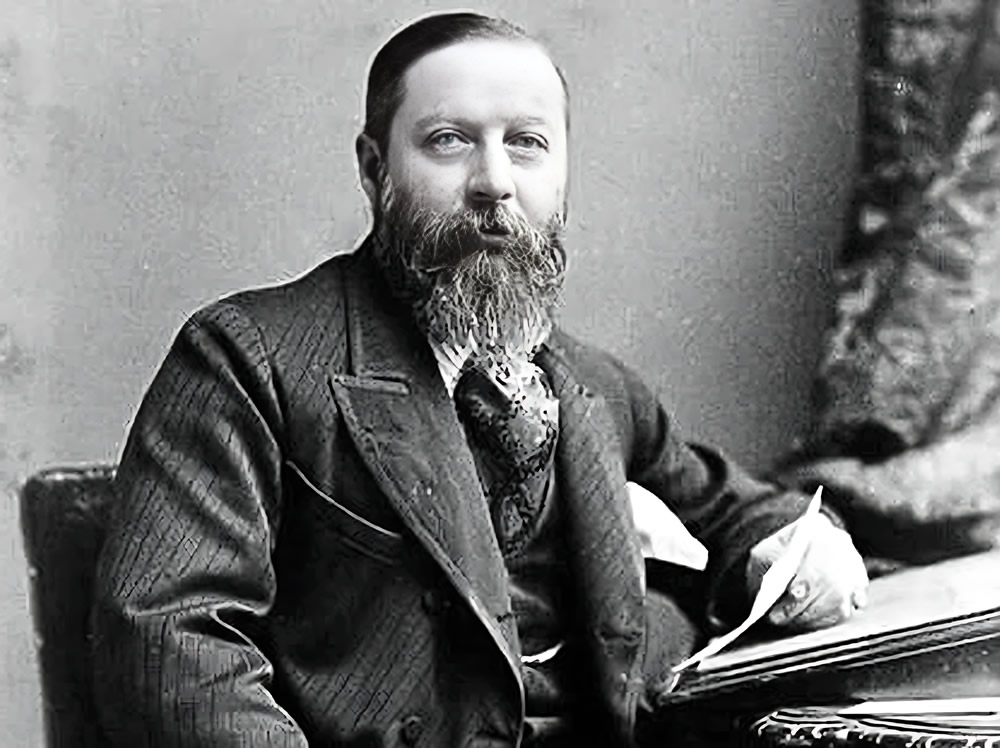
William Stainton Moses was born on 5 November 1839 in Domington, Lincolnshire, England, and disembodied on 5 September 1892.
His father, William Moses, was rector of the grammar school, and his mother was the daughter of Thomas Stainton d'Alford. Young William Stainton Moses began his studies under his father's guidance and was then entrusted to a private teacher who, marvelling at his aptitude, made a fervent effort with his father to send his son to a public school. In 1855, he entered Bedford Grammar School, where he studied for three years, and was praised most heartily by his teachers, for his devotion to his studies was accompanied by a keen sense of duty. After receiving numerous prizes he left this school.
From Bedford, Stainton Moses entered Exeter College, Oxford in 1858. His student life was worthy of the highest honours, having even become seriously ill due to excessive attachment to school subjects.
To convalesce from his illness, he travelled for a year on the European continent and, on his return, spent six months in the old Greek monastery of Mount Athos. Curiosity and above all a great need for meditation and isolation forced him to remain in the monastery all that time. A few years later his spiritual mentor, known as Imperator, explained to him that he had since been influenced by spiritual entities interested in helping his spiritual education.
At the age of 23, Stainton Moses returned to Oxford. Ali, receiving his degree, left the university in 1863. Although he was enjoying better health, the need to live a country life led him to accept a curacy at Maughold, near Ramsay, Isle of Man, where he remained for five years, replacing the rector who, due to his advanced age, was no longer able to exercise those functions. This led to Moses having a double task.
A smallpox epidemic, which broke out in that region, highlighted his dedication and courage. As there was no doctor in the area, the young man, who had some knowledge of medicine, treated the bodies and souls of the inhabitants of the region. Day and night, he worked day and night, but the epidemic progressed slowly, making him not only a religious pastor, but also the doctor and gravedigger of this population centre. His extreme dedication made him even more beloved by his parishioners. However, his health, which could not cope with the obligations imposed by the administration of two parishes, forced him to look for a new residence. In spite of a request addressed to him by the local inhabitants, Stainton Moses painfully retired to occupy in 1868 the curacy of Saint-Georges, Douglas, Isle of Man, where he fell seriously ill, being treated by Dr Stanhope Speers, who resided in Douglas with his wife, and who was no longer practising his profession.
In September 1869, he left the curacy, leaving a deep impression by the preaching and charity practised there. After a few months, during which he held ecclesiastical functions in Langton, and in a curacy in the diocese of Salisbury, an illness of the throat forced him to resign from the ministry.
At the end of the year 1870, Stainton obtained a teaching post in English at University College School, a position he held until 1889. In 1870 his attention was drawn to Spiritualism during the time he resided in the London home of Dr. Speers. The doctor's wife was ill for three weeks and, to distract herself, she read the book "Debatable Land" (Region in dispute between this world and the other), written by Dale Owen. Becoming intensely interested in this book, as soon as she managed to resume her place at the family reunion, she asked Stainton Moses to read and seek to discover what might be true in the events narrated by the author.
Dr. Speers and Stainton Moses repeatedly disputed some doctrinal points of the religion he professed, and being dissatisfied with the existing doctrines, Dr. Speers had become an uncompromising materialist.
In 1872, Stainton Moses began to study Spiritualism in order to fulfil the promise made to Mrs. Speers, having attended some séances, especially one with Lottie Towler as medium. At a seance held at the Speers' residence, with Stainton Moses as medium, all were convinced of the reality of the existence of communicating spirits, thus cementing the belief in the immortality of the soul.
At that time the mediumship of Moses, who was endowed with extraordinary power, began to blossom. Never were there less than ten different kinds of manifestations in the course of the seances conducted through him. When conditions were favourable, the manifestations multiplied, the rappings became more frequent, the lights brighter and the musical sounds more distinct. Wonderful phenomena were produced through him: musical sounds, raps, flashes, balsamisation of the atmosphere with various perfumes, heavy footsteps produced by a spirit who called himself "Rector", which shook the atmosphere, tinkling of bells, levitation of heavy bodies: tables, chairs; transposition of matter, phenomena of direct voice, besides an indescribable variety of phenomena of the most varied shades.
During the active period of his mediunity, Stainton Moses was assiduously engaged in the formation of societies for the purpose of studying Spiritualism. He contributed to the founding of the British National Association of Spiritualists in 1873; of the Psychological Society of Great Britain in April 1875, of which he was one of the first council members; of the Society for Psychical Research in 1882; and finally of the London Spiritualist Alliance, of which he was the first president, a position he held until his disincarnation.
In addition to these activities, he edited the magazine Light, a periodical with a spiritist background. Although his mediumistic faculty decreased in intensity, he always retained the faculty of psychography.
Since 1889, his health had deteriorated sharply, successive bouts of influenza had undermined his constitution, which had never been robust, causing his disembodiment.
His work "Spirit Teachings" is a work containing a set of teachings given by the Spirit Emperor.
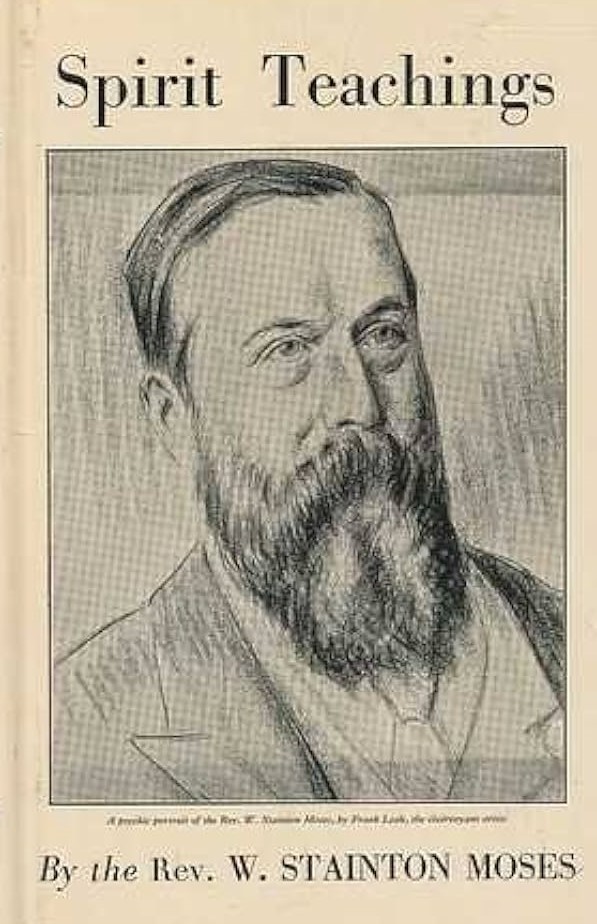
In his life of relationship, Stainton Moses was a sane, just man, who always exercised right judgments, modest, without vanity, who never spoke harsh words to his detractors, and who, in short, possessed a set of qualities rare among men.
 English (UK)
  Español
  Deutsch
  Português do Brasil
  Français
  Русский
  Türkçe
  Italiano