Plato
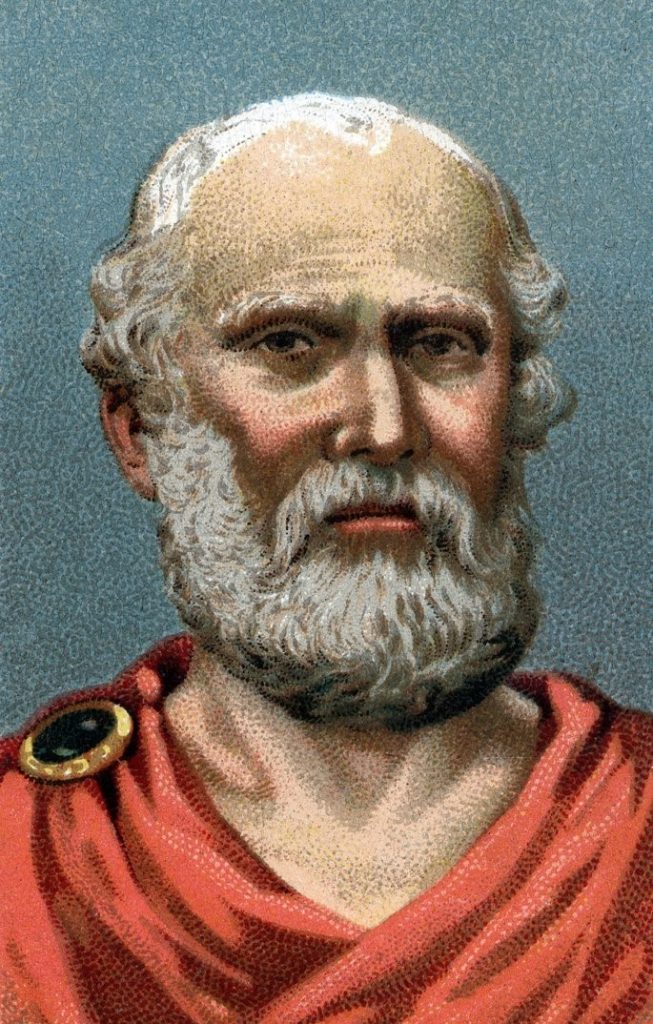
The tree is known by its fruits. All action should be characterized by what it produces: it must be called bad if it produces the wrong, and good when it produces the well. These words can sound like the words of the Lord Jesus to anyone who has read the Gospel.
However, they were written and given to the world centuries before Jesus by Plato, Greek philosopher, disciple of Socrates. He was born in the year 428 or 427.C., in the city of Athens, Greece. Belonging to the high aristocracy, to the 20 years he met and befriended the philosopher Socrates, who accompanied him to his last days, and of whom he wrote his teachings, which have reached our days.
He traveled to Egypt and to the south of Italy. In Sicily, he attended the court of a tyrant of Syracuse called Dionysius. Eager to influence on the policy of the city, ended up being incompatible with Dionysus, that caused him to sell as a slave on the island of Aegina, which was at war with Athens. Rescued, he returned to his hometown where, at the age of forty, he founded the Academy, where he taught until the end of his days on earth.
It is easy to understand why he and Socrates are considered to be precursors of the christian idea, and of Spiritualism, with only read some of his writings. The works of Kardec-The Gospel according to Spiritism presents short passages that relate to the design of the two Greek philosophers about the soul, its progress, the reincarnation, the spirit world and its inhabitants, as well as the virtues most exalted, drawing a parallel between those ideas, those of Christ and, as a result, the fundamental principles of Spiritism.
Considered one of the most influential philosophers of all time, as his thought dominated the christian philosophy ancient and medieval writings bequeathed to us the thinking socratic, as well as moving accounts of the last days of his teacher. He was also the personal creator of the philosophical dialogue, a kind of drama of ideas.
His work The Banquet is considered one of the greatest of the ancient literature. As a poet, his style is the highest point of the prose Greek and it shows in his prose poems about the myth of the cave, Atlantis, and Eros.
Wrote: love is everywhere in Nature, which invites us to exercise our intelligence; even the movement of the stars we found it. It is love that adorns nature with its rich carpets; it adorns itself and is installed where there is flowers and perfumes. It is also the love that gives peace to the men, the calm of the sea, the silence, the winds and the dream of the pain.
The works of Plato treated the lie, the nature of man, piety, duty, beauty, wisdom, justice, courage, friendship, and virtue. In the book VII of The Republic, presents the famous myth of the cave: chained in the interior of an underground prison and back to the entrance by penetrating the light, there they are trapped can only see the shadows cast by the men, the animals and everything that is outside of the cavern.
A man that gets released is dazzled by the light of the sun outside, and he discovers that everything I had seen up until then it was unreality. There was the real world. However, if you return to the interior and you want to transmit what he has seen to others, who are still prisoners, he feels that it runs the risk of being mistreated and even murdered. This is it exactly, according to Plato, the mission of the philosopher.
Disincarnate, full of clarity and creative force, at the age of 80, Spirituality, joining many other Spirits-caliber intellectual and moral, Plato continues his mission, revealing the nuances of the spiritual world, the world of the blinding sun, the real world, true.
His name is mentioned in the introductory sections of The Book of the Spirits; signing one of the passages of the answer to the question 1009 of the same work, where, speaking of the absence of penalties eternal, remember the exhortations of Socrates, when, in his time, he presented the soul migrating through multiple existences, followed by a longer or shorter period of erraticidad.
And he concludes: Humanity, not hundas your sad eyes in the depths of the earth, looking for there punishment. Crying, waiting, atones for and take refuge in the idea of a God is inherently good, absolutely powerful and essentially fair.
 English (UK)
  Español
  Deutsch
  Português do Brasil
  Français
  Русский
  Türkçe
  Italiano