Giovanna Ermelinda Gazzera
Giovanna Ermelinda Gazzera (Rome, Italy, 26 August 1890 - São Paulo, Brazil, 24 November 1942) was a renowned physical effects medium, especially known for phenomena involving the materialisation of Spirits. At the height of the manifestations produced through her mediumship, at the beginning of the 20th century, her mediumistic abilities were examined and confirmed by important researchers, such as Enrico Imoda, Cesare Lombroso and Charles Richet. Her name is remembered by Spiritist scholars and other spiritualists as one of the most important among the herald mediums of Modern Spiritualism.

Giovanna Ermelinda Gazzera was born in the Italian capital at the end of the 19th century, when discussions about spiritual phenomena were still at their height, giving rise to Table-Turning, modern Spiritualism and Spiritism. While still young, her remarkable mediumship emerged and attracted the attention of renowned psychical researchers; at the age of eighteen, Linda Gazzera was taken to Turin to be examined by Dr Enrico Imoda — an Italian physician and physicist who had been seriously dedicated to the investigation of such spiritual phenomena for many years. This particular investigation continued between 1908 and 1911, under the patronage of the Italian princess, the Marchioness of Ruspoli, who provided her own residence for a series of sittings — in which she also actively participated — with the aim of obtaining photographic records of the incredible ectoplasmic manifestations produced through the mediumship of that young medium. On other occasions, in the absence of the princess, the meetings were held at the home of the widow Coggiola (Mrs Marguerita Borghino), or at the home of Mr Raimondo Demaison, a dedicated French scholar of Spiritualism (and future husband of Linda Gazzera). Meanwhile, the young woman travelled to Paris so that her mediumship could also be personally examined by Charles Richet, the notable French physician and Nobel Prize winner, who tested her during a dozen sittings in 1909.

Upon returning to her homeland, Linda continued to be studied by Dr Imoda and his select circle of researchers. At the end of 1909, the physician withdrew from his activities in order to undergo treatment for a serious illness, entrusting the direction of the sittings to Mr Demaison. However, Dr Imoda eventually died in 1912; his material was then compiled by his fellow researchers and published in the book Fotografie di Fantasmi, in Italian by Fratelli Bocca Publishing House, with a preface by Charles Richet. As the title itself indicates, the aforementioned book was enriched with many photographs of the young Italian medium, during her activities, capturing the embodiment of fluid entities.
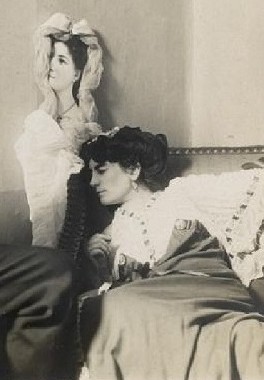
Dr Imoda described the following characteristics regarding Linda Gazzera during the mediumistic experiments:
“Her ‘trance’ (that is, her mediumistic sleep) presents two precious qualities: the medium falls asleep with extraordinary ease and rapidity; within a few minutes she reaches the state of lucid mediumistic somnambulism and, at the end of the sitting, with the same speed, upon a simple and gentle breath upon her eyes and the calling of her name in a low voice, she suddenly awakens, immediately regaining full awareness of herself. [...].”
“In her best conditions, the ‘trance’ is calm: the medium remains content, cheerful without excess, very courteous and kind; her voice is clear and calm, she warns the participants about how they should behave in order to encourage the phenomena, the precautions they should take, etc.”
“However, if in the hours preceding the sitting she had argued or felt anger or fear, or if there were someone present at the meeting whom she disliked; or, in short, if during sleep her subconscious was disturbed by some passion; or if her stomach was still engaged in digestion, then the behaviour of the medium and the character of the sittings changed completely. In this case, the mediumistic force was even more physically energetic. Tremendous knocks that shook the furniture were produced as if struck with a hammer. The medium sweated, panted, trembled, became agitated and contorted herself: the mediumistic personality changed its character and assumed a violent, brutal behaviour.”
For his part, Richet summarised his investigations with Linda Gazzera and recorded her extraordinary abilities in the work Thirty Years of Psychical Research, published in 1923.
The medium continued to be the subject of investigation by other scientists interested in Spiritualist studies, among them the criminal anthropologist Cesare Lombroso, who likewise recognised the reality of those phenomena; during the sittings directed by Mr Demaison, the fluid creations originating from Linda began to display a fantastic luminosity, eliminating any speculation of fraud. Throughout her career, her best-known materialisations were those of a cavalry officer who identified himself as “Vincenzo” and a four-year-old girl identified as “Carlotta”. In his column for the Diário de São Paulo, José Herculano Pires — who signed his articles under the pseudonym Brother Saulo — highlighted the abilities of the young Italian medium in the article ‘Materialisation Phenomenon’:
“Miss Linda Gazzera presented a curious mediumship, capable of producing physical phenomena with extreme rapidity, as soon as the light was extinguished. Guillaume de Fontenay, a French experimenter who participated in the sittings, observed that in less than a minute the phenomena began to occur, in an intense and varied manner. However, the medium could not tolerate light and her spiritual guide, Vincenzo, always required complete darkness in the work room. Fontenay believed that this photophobia of the medium could gradually be overcome. In any case, the phenomena obtained by Imoda, and later also by Richet, with Linda Gazzera, prove the excellence of her mediumistic gifts.”
Linda Gazzera’s mediumistic phenomena were also highlighted by another great Brazilian Spiritist scholar: Cornélio Pires:
“Controlled by Dr Imoda, in Italy, the medium Mrs Gazzera produced the most remarkable materialisations of Spirits, having deeply contributed to affirm the convictions of Professor Richet, a hardened and scrupulous scientist, defeated by Spiritist Facts, as were the great Crookes and all sceptical researchers who, wisely, investigate without preconceived ideas.”

After dedicating years to psychical research, Linda married Raymond Victor Demaison, one of the Spiritualist scholars to whom she lent her mediumship for scientific studies. After their marriage, the couple moved to Winnipeg, Canada, where she had her only child. Finally, she moved her residence to São Paulo, Brazil, where she passed away; her body was buried in São Paulo Cemetery, in the Pinheiros district of the capital of São Paulo.
Linda Gazzera lived during a generation of renowned physical effects mediums, including her compatriot Eusapia Palladino. She experienced table-turning sittings, typical of the fashion of the Table-Turning era, but soon moved on to a phase of more sophisticated productions — due to her exceptional abilities. It was a time of intense debate between sceptics, materialists and those who felt touched by spirituality; phenomena such as the materialisation of Spirits, produced by mediums like Linda Gazzera, were fundamental in supporting Spiritualist belief. It was necessary for the Spirits themselves to manifest — to some extent in a striking manner — in order to affect the senses and the pride of materialists, thus demonstrating the existence of the spiritual plane and the immortality of the soul. It is with the support of this “material testimony” that the philosophical ideas of the Spirits can carry out the plans for the moral transformation of humanity — whose greatest synthesis is found in the fundamental concepts of Spiritist Doctrine, codified by Allan Kardec.
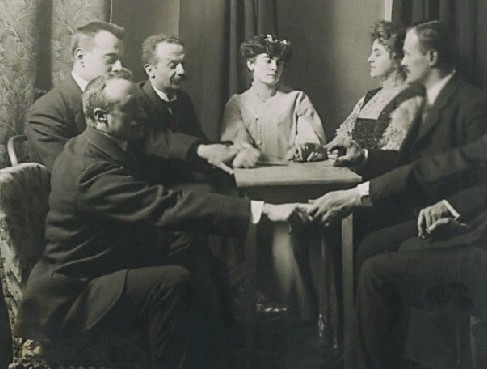
For this reason, the name of Linda Gazzera has its place in the gallery of the great mediums who offered their service for the common good and who will forever be remembered as contributors to Spiritism.
 English (UK)
  Español
  Deutsch
  Português do Brasil
  Français
  Русский
  Türkçe
  Italiano