Frederica Hauffe
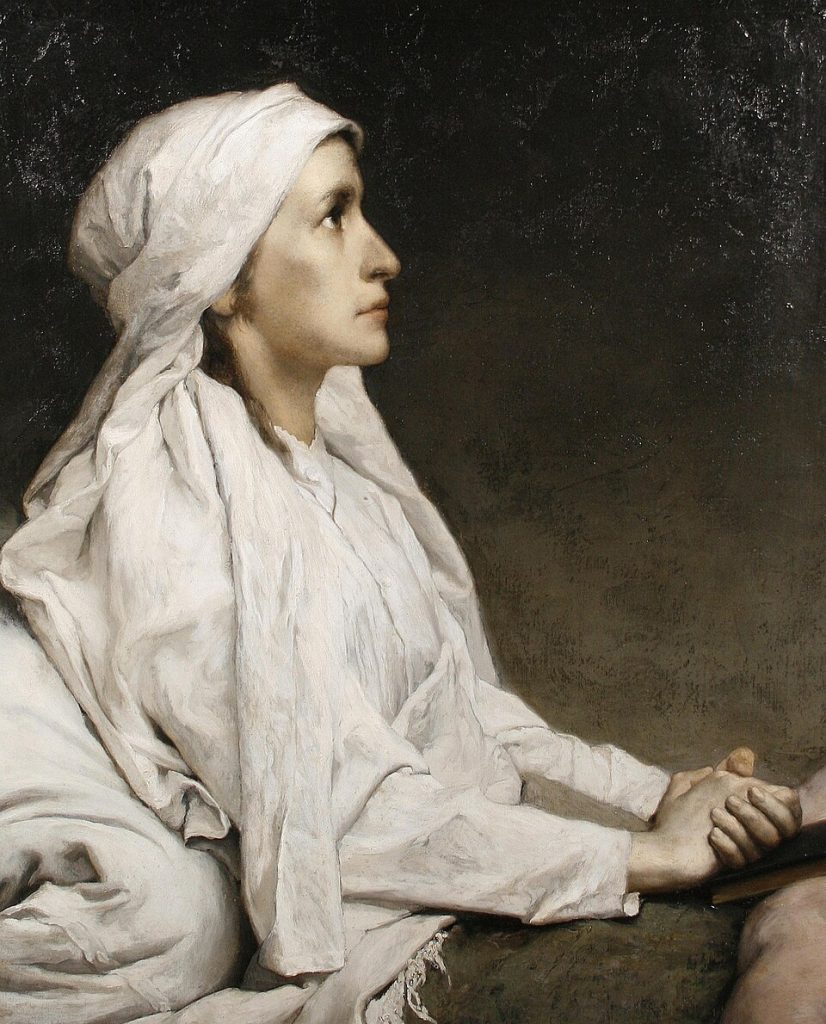
Near the town of Löwenstein in Baden-Württemberg, nestled among the mountains whose highest point reaches 1,879 feet above sea level, surrounded by hills and valleys, in a picturesque hollow, lies the small village of Prevorst. It has just over 400 inhabitants, most of whom live from forestry for coal production and the harvesting of local produce. In the year 1801, in these high mountains of Prevorst, a girl was born who displayed extraordinary inner abilities from an early age.
Frederica Hauffe, commonly known as the Seeress of Prevorst, whose father worked as a forest warden, was brought up in the greatest simplicity and innocence due to the isolation of the village. Mrs Hauffe received no formal schooling or certificates; she knew no languages, history, geography, or natural science, and possessed none of the usual accomplishments of her sex. For many years, the Bible and the Book of Psalms were her only studies. Her morals were indisputable; devout without hypocrisy, she regarded her long suffering and unusual circumstances as God’s providence and expressed her feelings through poetry.
As a counterpart to this insensibility, an undeniable, supernatural or clairvoyant ability manifested in her already as a child, appearing especially in prophetic dreams. When she was scolded, angered, or hurt for any reason, or when her feelings were wounded, she was guided at night to these deep recesses, where instructive, foresightful, or prophetic visions would visit her.
It once happened that her father lost a valuable item and blamed her for it, although she was innocent. She was so distressed that in a dream she saw the place where the object was located. Even as a small child, she indicated with a hazel wand where water and metals could be found. Later, when the town had few cultural opportunities, her parents entrusted her to her grandfather, Johann Schmidgall, who lived in Löwenstein, only a few kilometres away. To the great regret of the family, this receptivity to spiritual influences, which others could not perceive, soon became evident. In her grandfather’s house, a spirit appeared to the poor girl for the first time. At midnight, she saw in the corridor a large, dark figure that sighed as it passed by; it stopped at the end of the hallway and showed her a face she would never forget. This first apparition caused her no greater disturbance than later appearances in her life. Calmly, she went to her grandfather and said, “There is a stranger in the corridor; go and look at him.”
Such important, yet regrettable, abilities brought no change in the girl. She was the happiest among her playmates, although due to her sensitivity she had to stay in her room for long periods; it was a preparation so that she could see with ordinary eyes what was invisible to others—the unfolding of spiritual sight through the bodily senses.
Later, she lived with her parents in Oberstenfeld, which was at times the family home. From the ages of seventeen to nineteen, in a period of pleasant and lively influences, she seemed to have lost this inner perceptive ability to some extent; only her particularly intellectual character shone through in her gaze, as well as a greater joy, without departing from her usual manners or those of the young women in her society. Despite false rumours, it is certain that she formed no attachments at this age and experienced no disappointments of the heart. She was extremely receptive to spiritual apparitions of all kinds: prophetic dreams, predictions, prophetic visions in glasses and mirrors. She once saw in a glass a person who would enter her room half an hour later, as well as a carriage which she could not identify from her position; she described the coach, the people travelling within it, and the horses—and half an hour later they indeed arrived at her house.
During this time, she seemed to enjoy the “second sight.” One morning, as she left her room during a doctor’s visit, she saw in the corridor a coffin blocking her way, and within it the body of her grandfather. She returned to her room and asked the doctor and her parents to see it. Yet at first, none of them—and not even she herself—perceived anything further. The following day, however, the coffin and the body were beside her bed. Six weeks later, her grandfather died, having been in excellent health until the very last days.
The ability to see spirits, which Mrs Hauffe had possessed since childhood, developed continuously. Between 25 November 1826 and 2 May 1829, Dr Justinus Kerner was able to examine her thoroughly and compile the basis for a book that attracted great attention in Germany, as five editions were sold out within a few years. The work was translated into English by Mrs Crowe and into French by Dr Dusart.
Eschenmayer writes of her in Die Geheimnisse: “Her natural dispositions were sweet, amiable, serious. She was always drawn to contemplation and prayer. There was something intellectual in the expression of her eyes, always clear and luminous despite suffering; they were very lively in conversation, then suddenly fixed—and one could see by this sign that she was confronted with one of her strange apparitions. Under such conditions she spoke rapidly.”
On 5 August 1829, at ten o’clock, the seeress observed a white figure entering her room; at that moment, the dying woman uttered a cry of joy, and her spirit seemed to depart at that instant. Shortly afterwards, her soul left the body, which remained entirely recognisable, as none of her features preserved its previous form. The remains of one who had suffered so much were interred in the picturesque cemetery of Löwenstein, where already lay the bodies of her grandfather, the esteemed Schmidgall, and his wife, whom she had recognised as her spiritual guardians.
 English (UK)
  Español
  Deutsch
  Português do Brasil
  Français
  Русский
  Türkçe
  Italiano