Félicité Robert de Lamennais
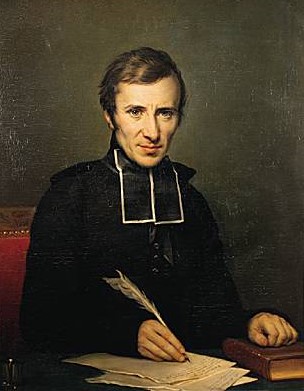
Born into a bourgeois family on 19 June 1782 in Saint-Malo (France), he was a brilliant writer who became an influential and controversial figure in the history of the French Church.
Together with his brother Jean, he conceived the idea of revitalising Roman Catholicism as the key to social regeneration. They even outlined a reform programme in their work Reflections on the State of the Church..., in 1808.
Five years later, in the midst of the conflict between Napoleon and the Papacy, the brothers produced a defence of Ultramontanism (the doctrine and policy of French Catholics who were inspired by the Roman Curia, defending the absolute authority of the Pope in matters of faith and discipline). This book brought Lamennais into conflict with the Emperor, causing him to flee quickly to England in 1815.
A year later, at the age of 34, Lamennais returned to Paris and was ordained a priest. A fluent writer, politician and philosopher, he strove to combine liberal politics with Roman Catholicism after the French Revolution. Thus, as early as 1817, he published Essays on Indifference in Matters of Religion Considered in Relation to Political and Civil Order, as well as a translation of The Imitation of Jesus Christ. The Essays brought him immediate fame.
In it, Lamennais defended the necessity of religion, basing his appeals on the authority of tradition and the general reason of mankind, rather than on the individualism of private judgement. Although he defended ultramontanism in the religious sphere, in his political convictions he was a liberal who advocated the separation of state and church, freedom of conscience, education and the press.
After the July Revolution of 1830, Lamennais, together with Henri Lacordaire (another exponent of the Codification) and Charles de Montalembert, as well as an enthusiastic group of liberal Roman Catholic writers, founded the newspaper L'Avenir. In this journal, Lamennais defended democratic principles and the separation of church and state, creating problems with both the French ecclesiastical hierarchy and the government of King Louis-Philippe.
Pope Gregory XVI disavowed Lamennais' views in the encyclical Mirari Vos of August 1831. Thereafter, Lamennais turned to attacking the papacy and the European monarchies, writing the famous poem Words of a Believer, which was condemned in the papal encyclical Singulari Vos in July 1834. The result was Lamennais' exclusion from the Church.
Tireless, he devoted himself to the cause of the people, putting his pen to the service of republicanism and socialism. He wrote works such as The Book of the People (1838), The Affairs of Rome and Outline of a Philosophy. He was sentenced to prison, but in 1848 he was elected to the National Assembly and retired in 1851.
When he died in Paris on 27 February 1854, unwilling to reconcile with the Church, he was buried in a pauper's grave.
In the Spiritual World, he did not remain idle, and in The Spirits' Book, in question number 1009, we find a message from him, which illustrates the answer. In it, he reveals the traits of his faith, urging people to draw near to the Good Shepherd and the Father Creator, vigorously combating the belief in eternal punishment.
In his signature message in The Gospel According to Spiritism, chapter XI, point 15, he reveals himself as a compassionate being, calling creatures to obey the voice of the heart, offering, if necessary, his life for the life of an evildoer.
 English (UK)
  Español
  Deutsch
  Português do Brasil
  Français
  Русский
  Türkçe
  Italiano