Deolindo Amorim
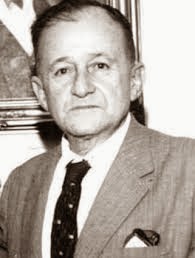
Deolindo Amorim was born on 23 January 1908, although his documents state 1906, in the city of Baixa Grande, State of Bahia, and passed away in Rio de Janeiro on 24 April 1989. Son of Deolindo Antonio de Amorim and Maria Flora de Amorim, he married Delta dos Santos Amorim, with whom he had two children: Paulo Henrique Amorim (journalist and foreign correspondent) and Marília dos Santos Amorim.
Born into a Catholic family, he converted to Protestantism through the Presbyterian Church of Bahia in 1925/1926, having participated in the great campaign that Evangelical Believers carried out in southern Bahia in defence of religious freedom, against the amendments that were being discussed in the National Congress at the time. He was selected to study at an evangelical seminary to become a pastor, but he never made his profession of faith. He left Protestantism after being admonished by a pastor while reading a non-evangelical book with the following words: ‘Look, my brother, those who dedicate themselves to the Lord's ministry must despise all these things.’
Self-taught, his vocation for literature manifested itself early on. His first works on evangelical themes were published when he was 17 years old, in a Protestant publication in Canavieiros, Bahia, called Noroeste Evangélico. However, these were years of searching; he became agnostic, but doubts and depression were always present. Until, in 1935, he was invited by a friend to attend a meeting at the Jorge Niemeyer Spiritist Centre in Rio de Janeiro, the city where he had lived since serving in the Army. Deolindo not only enjoyed the lecture and the concepts he heard there, but also became a regular visitor to the Centre, where he began to study the basic works. In the first election held after his conversion, he was elected 1st Secretary of the Entity.
At the age of 23, he was already working as a journalist. In Rio, he collaborated with the Jornal do Comércio newspaper, later moving on to A Vanguarda. And, already a professional unionised journalist, he moved on to O Radical. He remained faithful to journalism until the end of his physical life.
With his vast culture and talent, coupled with his characteristic humility, he was editor of Mundo Espírita, a newspaper launched in Rio de Janeiro, later transferred to Curitiba, Paraná, and was its correspondent in Rio until the last days of his physical life. He collaborated with most of the Spiritist newspapers and magazines in Brazil and abroad.
In 1939, together with Lins de Vasconcelos, he participated in the Pro-Secular State Coalition. It was also in 1939, on 15 November, when Brazil celebrated the 50th anniversary of the Proclamation of the Republic, that he established and presided over the First Brazilian Congress of Spiritist Journalists and Writers.
In 1948, together with Leopoldo Machado and other colleagues, he organised the First Congress of Spiritist Youth of Brazil. He was secretary of the Second Pan-American Spiritist Congress, held in Rio de Janeiro in 1949, and was later elected secretary of the Pan-American Spiritist Confederation (CEPA) during the three years that this international organisation operated in Brazil. Deolindo Amorim launched teaching methods in Brazil for the dissemination of Spiritism and, with this objective in mind, founded the Faculty of Psychic Studies, which in turn would be succeeded by the Brazilian Spiritist Culture Institute (ICEB). He was its president during his lifetime. He dedicated the best years of his life to ICEB, implementing the Regular Spirit Courses there, as recommended by Allan Kardec.
He wrote, among others, the books: Spiritism and Spiritualist Doctrines; Spiritism and Criminology; Africanism and Spiritism; Spiritist Ideas and Reminiscences; Spiritism and Human Problems; Spiritism in the Light of Criticism; and the pamphlets The Immortalist Meaning of Leôncio Correia's Thought; 18 April - Great Spiritist Date; Allan Kardec - the Man, the Era, the Environment, the Influences, the Mission; and The Philosophical Thought of Léon Denis.
Many of his works have been translated into several languages. He also wrote some books in partnership with other colleagues, and after his passing, several more were published on the initiative of journalist and Spiritist writer Celso Martins, who has conducted meticulous research in the national press, gathering Deolindo's works and compiling them into books.
With a degree in Sociology from the National Faculty of Philosophy at the University of Brazil, Deolindo Amorim also held diplomas in advertising and social services, in addition to having been an employee of the Ministry of Finance, where he held high positions. He was also a member of the Academy of Letters of the State of Rio de Janeiro, the Brazilian Society of Philosophy, the Historical and Geographical Institute of Bahia, and the Brazilian Press Association.
Furthermore, at the VI Brazilian Congress of Spiritist Journalists and Writers, held in July 1976 in Brasilia, the Brazilian Association of Spiritist Journalists and Writers (ABRAJEE) was founded, an ideal that he and other colleagues had cherished for years. Deolindo was the first president of this entity.
It is not without reason that Deolindo Amorim is the most widely known Brazilian Spiritist writer and journalist abroad. His culture and dynamism, his clear way of presenting the concepts of the Doctrine to the public, combined with his humility, account for his success in the four corners of the world and, certainly, also in the Spiritual Plane.
 English (UK)
  Español
  Deutsch
  Português do Brasil
  Français
  Русский
  Türkçe
  Italiano