Maria da Conceição Rocha e Silva
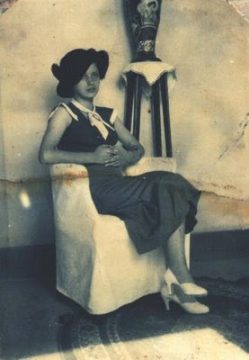
The new generations need to get to know Maria da Conceição Rocha e Silva, affectionately called “Nina”. She adopted the pseudonym Nina Arueira, the latter being her father’s surname. She was born in Campos dos Goytacazes on 7 January 1916 and passed away on 18 March 1935. A journalist, writer, trade union leader, and poet, her death at the age of 19 changed the life of her fiancé Clóvis Tavares forever.
By the age of five, she is said to have already read a book by Victor Hugo. Nina would dictate small poems which her father recorded. Later, they were published in the newspaper Rindo under the pseudonym “Princess of Vera Cruz”, daughter of Lino Arueira and his wife Maria Magdalena Rocha e Silva. From childhood, she showed herself to be precocious and gifted. Her grandmother called her “Pequenina”, and her family simply “Nina”, a pseudonym she would adopt in adolescence. On 15 July 1924, at the age of eight, she was chosen to receive, at a major municipal civic celebration, the first bishop of the city of Campos dos Goytacazes, D. Henrique César Fernandes Mourão. In 1928, when she was twelve, her father passed away, and Nina began helping her mother in the small family business. It was a very difficult period, a time of great maturation for the young girl, and the observations she made about society, labour relations, and prevailing hypocrisy would later be reflected in her texts and poems.
Nina as a young woman
At the age of fifteen, Nina entered the Liceu de Humanidades in Campos. She gave lectures at the city theatre, where her reputation as a columnist and critic spread. She wrote the manifesto To the Youth of My Land. Because of her ideas, she faced criticism and persecution from other journalists and residents of the city. At the Liceu, she met Clóvis Tavares and Adão Pereira. They founded a student newspaper. By the age of sixteen, she was already publishing articles defending the working class and prostitutes. At eighteen, she joined the Communist Party and founded the National Liberation Alliance in Campos, a leftist front composed of sectors from various anti-fascist and anti-integralist organisations. She left the Liceu due to dissatisfaction with the educational methodology.
In the difficult years at the beginning of the 1930s in Brazil, and amidst family concerns, she joined the Communist Youth Union along with her two friends from the student newspaper. For the young woman, a period of struggle began: weary of written debates, she went to the gates of factories, where she organised rallies and founded unions. During this period, she also began attending the Theosophical Society, seeking the spirituality she found lacking in the labour movement, and she fell in love with Clóvis Tavares, her constant companion.
By 1931, she was already publishing poems that demonstrated her intelligence and moral maturity. She wrote the following concept of God: “God is an endless ocean and we are each a Mediterranean in the inlets of the earth.” Deeply spiritual, Nina was ahead of her time. She dreamed of a fraternal society and defended more liberal ideas for women, advocating equality of rights between men and women. On 1 May 1934, during a major rally at Praça do Santíssimo Salvador in Campos, the couple was invited to speak to the workers. During Clóvis’ speech, someone in the crowd set the national flag on fire, which the police present interpreted as an affront to the government. In the subsequent crackdown, Clóvis was arrested, and Nina managed to escape. The history of Campos is full of remarkable women who left their mark on their time.
Her friendship with Virgílio de Paula was fundamental, for when she contracted typhus, it was the beloved “Grandpa Virgílio”, as she called him, who cared for her until her death, which occurred before she could marry Clóvis Tavares and before her twentieth birthday.
Deeply affected by the death of his fiancée, Clóvis Tavares received news that Nina’s spirit had communicated in a spiritist society. This event gave a new meaning to his life, and from then on he became an adherent of Spiritism. Shortly afterwards, in October 1935, he founded the Jesus Christ School for children, inspired by a school on the spiritual plane founded by the spirit of Nina Arueira. Nina was the great inspiration of his life and, in the spiritual homeland, continues her educational work supporting children and young people.
Spiritist houses, charitable groups, spiritist youth organisations, and schools were created in the name of Nina Arueira, such as the CIEP Nina Arueira located in the Penha neighbourhood of Campos dos Goytacazes. Let us give thanks to God, for through the teachings of Spiritism and life examples such as Nina and Clóvis, we prepare ourselves day by day for the experience of immortality and divine justice.
What did Nina do to become immortalised? After her death on 18 March 1935, a historical process began in which two currents—the Spiritists and the Communists—contested her memory and attributed to her mystical characteristics of heroine and martyr. According to Juliana Carneiro, author of the book The Awakening of Nina Arueira: From the Struggle over Memory to the Construction of a Myth, for the Communists, she died as a combative activist, a reference for mobilising new activists. For the Spiritists, however, Nina did not die: she merely disincarnated. She ceased to struggle on the earthly plane and evolved to contribute to humanity from the spiritual realm. The following year, Clóvis met Chico Xavier, and this friendship was very important for his life as a teacher and writer. Among the mediums who psychographed messages from Nina’s spirit, Francisco Cândido Xavier stands out.
“The woman who recognises her quality as a human being; rational, sensitive, vibrant, with equal rights to life and liberty. She is the woman who considers herself capable of facing all struggles…” (psychographed message, Nina Arueira, 29/04/1942)
Below is an excerpt from one of the most beautiful poems by the young Nina Arueira:
“My spirit vibrated in the silence of matter…
My soul exalted in the vibration of light…
I lived upon the earth in the sidereal aspiration
to touch with my soul the lyre of Jesus…
Of life, I saw nothing but deceptive appearances,
fictitious riches that did not tempt me,
for my heart was made of the essence
that rises from heaven and ascended back to heaven.
The world came to me full of flatteries…
And I rejected the world and its proud court…
I knew not the sad ambitions of life,
but the happy ambition from up above…”
 English (UK)
  Español
  Deutsch
  Português do Brasil
  Français
  Русский
  Türkçe
  Italiano