Johannes Brahms
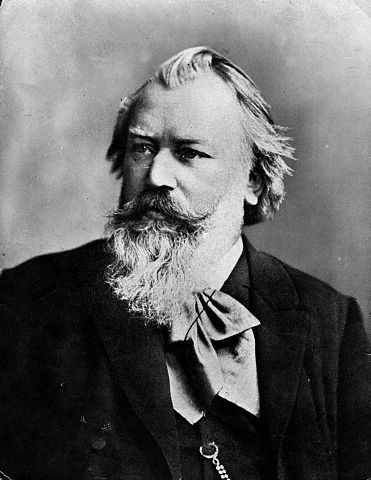
Johannes Brahms was born in Hamburg on 7 May 1833, a lover of study who was always open to all that was noble and beautiful and who shared both the sorrows and the joys of others. The main characteristic of his music is elegiac resignation.
It should be emphasised that Brahms understood that music, despite its outer shell, is a matter of the spirit in its highest expression!
We fully agree with this, because the physical body is only a means of carrying out the commands and vibrations of the spirit, and especially when it comes to music, because music is a language par excellence.
Brahms was a sentimental man, deeply sensitive to sweet harmonies, although his physicality did not match the delicacy of his spirit.
Music and temperament, according to one of his biographers, conceal a tender soul in a body of granite. It is even said that he jumped up from his chair in the middle of a rehearsal of one of his works, crossed the hall with clenched hands and shouted: ‘Stop this terrible music’. He turned his back on the musicians and tears streamed down his face. The emotions had overwhelmed him and this was the means he used to hide them.
In Schumann's opinion, the young Brahms had all the signs of being predestined at the time, and he went so far as to say: ‘If this young man decides to deal with the choir and the orchestra, if these mighty masses lend him their strength, then he will give us even more dazzling insights into the secrets of the spiritual world’.
Brahms' mediumship enabled him to offer us music of such sentimentality that our spirit seems to detach itself from the somatic body as we listen, in its irrepressible desire to reach ethereal regions of light, wisdom and love!
When he was about 64 years old, his ailing body, afflicted with liver cancer, slowly began to decline. On 2 April 1897, he lost consciousness and the next morning, at half past eight, his blue eyes closed.
His last word as the doctor administered a sedative was: ‘Thank you’.
 English (UK)
  Español
  Deutsch
  Português do Brasil
  Français
  Русский
  Türkçe
  Italiano