Ivan Dutra
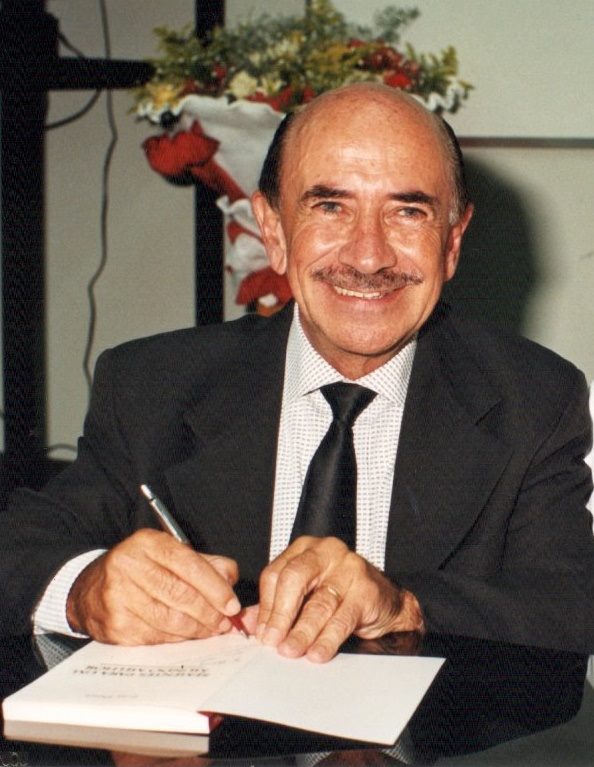
In the small town of Ubá (MG), Ivan Dutra was born on 10 November 1934 into a humble family, as one of the eight children of Lindolfo and Odete Dutra. The family was devoted to Spiritism, so Ivan received the necessary spiritual guidance from an early age, as his parents placed great importance on the spiritual education of their children. From his earliest days at primary school, the boy demonstrated a remarkable ability to learn and retain knowledge, dates and numbers, standing out among the most diligent pupils. He memorised facts and dates with precision.
Even at the age of 12, he was giving mathematics lessons to his classmates, and with the money he earned he could buy some of the things he needed. A studious boy already known to his teachers, he realised that he would not be able to continue his studies, and so, on the advice of friends of his parents, he applied to the best school in Juiz de Fora – Granbery, a private school, to take an entrance test and gain a scholarship. Ivan Dutra passed the test and began his studies at that institution, always needing to maintain top academic performance. At eighteen, he was transferred for work from São Paulo to Bauru, where he began to participate actively in the youth Spiritist movement in that state. He attended the Spiritist youth group, collaborating in campaigns, children’s evangelisation work, and volunteering at the Night Shelter.
In the 1960s, his work within Spiritist Doctrine involved the youth department of the USE in São Paulo. According to his friend Milton Felipele, he acted as a moderating influence in meetings, contributing with a sense of reconciliation, without irritation or self-interest, always speaking kindly, with gentle gestures, a contagious smile, and, above all, with great calm. As Felipele said: “He had the qualities of a leader, possessed vast knowledge, and demonstrated this ability as a teacher; it was natural to him. He reincarnated to teach, or rather, to help those who wished to learn, and he knew how to pass on knowledge.” He graduated in Law in 1960 and, to practise his profession, moved to Santo Anastácio in the State of São Paulo. Already married, he began his legal work without abandoning participation in the Spiritist movement, working in the town’s two Spiritist centres and making many friends. In one centre, he devoted himself to the evangelisation of 12- and 13-year-olds, while in the other, he worked with young people, founding with colleagues a nursery that catered for 70 children, thereby helping needy mothers.
He worked diligently in a Boys’ Home, which was not a Spiritist institution but a charitable enterprise, and the young lawyer devoted himself wholeheartedly to the work of helping others. He lived ten years in Santo Anastácio, earning him the title of Cidadão Anastaciano in recognition of his community service. For professional reasons, he moved to Tupã, where he continued his work as a lawyer and also began teaching at the Faculty of Law, Economics and Administration. The town, which already had an established Spiritist presence thanks to the dedication of many Spiritist colleagues, welcomed him, and once again Ivan joined Spiritist workers in study, social assistance, and youth evangelisation activities.
At that time, he taught at the Faculty of Law in Presidente Prudente, with classes now also taking place in Tupã, Marília and Lucélia. Extremely dedicated and efficient, he also graduated in Economics, Pedagogy and Administration, completing a master’s and doctorate in the latter at the University of São Paulo, thereby fulfilling the trust placed in him, which was returned through the recognition, thanks, and honours he received over the years for his expertise and dedication. From Tupã, he moved to Rolândia, where he worked in the Spiritist movement as a collaborator of the Emmanuel Spiritist Centre and the André Luiz Spiritist Home, helping the boys there and establishing the habit of conducting the Gospel Service in Spiritist households.
Shortly thereafter, due to work commitments, he moved to Apucarana, where he resumed his role as youth Spiritist guide, collaborated in study sessions and meetings at the Spiritist house, and participated in care for disadvantaged minors assisted by the institution known as Recanto da Criança Allan Kardec. There, young shoeshiners, paper collectors, and others received meals, health guidance, and moral instruction. Still in Rolândia, he was one of the founders of AREC – Associação Rolandense de Ensino e Cultura, established in 1974, which later became the governing body of the Faculty of Accounting and Administrative Sciences of Rolândia, FACCAR, with Ivan serving as president that year.
For health reasons, he moved to Londrina seeking better medical resources and continued his work as a lecturer at UEL while serving as a “worker” at the Spiritist house, also becoming a volunteer at the Irmã Scheilla Dispensary, part of SEPS, which he eventually presided over. In Londrina, together with other partners, he founded INBRAPE – the Brazilian Institute for Socioeconomic Studies and Research – in 1986, an institution dedicated to the generation and dissemination of knowledge, and he always remained active in the local Spiritist movement as a speaker, participant in mediumship groups, and in study circles. He was a council member and vice-president of the Nosso Lar Spiritist Centre, among many other roles.
With other colleagues, he separated the Irmã Scheilla Dispensary from SEPS, establishing it as an independent entity called Núcleo Espírita Irmã Scheilla. For nearly three decades, this organisation has undertaken significant social work, running programmes for youth from marginalised communities, vocational training, and family support. He charmed everyone with his smile and calm demeanour, always ready to listen and make the most of ideas that were not always perfect but could be subtly improved. Humble and kind, he became a friend and companion to all, treating everyone—from the needy to prominent businesspeople—with serenity, patience, and friendly words.
Ivan was, above all, a teacher, a title he accepted with joy and humility; yet his teaching was not confined to the classroom, as he also taught through daily interactions with family, friends, and fellow Spiritist practitioners. Within his family, he showed deep love for his wife, his three sons, and his daughter, doing everything to make them happy and an integral part of his life, work, and studies. His family grew, and he also met his 13 grandchildren and two great-granddaughters. His dedication as a teacher was total, making his projects the reason for work done with love and selflessness. He never lacked friendly advice or a sincere smile, opening doors to trust and better relations with the young pupils of the Núcleo. In this way, many young people were integrated into society through the dignified work promoted by the Núcleo.
Throughout his productive life, he wrote professional books such as Contemporary Economics and Elements of Economics, adopted in universities. He wrote three books aimed at youth education: in February 2000, Seeds for a Better World, real accounts of work with families in marginalised communities and the results achieved, demonstrating the value of sowing Christian principles; in 2002, Tales of Youth, a book addressing young people, their concerns and problems; and finally, in 2003, New Tales of Youth, stories created by volunteers of the Núcleo Espírita Irmã Scheilla in Londrina, highly useful for both young people and parents wishing to give their children secure guidance grounded in the teachings of Jesus.
His books, lectures, and, above all, his actions were aimed at teaching and encouraging the practice of good. As an educator in the broadest sense, he always devoted himself to young people, particularly those in the outskirts of Londrina. His influence left a mark on the city’s social welfare history, combining his benevolent presence with competence, felt across all corners of the city, in volunteer groups working in the São Jorge, João Turquino, Maracanã, Pacaembu, Campos and Leonor districts. He passed away on 4 January 2004, moving to another dimension, that is, to spiritual life, leaving us great examples, wonderful life lessons, and profound nostalgia.
 English (UK)
  Español
  Deutsch
  Português do Brasil
  Français
  Русский
  Türkçe
  Italiano