Ernestina Ferreira dos Santos
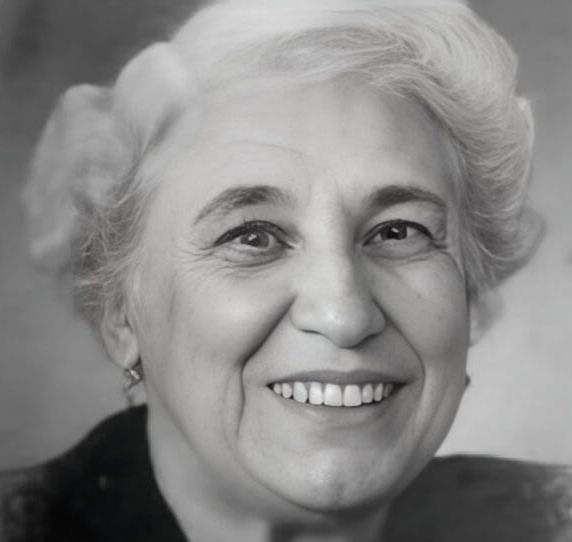
She was born on 1 January 1879 in Rio de Janeiro and died on 16 November 1953 in the same city. She was the daughter of Aristides Gonçalves Ferreira and D. Augusta Dias Ferreira. She lost her father at an early age and was raised by her kind and devoted mother, who gave her a careful education. Very thin and in delicate health, at the age of five she suffered severe pain in her left leg; it was the beginning of bone porosis, which dislocated her hip. After a series of very painful operations, the head of her femur had to be amputated, leaving her with one leg shorter than the other, which caused her years of intense suffering; her pain was so severe that people could only enter her room on tiptoe so as not to disturb her.
Thus, she reached adolescence in constant torment. She rebelled against her parents' religion, Catholicism, which was professed by the whole family. She argued, ‘I feel that God exists, but not as they present him. Why do I, who have never hurt anyone, suffer so much, while so many wicked people are healthy and live happily?’ Her grandfather, who loved her dearly, was horrified by this thought and said: ‘Let us pray, people, that our Nenê is being tempted by the devil.’ Her mother, a teacher, widow, poor and with many children, was transferred to Jacarepaguá. There she met a couple of farmers, parents of nine children, and one of them married her eldest daughter, whereupon a romance blossomed between another of the couple's sons and Ernestina, with no hope of the marriage taking place due to the precariousness of her health.
Ignácio Barbosa dos Santos, two years older than Ernestina, fell in love with her innocence. He was good-natured and loving and became her constant companion, accompanying her without discouragement, despite her illness and weakness. At the age of 17, after undergoing seven operations on her leg, she walked with difficulty and in excruciating pain. Even so, the two felt themselves growing more and more in love. They were undoubtedly soul mates who had found each other again.
Due to her illness, she was forced to seek out a healer named Eduardo Silva in São Paulo, who, although not a Spiritist, was gifted with mediumistic abilities. At that time, a cousin of hers gave her a copy of The Gospel According to Spiritism. During the trip, she read the book and felt that a new horizon was opening up before her eyes. At that time, when Eduardo Silva laid his hands on her, she felt a great improvement in her physical condition; at the hotel, she noticed that her clothes were wet with a secretion. With further applications of passes, her pains disappeared completely.
Feeling cured, two years later she agreed to marry, becoming a wife and mother. Her husband became a devoted carer, with a deep sense of protection towards her physical defect. Years after they were married, the illness returned. The doctor advised her to have surgery, but she met a citizen who practised spiritualism, who suggested the application of passes, a recommendation she received with great joy. At that time, she had the opportunity to develop her mediumship, giving passivity to a spirit named Ester who, going back to past lives, revealed the causes of her suffering. Shortly afterwards, the doctor confirmed that she was completely cured.
Upon becoming involved in Spiritism, she and her husband founded the Cultivadores da Verdade Spiritist Group in their own home, which operated for some time under the direction of Mr. Serrão, a friend of the family, and was later taken over by the famous medium Inácio Bittencourt. Then the ‘Pão dos Pobres’ (Bread of the Poor) was created, a way to help the needy, and Ernestina often climbed the hills, with the help of a child, to carry out her charitable work. At that time, her husband suffered a financial setback and had to liquidate his business. Ernestina entered a competition at the Normal School, graduated as a teacher and began to help her husband until the couple's life returned to normal. Her main aspiration was to found a home for homeless children, but she saw no possibility of doing so, as resources were scarce; the people who frequented the Group were quite modest and poor. Teresa of Jesus, who communicated through her, announced that, from that small association of Bread for the Needy, a great House of Charity would develop in the very near future.
On 31 December 1918, everything was ready for distribution the following day: food parcels, fabrics, clothing, toys and even money in envelopes, when someone knocked on the door and handed over a list with the sum of 930.000 réis, a fortune at that time. What to do with all that money? Ernestina thought about it and put it aside to deliberate later. The next day, 1 January 1919, the usual distribution took place. It was Wednesday, and that night the meeting was held. At the end, as usual, a message arrived from Teresa of Jesus, saying: ‘The money that has arrived at the last minute is the seed for the House of Charity that I have been announcing to you. It will be for the poorest children you can find. Work, and I will help you.’
There was widespread joy. At that very moment, the founding charter was drafted and those present registered as founding members. The first board of directors of the Teresa de Jesus Shelter was constituted as follows: President, Ignácio Bittencourt; Vice-President, Raul Salgado Zenha; Director, Ernestina F. dos Santos; Deputy Director, Manoel Santos; Treasurer, Antônio Batista Coelho; Deputy Treasurer, Samuel Caldas; Secretary, Octávio Pereira Legey; Vice-Secretary, Alexandre Dyott Fontenelle; and Attorney, João Esberard. His selflessness and spirit of hard work, alongside children and those in need, his charitable soul and personified kindness earned him, in 1951, the Diploma and Medal of ‘Honour of Merit,’ awarded by Radio Nacional, in a programme directed by Dr. Paulo Roberto, intended to reward those who stood out for their contributions to humanitarian causes.
We do not wish to sanctify anyone; that is not our goal in revealing these great lives, but rather to show them as examples of self-sacrifice to future generations, telling them that even in this age, in which evil and corruption reign, all is not lost, for great souls stand out for the sweetness of their feelings and their moral strength, as true disciples of Christ. Her passing left behind a trail of light, followed by a handful of companions who, to this day, support and will continue to support the Casa de Teresa de Jesús, a model institution in the state of Rio de Janeiro.
 English (UK)
  Español
  Deutsch
  Português do Brasil
  Français
  Русский
  Türkçe
  Italiano