Christian Friedrich Samuel Hahnemann
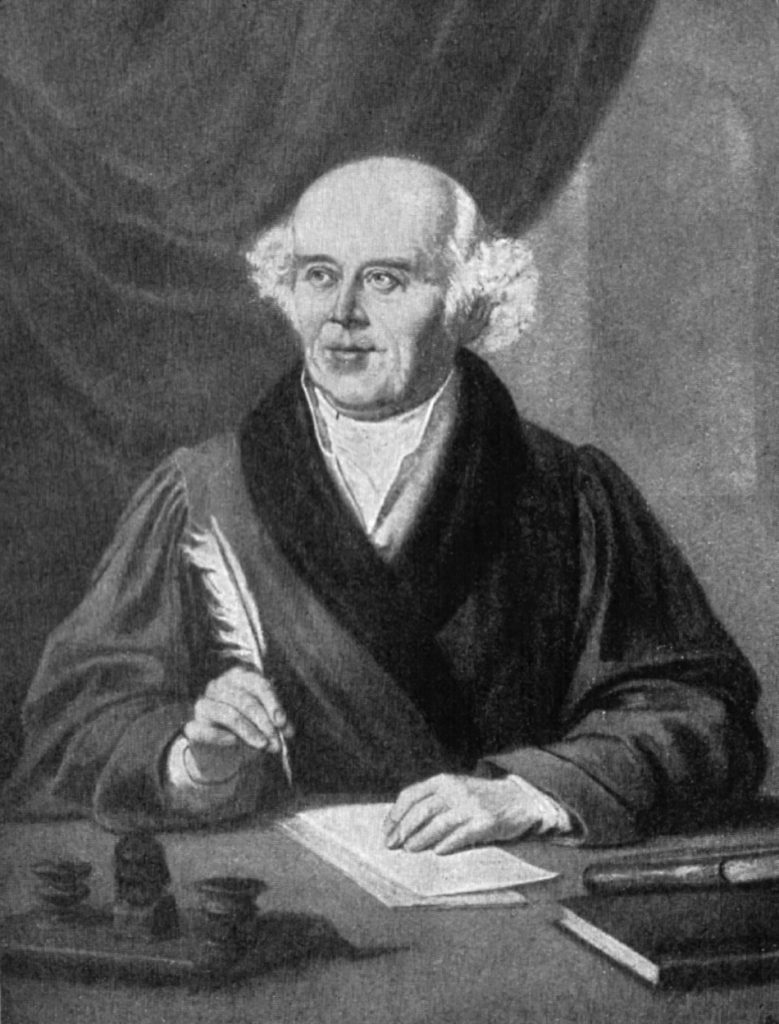
Christian Friedrich Samuel Hahnemann was born on 10 April 1755 in Meissen, Saxony. His parents gave him the names Christian, follower of Christ; Friedrich, protégé of the king; Samuel, God has heard me, in recognition of God.
His father was a porcelain painter and he himself was prepared to follow his father's career. At school he learned several foreign languages: English, French, Spanish, Latin, Arabic, Greek, Hebrew and Chaldean, in addition to the national language. His goal was to be able to trade porcelain in other countries in the future.
But his destiny was to be different. He went to study medicine in Leipzig and Vienna. Being poor, he supported himself by translating, which brought him into contact with works on existential doctrines.
In 1812 he became a professor at the University of Leipzig. However, during his medical studies, he became worried because he did not achieve good results in curing the patients he treated. His friends said that he was dreaming, that everything he wished for was a utopia. Man is limited, and so is his knowledge.
Finally, at the age of 36, after the death of a friend whom he was treating clinically, he decided to give up medicine.
He enters his practice and tells his patients that he will not see them any more. If you can't cure them, what's the use of your science! And he dismisses them all. He is deeply discouraged. To survive and support his family, he translates, especially in the fields of chemistry and pharmacology.
Translating a work by a Scottish physician, William Cullen, in 1790, he was struck by the description of the properties of quinine. He was particularly struck by the fact that quinine poisoning presented symptoms similar to those of the natural disease of intermittent fever. He began ingesting doses of quinine himself and found that the results were similar to those of the fever he was fighting.
He repeated the experiment with other drugs, such as mercury, belladonna and digitalis, always on healthy men, and ended up elaborating the homeopathic doctrine, summarised in the expression: similia similibus curantur, i.e. similar symptoms are cured by similar remedies. In 1796, his observations were published. These observations would constitute his most important work: the Organon, published in 1810, where he explained his system and created homeopathy. He would later publish The Pure Medical Science and The Theory and Homeopathic Treatment of Chronic Diseases.
Homeopathic principles state that any substance which, in a considerable dose, is capable of provoking a symptomatic condition in a healthy individual, also has the capacity to make it disappear, when administered in small doses. Also, that the preparation of medicines requires infinitesimal dilutions, as these would have the capacity to develop the dynamic medicinal virtues of the bulk substances.
From the beginning, Hahnemann suffered a fierce campaign against what he was exposing, especially from the pharmacists, for which he suffered greatly. It was not until 1835, when he was over 80 years old and a widower, that he was sought out by a young woman who sought him out in her village as a last medical resort and was cured by him. They met and she took him to Paris, where he was finally recognised.
He died in Paris on 2 July 1843, 14 years before The Spirits' Book was published and Spiritualist doctrine was born. As part of the spiritual team responsible for the Codification, he made his contribution especially to The Gospel According to Spiritism, chapter IX, Blessed are the meek and peaceable, where he signed the message of point 10, which deals with the virtues and vices inherent in the Spirit. The message was delivered in Paris in 1863.
As a curiosity, in the same year, on March 13, at the Spiritist Society of Paris, with Mrs. Costel as medium, Hahnemann spoke on the state of science at the time, in reply to a foreign homoeopathic physician who was present at the session. This dissertation is found in the sixth volume of the Spiritist Review.
 English (UK)
  Español
  Deutsch
  Português do Brasil
  Français
  Русский
  Türkçe
  Italiano