Amalia Domingo Soler – The chronicler of the poor.
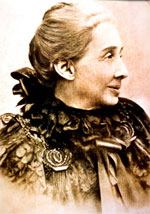
Born in Seville, Spain on 10 November 1835, her childhood and youth were marked by many hardships. From birth her health was fragile and at the age of eight days she had a serious sight problem that almost left her blind, but thanks to the treatment of a modest pharmacist she partially recovered, and after three months she recovered her sight, which nevertheless remained very delicate. She suffered from a weakness of the retina which remained with her throughout her life.
Her eyes were very imperfect, but her mother was absolutely devoted to her, and had no other concern than to make her happy, without neglecting her education in the slightest by her extreme affection. When she was two years old her mother began the arduous task of teaching her to read, for Amalia's mother was very persevering, and although she threw all the primers she could in the street or tore them up with the greatest pleasure, she always had spare primers, and never for one day failed to give her a lesson. As a reward for her eagerness and her vigilance, she succeeded in getting her to read correctly at the age of five, making her read aloud two hours a day, and when she was older, two in the morning and two in the afternoon.
These two spirits united in such an admirable way that they were able to guess each other's thoughts by looking at each other. Although physically she was of a sickly constitution, from an early age she displayed a strong and resolute character.
Death of her mother
Her mother passed away in June 1860, Amalia was twenty-five years old, and for three months she lost her memory completely. Her mother's resources were practically exhausted in the treatment of her health, and her relations with her relatives (her father's relatives) were not the best. Thus, beyond the loneliness, Amalia's days of great hardship began. The solutions proposed by her relatives were impossible for her to accept: entry into the convent or an arranged marriage to a much older man in a good financial position. She did not want to be a nun, she said:
My soul does not feel the need of fasting or penance; nor do I find God in the altars of temples; convents have always seemed to me to be the dungeons of the intellect. I find my God in the sun, in the air, in the flowers, in the birds, in the mountains, in the rivers, in the seas, wherever life manifests itself.
For 6 months her relatives gave her a small pension in exchange for being the seamstress in the house, after which they told her that this was a superfluous expense and that they could no longer take care of her.
Study of the spiritism
She had contact with a materialistic doctor, and seeing Amalia's interest in these people, she undertook to bring her a newspaper she received called ‘El Criterio’. She was invited to write for the newspapers, publishing her first spiritism article in issue number nine of 1872, in ‘The Criterion’ entitled ‘The Spiritist Faith’. She sent poems to the newspaper ‘La Revelación’ in Alicante. He also published an article ‘Spiritism is the truth’. From that moment on he began to study Spiritism and one morning at home he began to feel a painful and strange sensation in his head; at the same time he seemed to hear strange and confused voices saying: ‘Light! Light!’. Without knowing why she began to cry and without realising it she looked in the mirror and noticed that her eyes were open as they had not been for a long time. Then she asked aloud as if someone could answer her: ‘Has the time come for me to receive my freedom? And he heard a yes, in a very distant voice. At that moment he regained his sight and ran off to the doctor, to whom he said that he had regained his sight and that from then on he would not have to strain himself.
Thus he got in touch with the Spanish Spiritist Federation and read for the first time a poem dedicated to Allan Kardec on April 4th, 1874. From then on, editors and publishers of spiritist magazines and newspapers wrote to him asking him for works; he says that what he wrote at that time astonished him because he had neither dictionaries nor grammar books.
Works
Amalia wrote her first poems at the age of ten, and at 18 she published her first verses. One of her poems recalls the best days of her youth, her walks with her mother and friends in the gardens of the Alcázar in Seville. His articles are today, as they were yesterday, clear and direct expositions on Spiritism, faithful interpreters of the Spiritist Science codified by Allan Kardec. From the year 1873 to 1903, Amalia had delivered to the press more than 2. 000 productions (as she indicates in the prologue of her book Ramos de Violetas), which were published in newspapers in Spain and abroad, some of which were: El Criterio and El Espiritism, of Madrid; La Gaceta de Cataluña, La Luz del Porvenir and the Revista de Estudios Psicológicos, of Barcelona; La Revelación, of Alicante; El Espiritism, of Seville; Las Ilustraciones Espíritas, of Mexico; La Ley del Amor, of Mérida de Yucatán; La Revista Espírita, of Montevideo; La Constancia, of Buenos Aires; the Annals of Spiritism, in Italy. Her Most Beautiful Writings, contains accounts of daily life analysed in the light of Spiritism by Amalia.
Death
After a long and active career, the last years of his life were spent, even in very poor health, in the same line of writings and collaborations on spiritism, until his death on 29 April 1909 as a result of bronchopneumonia. His civil burial took place in the South-West Cemetery, on the slopes of Montjuic.
In the same year as her death, her book Flowers of the Soul (1909) appeared, and three years later, her Memoirs of the Distinguished Singer of Spiritism (1912), which, divided into two distinct parts, present in the first the chapters written by the author herself, and in the second, those that were ‘dictated from space by herself’, and her revelations through the medium Maria.
Several other books appeared posthumously, among which we can remember Consejos de ultratumba, Las grandes virtudes, Cuentos para niños, and, in a very special way, we can highlight his interesting and very curious Cuentos espiritistas.
 English (UK)
  Español
  Deutsch
  Português do Brasil
  Français
  Русский
  Türkçe
  Italiano