Raymond Auguste Quinsac Monvoisin
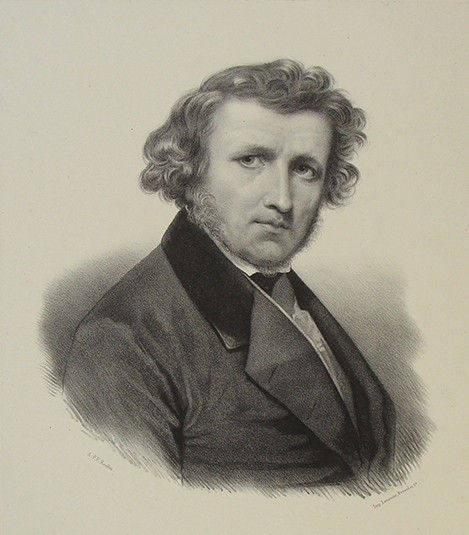
Raymond Auguste Quinsac Monvoisin was born on 31 May 1790 in Bordeaux, France. A painter of genre scenes, landscapes, history and portraiture, he was one of the most distinguished pupils of Baron Guérin at the École des Beaux-Arts in Paris. Awarded multiple times, at the age of 27 he became a royal pensioner in Rome under the King of France. On returning to France, he gained distinction at the Salons and was twice awarded first prize. From this period, which lasted until 1842, come his series of portraits of the kings of France and the marshals of the Renaissance, commissioned by the government for the historic galleries of the Palace of Versailles.
In 1836, Monvoisin – who had a strong temperament – fell out with the director of the French royal museums, Mr de Cailleux. Shaken by this incident and by other personal difficulties, he left France in May 1842. He travelled to South America. Monvoisin and Rugendas were the two most important artists to visit the American continent at that time. After a brief stay in Buenos Aires, he arrived in Chile in January 1843, bringing just over ten panels, which were exhibited in March of that year at the University of San Felipe. This exhibition, which became a landmark in the history of art in Chile, attracted the attention of numerous prominent figures and elicited admiration for the skill and beauty of the works. Monvoisin received at least a hundred portrait commissions, painting practically the entire Chilean aristocracy of the time. The government promised him the direction of the future Academy of Drawing and Painting in Chile, but ultimately chose the Italian Alexandre Cicarelli.
After some time, Monvoisin visited Peru and Brazil. He arrived in Rio de Janeiro on 19 October 1847. In a letter to his brother, he complained about the heat and stated that he would paint a portrait of Emperor Pedro II, who received him warmly. The painting – showing Pedro standing in imperial attire – is considered the most faithful portrait of the Brazilian Emperor. In recognition, Pedro II awarded the artist the insignia of Knight of the Order of the Cruzeiro and a bronze pendulum. The painting – which can be seen at the Imperial Museum in Petrópolis – belongs to Prince João of Orléans and Braganza, great-grandson of Pedro II. The Emperor also had another painting by Monvoisin in his collection at the Paço de São Cristóvão: Young Peruvian (or Young Araucanian). Monvoisin returned to France in 1858, at the height of Spiritism. He became a Spiritist and a practitioner of homeopathy. The first reference to him appears in the Revue Spirite of May 1866. The section “Conversations from Beyond the Grave” contains the transcription of an evocation of the spirit of Abbé Laverdet, one of the pastors of the French Church, which took place on 5 January 1866. There, Kardec reports that “one of the Abbot’s closest friends, Mr Monvoisin, the eminent history painter and fervent Spiritist, having wished to receive some words from him from beyond the grave, asked us to evoke him.”
A member of the Parisian Society for Spiritist Studies, Monvoisin was also the author of a portrait of the Codifier of Spiritism. A donation of eight paintings by this renowned artist inspired Kardec’s desire to create a Spiritist Museum: Allegorical portrait of Allan Kardec; Portrait of the author (Monvoisin); three Spiritist scenes from the life of Joan of Arc (Joan at the fountain, Joan wounded, and Joan on the pyre); the Auto-da-fé of John Huss; a symbolic painting of the Three Revelations; and the Appearance of Jesus among the apostles after His corporeal death. The painter died in Boulogne-sur-Seine (Paris) on 26 March 1870. In the May edition of that year, the Revue Spirite reported his passing with an extensive article, detailing his life and dedication to Spiritism. The text includes several of his own statements, among them: “I shall be the precursor and father of Spiritist painting.” At the time of his death, he was working on a series of portraits of the precursors of Spiritism.
 English (UK)
  Español
  Deutsch
  Português do Brasil
  Français
  Русский
  Türkçe
  Italiano