Francisco Leite de Bittencourt Sampaio
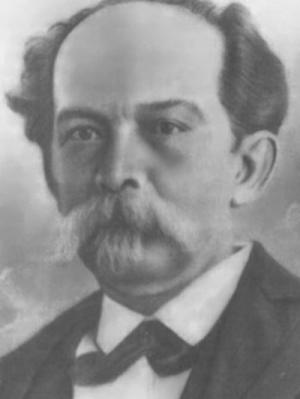
Francisco Leite de Bittencourt Sampaio was born in Laranjeiras, Sergipe, on 1 February 1834. He was the son of a Portuguese merchant of the same name and Dona Maria de Sant'Ana Leite Sampaio. He was a jurisconsult (a person with great legal knowledge who gives consultations and opinions on questions of law); magistrate; politician; civil servant; journalist; literary man; lyric poet and an excellent spiritist medium.
He began his law studies at the Faculty of Law in Recife. In 1856 he interrupted his studies to attend to the patients of the cholera epidemic that devastated the province of Pernambuco in 1855. As a result, he was decorated by the Imperial Government with the Order of the Rose, a decoration he did not accept as it was incompatible with his political ideals. In 1859 he graduated in law at the Academy of S. Paulo (now the Faculty of Law). From 1860 to 1861 he worked as a prosecutor in Itabaiana and Laranjeiras, and as an inspector of the literary district of Itabaiana. In March 1861, he left the province of Sergipe and settled in the old court of Rio de Janeiro, where he practised as a lawyer.
In politics, he joined the Liberal Party and was elected deputy from 1864 to 1866 and from 1867 to 1870. During the latter period, he was appointed President of Espírito Santo, serving as such from 29 September 1867 to 26 April 1868, when he returned to the legislative mandate to which he had been elected.
In 1870, embracing republican ideas, he left the liberal party and became an ardent propagandist for the Republic, signing the «Manifesto of 3 December 1870», an important historical document. As a journalist, he was respected for the brilliance, elevation, sincerity and firmness with which he supported and defended his political ideals.
When the Republic was proclaimed, he was entrusted with the inventory of all the newspapers of the Chamber of Deputies and, shortly afterwards, the drafting of the debates of the Constituent Assembly. He was the first administrator of the National Library of Rio de Janeiro to hold the title of Director.
It is not known exactly when Bittencourt Sampaio joined Spiritism, but on 2 August 1873 he was already a member of the Board of the «Confucius Group», the first spiritist society in Rio de Janeiro. There he developed his mediumship, curing many patients with homeopathic remedies. He seems to have been attracted to Spiritism by mediumistic phenomena, a subject he studied in depth, but it was the moral side of this new philosophy that impressed him most.
In 1876 he founded the «Society for Spiritist Studies God, Christ and Charity», presiding over its work and incorporating the study of the Gospels in the light of Spiritism as an essential part of its activities.
In 1880, the «Grupo Espírita Fraternidade» (Spiritist Fraternidade Group) was founded, to which Bittencourt Sampaio also lent valuable collaboration. The respected figure of Spiritism in Brazil, Dr. Antônio Luís Saião, who had converted to Spiritism thanks to Bittencourt Sampaio's healing mediumship, then gathered the mediums of the aforementioned Society in the «Ismael Group», which he himself created (and which is still active today), and there Bittencourt Sampaio became one of the intermediaries of beautiful and instructive messages from the Higher Spirits.
Bittencourt Sampaio escribió «La Divina Epopeya de Juan Evangelista», publicada en 1882 y única en el mundo. Se trata del cuarto Evangelio, el de Juan, en verso decasílabo. Esta composición poética incluía también una segunda parte, en prosa, en la que se explica cada uno de los cantos a la luz de la Revelación Espírita. Estas explicaciones van precedidas de un largo prefacio en el que se analiza detalladamente la cuestión de la divinidad de Jesús.
Bittencourt Sampaio died on 10 October 1895 in Rio de Janeiro. The magazine «Reformador» of 15 October of that year reported that ‘Bittencourt was preparing to write the Divine Tragedy of Golgotha, when, ripe fruit, he was picked by the hand of the heavenly gardener’.
After his disincarnation, the Spirit of Bittencourt Sampaio wrote, through the medium Frederico Júnior, the following works: ‘Jesus before Christianity’; «From Jesus to the Children» and «From Calvary to the Apocalypse».
In the mediumistic book «Voltei», Brother Jacobo, through the medium Francisco Cândido Xavier, reveals that Bittencourt Sampaio collaborates on the higher planes of Spirituality in the supervision of evangelical Spiritism in Brazil.
 English (UK)
  Español
  Deutsch
  Português do Brasil
  Français
  Русский
  Türkçe
  Italiano