Dr. Anastasio García López
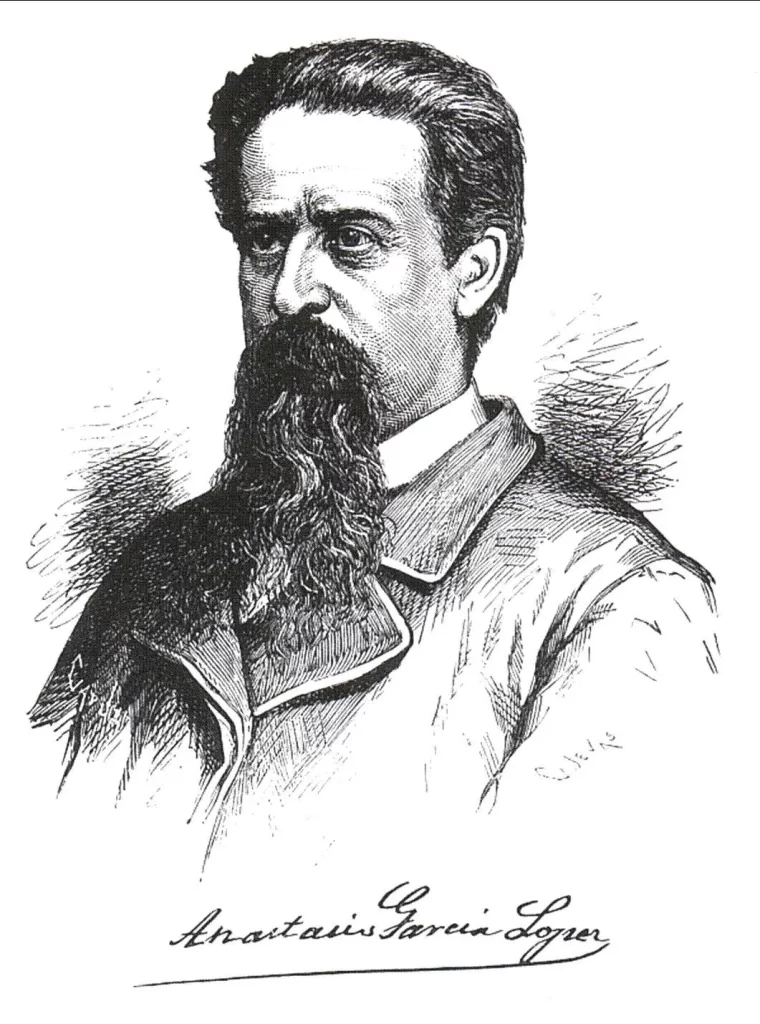
Dr. Anastasio García López (born 27 April 1823 in Ledaña, Cuenca, died 1 May 1897 in Seville), was an outstanding doctor, surgeon, homeopath, hydrologist, politician and spiritist. In any case, he was a multifaceted character, and his written work, both through his books and journalism, stands out.
A democrat and republican, he was a member of the Cortes in 1873.
Outstanding student
Orphaned by his father at the age of five, his mother's constant maternal zeal ensured that in 1838 he began studying philosophy at the Seminary and Secondary School of Murcia until 1841, where he obtained a bachelor's degree in philosophy with the highest marks.
In 1841 he began his studies as a surgeon at the San Carlos College of Medicine in Madrid, until 1848, when he obtained the degree of Licenciado with matriculation and extraordinary prize.
He was a boarding student from 1843 to 1848.
In December 1847, he was unanimously awarded the second class regent's degree in philosophy, psychology and logic. He was awarded a degree in Philosophy and Letters a few years later. He was awarded a doctorate by the University of Salamanca in 1870.
With a degree in Medicine and Surgery, he worked in different towns on the Peninsula, including as a doctor in Cebreros (Ávila) and Navalperal de la Mata (Cáceres).
Subdelegate of Medicine shortly afterwards, commissioned by the Government to study a special epidemic in the villages of Casatejada and Serrejón, and to analyse the waters of the Fuente del Oro.
Seven years of practising traditional medicine were enough to make Dr. Garcia Lopez disenchanted with the successes he dreamed of obtaining for the benefit of the suffering humanity entrusted to his care. The straw that broke his camel's back was a neuralgia which he tried in vain to combat and cure in a client with the ordinary means recommended by ancient medicine.
Being familiar with Dr. Hahnemann's new method, he tried the indicated means on that rebellious disease, achieving with satisfaction and surprise the cure of that ailment which had resisted his expertise in the most recommended treatments.
From then on – in – he devoted all his talents and efforts to deepening and broadening his knowledge of the homeopathic method, directing his research not only to the fundamental principles of this essentially vitalist school, and as such in perfect harmony with the philosophical convictions he had long professed, but also to Hahnemann's materia medica, an inexhaustible source of salutary therapeutic indications.
He was also an introducer of Spiritism in Spain, president of the Spanish Spiritist Society and founder of its organ of expression, El Criterio Espiritist (1868), of which he was director at various stages.
He was the founder of the Spiritist Society called The Universal Brotherhood and of the newspaper of the same title, where he published philosophical articles and gave innumerable lectures, not only on the spiritism doctrine, but on all the branches of human knowledge in which his powerful intelligence reached high levels.
Anastasio García López was one of the deputies who presented and signed the bill on the study of Spiritism in secondary and university education.
About how he became a spiritism, he himself tells us and we reproduce it as it was published in the magazine "El Buen Sentido" (Lérida, October 1882).
My Conversion to the Spiritism
When my good friend Huelves (he refers to Joaquín Huelves Temprado) published in El Buen Sentido an article aimed at explaining how he had become a spiritist, inviting others to also write about their conversion to this doctrine, it seemed to me an acceptable thought, like all his, and I felt obliged to follow his example, thus corresponding to the wishes of the meritorious leader of our school, Mr. José Amigó y Pellicer, to whom I offered some time ago to send this note, to whom I have written with the memory of my past beliefs, and which is therefore a faithful expression of the evolution of my beliefs. José Amigó y Pellicer, to whom I offered some time ago to send the present note, which I have written with the memory of my past beliefs and is, therefore, the faithful expression of the evolution of my spirit since I have had the use of reason.
From a very early age, when I was only three years old, I lost my father, and my education was therefore left to the exclusive care of my virtuous mother, and we were imbued with all that constitutes the dogma of the Roman Catholic Church. But already at that tender age my childish reason rebelled somewhat against what I was told were mysteries, and I asked a multitude of questions of my mother and others who deserved my respect, either about original sin, or about confession and communion, or about the substantial change of the wine and the host into the flesh and blood of Christ, or about other matters that were said to be mysteries, and about other matters that were said to be mysteries, and on other matters which resisted my intelligence and with the problems of which I was almost always impertinent, and silence was imposed on me with the maxim that I should believe all these and other things without ever being in doubt, because faith in what the Church taught was above what my reason might suggest to me.... ....
Dr. Anastasio García López died in the city of Seville on May 1, 1897, at the age of seventy-four, victim of an infectious malarial fever, against which the efforts of science were in vain.
...Weep not ye who remain for those who depart, for they do not cease to be among you, though they have passed through the porch of the temple of the true light, for from their new abode they radiate their fluid to your spirit....
I would like to give you a condensed moral standard, but it is almost impossible. However, follow this advice: Look deep inside yourselves, and you will be tolerant of outsiders.
For to want to know God, and not to know oneself, is to reverse the order of advancement.
Anastasio García López, in the Spiritism Almanac for 1873, published in Madrid. Municipal Newspaper Archive of Madrid.
Dr. García López was an outstanding physician, but also a tireless propagator of spiritism and homeopathic medicine. In this respect he was the author of numerous interesting articles, books and pamphlets.
 English (UK)
  Español
  Deutsch
  Português do Brasil
  Français
  Русский
  Türkçe
  Italiano