Joan of Arc
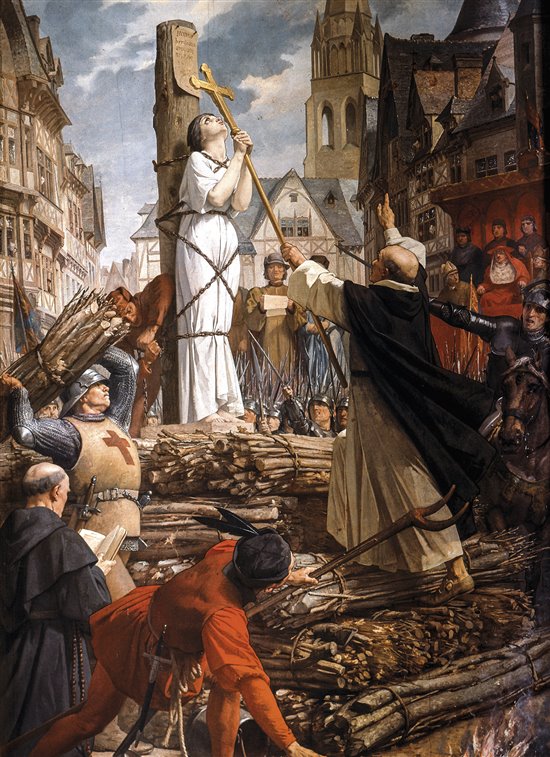
France was a country that bowed to English power. It was not exactly one country as we know it today. It was made up of several fiefdoms. And it was in a hitherto unknown village that, in 1412, a girl was born who was to become a famous and celebrated Domremy.
The daughter of poor peasants, she learned to spin wool with her mother and tended the flock of sheep. She had three brothers and a sister. She did not learn to read or write, as work soon took up all her hours. The village was quite remote and rumours of war were slow to reach her. Finally, one day, Joan of Arc came face to face with the horrors of war when English troops approached and the whole family had to flee and hide.
At the age of 12, she started having visions. It was a summer day at noon. Joan was praying in the garden near her house when she heard a voice telling her to trust in the Lord. The figure she saw she identified as the Archangel Michael. The two spiritual messengers who accompanied her, Catherine and Margaret, were saints according to the Church she attended.At the age of 12, she started having visions. It was a summer day at noon. Joan was praying in the garden near her house when she heard a voice telling her to trust in the Lord. The figure she saw she identified as the Archangel Michael. The two spiritual messengers who accompanied her, Catherine and Margaret, were saints according to the Church she attended.
They spoke to her about the situation in the country and revealed their mission to her. She was to come to the Dauphin's aid and crown him king of France. For four years, she hesitated and the story of her visions began to spread. At dawn on a winter's day, she got up. She was determined. She packed a small bag, a small parcel, a travelling stick, said goodbye to her parents and set off. That village of Lorraine would never see her again.
She went to Vaucouleurs, where one of her uncles lived, who believed in her and accompanied her to Chinon, to the Royal Palace. The situation was very serious. The Hundred Years' War was at a turning point. Dauphin Charles was too weak to make a decision. The English forces had taken most of the country and he had to send reinforcements to Orleans. However, he has few soldiers at his disposal and no leader to lead them.
It was then that Joan appeared at the palace. The illiterate peasant girl had travelled ten days and ten nights to reach Chinon. She claims she is being sent by heavenly messengers. She was to see the Dauphin and then lead the army to liberate Orleans. Charles receives the news with astonishment and decides to put the girl to the test. He hides among his courtiers, but as soon as she enters the room, she does not hesitate to address him and greets him as the rightful heir to the throne of France.
It was a test, of course. After all, the rumour the English were spreading to discredit the heir was that he was not the legitimate son of old King Charles VI. Then, in a private interview, he reminded him of the words of the prayer he had addressed to God alone in his oratory, just before arriving at Chinon.
Voices guide her through everything. The sword she will use in battle is found buried in the church of Saint Catherine de Fierbois. The voices awaken her when she is resting in Orléans, unaware of the attack perpetrated without her consent. Her spiritual guides tell her that she will be wounded on 7 May 1429 and that she should not last more than a year.
So she hurries. She takes Orleans, asks the Dauphin to go to Reims and the Dauphin is crowned king. Now crowned, Charles wants nothing more. But Joan knows that her mission is not over and continues her battles. Voices warn her of her arrest and her tragic end.
Betrayed, she is sold to the English, who hand her over to the Inquisition Tribunal. The whole process was a farce. The accused has no rights, not even a defence lawyer. Only witnesses for the prosecution. She is accused of being a sorceress and a heretic. Everything is presented as sacrilege and immorality: the fact that she wore men's clothes, that she spoke directly to the saints and disrespected the Church, that she consorted with men on the battlefields, that she wielded a sword.
The aim was to prove that Joan was a devil's envoy. As a result, King Charles VII would be demoralised. After all, what kind of a king was he who had allowed himself to be deceived by a witch? For six months she is subjected to a real moral torture. The interrogations are long and painful. Finally, the execution took place in the central square of Roeun on 30 May 1431.
Her hair is shaved off and, fearing the reaction of the people, 120 armed men escort her to the site. They tie her to a pole and light a bonfire. As the flames engulf her and bite into her flesh, she exclaims: "Yes, my voices came from God! My voices did not deceive me".
It was unmistakable proof of the mediumship that had guided his earthly journey.
In chapter XXXI of the Medium's Book, published in 1861, when the Codifier assembled the Spiritist Dissertations, he attributed to Joan of Arc number 12, where she addresses mediums in particular, exhorting them to exercise mediumnity.
He also advises them to trust their guardian angel and to fight against the stumbling block of mediumship, which is pride.
Advice that she had followed very well in her earthly life as a medium.
 English (UK)
  Español
  Deutsch
  Português do Brasil
  Français
  Русский
  Türkçe
  Italiano