José Herculano Pires
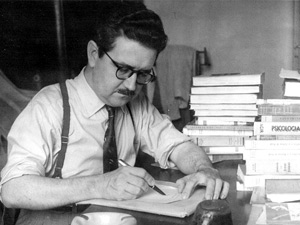
Known in Brazil as the "multiple" man and "Kardec's Apostle", he stood out for his constant struggle to faithfully preserve the work of the codifier, being courageous in the face of the great spiritist institutions in defence of the purity of the Spiritism. His superior intelligence and humanistic culture shone with great magnitude. Philosopher, journalist, educator, writer, literary critic, theosophist and politician. Author of more than 81 works including essays, short stories, philosophy, history, psychology, parapsychology and spiritism. Some of these books in association with the medium Francisco Cándido Xavier, whom he considered one of the most important authors within the spiritism movement.
He defended the concept of doctrinal purity, according to which it was necessary to preserve the doctrine from all mystical and esoteric influences. In the philosophical works he wrote, he makes it clear that the contribution of Spiritism, with regard to the meaning of human existence, is opposed to nihilism and materialistic existentialism.
He was one of the founders of the School of Philosophy of Araraquara, where he taught as Master of Philosophy (USP) and member of the Brazilian Society of Philosophy. President of the Union of São Paulo State Journalists. For 20 years he maintained a daily column in "The Associated Spiritism" under the pseudonym of Brother Saulo. He carefully and faithfully translated Kardec's works, enriching them with his comments and explanatory footnotes. A Spiritist from the age of 22, he spared no effort in the oral and written dissemination of the Doctrine to which he dedicated most of his life. To highlight his figure is for us a real honour to have the opportunity to remember his life.
We must go back to the year 1914 when in the old province of Rio Novo, today the beautiful city of Avaré, in the interior of Sao Paulo (Brazil), José Herculano Pires was born on the 25th of September. His mother, the pianist Bonina Amaral Simonetti Pires, and his father José Pires Correa, a pharmacist, welcomed him.
After his studies in Avarée, Itaí and Cerqueira César, his literary vocation began to reveal itself and at the age of nine he composed his first sonnet. Later, at the age of sixteen, he published his first book of short stories "Sonhos azuis", and two years later "Coracao" of poems and sonnets. He contributes to newspapers and magazines of the time, in Sao Paulo and Rio de Janeiro.
He moved to Marilia in 1940, where he bought the Daily Paulista newspaper, which he edited for six years, and in 1946, already in Sao Paulo, he published his first novel "The Halfway", which was received with excellent reviews.
After graduating in Philosophy from the University of Sao Paulo, he published an existential thesis "Being and Serenity". He was recognised by critics as one of the renovators of the Brazilian novel.
For thirty years, he worked as a reporter, editor, secretary, parliamentary chronicler and literary critic for the Diários Associados in 7 de Abril Street. For four of those years, he wrote a column in collaboration with Francisco Cándido Xavier under the title "Chico Xavier pide licencia" (Chico Xavier asks for leave).
He claimed to suffer from graphomania, i.e. a mania for writing day and night. He had no academic vocation and did not follow any literary school. His only personal aim was to communicate what he thought was necessary and in the best possible way. His debates on television made him famous for his polemics, especially his confrontations with his bitter enemy of Spiritism, the aggressive Jesuit Oscar Gonzales Quevedo, to whom he replied with his astonishing serenity and firmness. He was never irritated and listened patiently to his opponents. He was a loving husband and father of four children. He was the founding director of the spiritism magazine Educación.
He distinguished himself for being an idealist who fought for the spiritist cause being one of its most active and consistent followers of spiritism in Brazil. The most important characteristic of his works as a whole is the struggle to demonstrate the consistency of spiritualist thought and to defend the value of the critical aspects and systematic research proposed by Allan Kardec.
He is considered to be one of the greatest defenders of the integrity and purity of Allan Kardec's codification. He was admired and respected by all intellectuals of the time and his books continue to be widely sold and consulted on important issues of Spiritism.
In 1970 he founded the "Mary Virginia and J. Herculano Pires Foundation" to publish his books. Several publishers have published translations of her books.
In 1979 he disincarnated on 3 September in the State of São Paulo (Brazil).
His thinking:
To be faithful to Truth, to know how to respect it and to humble oneself before it are the three stumbling blocks of man on earth. We can know the Truth and proclaim it, try to live it and communicate it to others, but to have the courage to hold it in times of crisis is almost a privilege in the world of earthly vanities and lies. That is why the great Masters always tend to taste the gall cup of abandonment, like Jesus in the Garden, facing only the awakening of betrayal, or on Calvary, enduring the abandonment of crucifixion.
 English (UK)
  Español
  Deutsch
  Português do Brasil
  Français
  Русский
  Türkçe
  Italiano