Jean Meyer
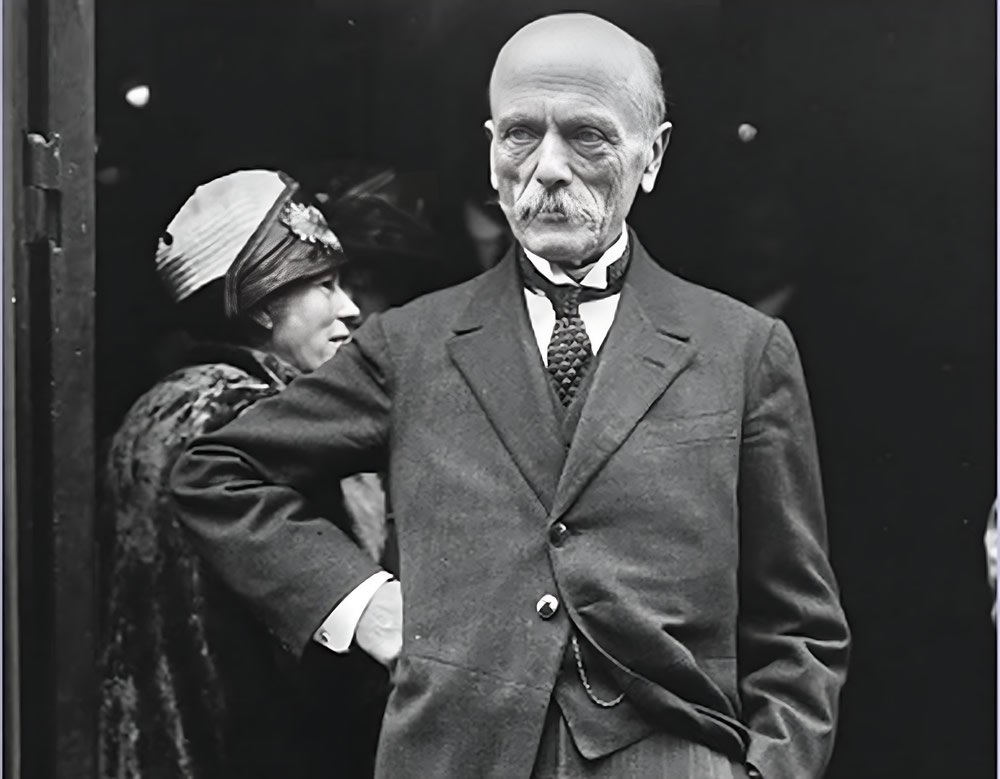
Born in Riken (Switzerland) on 8 July 1855 and died in Béziers (France) on 13 April 1931. Jean Meyer, Swiss writer, scientist, philanthropist and philosopher, was one of the most prominent spiritualist figures of the early 20th century. Converted to spiritualism after reading the works of Allan Kardec and Léon Denis, he devoted himself body and soul to the great task of spreading the Doctrine of the Spirits. Possessing considerable material wealth, he put it at the service of spiritualism, dedicating himself with determination and true love to the task of spreading its fundamental principles.
Thanks to his financial contribution and moral support, the ‘International Institute of Metapsychics’ was founded in Paris, where he had moved in his youth. Its first president was Dr. Roque Santolíquido, a notable professor, deputy and minister of public health and government advisor in Italy. The vice-presidency of this new institution was held by the equally famous Dr Gustavo Geley. Due to its important work, this institute was considered to be of ‘public utility’ by the French government. At the time of his death, Jean Meyer was the director and owner of the Revue Spirite, founded by Allan Kardec, which he ran between 1916 and 1931. In 1917, in his own residence, Vila Valrose, in Paris, the ‘French Spiritist Union’ was founded, with Gabriel Delanne and Léon Denis as his main companions. He was also vice-president of the ‘House of Spiritists’ in the same city; a prominent member of the ‘Society for Metapsychical Studies’ and the ‘International Institute of Metapsychics’, vice-president of the ‘International Spiritist Congress of The Hague’, vice-president of the ‘International Spiritist Federation’ when it was based in Paris, as well as a member of numerous scientific bodies in France and other countries.
Jean Meyer devoted himself wholeheartedly to the study of the philosophical and scientific aspects of the Spiritist Doctrine, without neglecting the philanthropic side, providing financial support to various charitable institutions, including a project built in Lyon by Mrs Stephen and Mrs Dayt. The great harvester spent a considerable part of his fortune on spreading Spiritism through ‘Editions Meyer’ and on supporting doctrinal institutions, among which the ‘French Spiritist Union’ stands out. He initiated numerous studies with Dr. Gustavo Geley* at the International Institute of Metapsychics, as he was a persistent researcher of spiritualist phenomena, to the point of earning the statement from Léon Chevreuil, one of the presidents of the French Spiritist Union, that ‘without Meyer, metapsychics would not exist.’
As vice-president of the Executive Committee of the International Spiritist Congress, held in Paris from 6 to 13 September 1925, Meyer worked tirelessly, impressively demonstrating his scientific knowledge. At the London Spiritualist Congress in 1928, in which he participated alongside Sir Arthur Conan Doyle, who held him in high esteem, he uttered the following words: ‘It is through the union of science with spiritualism, with that rational faith it gives us, helping one another, that we will arrive at an increasingly fair and ever higher understanding of God's work.’ We can say without hesitation that Jean Meyer was one of the most legitimate continuators of Allan Kardec's work, not least because he maintained the publication of the Revue Spirite for some 15 years and carried out an intense dissemination of spiritualist postulates at a time when the new revealed doctrine was beginning to brighten the gloomy horizons of the world with the splendour of its light. Jean Meyer was not a man who buried his talent, according to the wise phrase from the Gospels. He was convinced that material fortune should be put at the service of noble causes, so he did not hesitate to put that transitory legacy, which he had received from Heaven, at the service of Spiritism and those less favoured by earthly goods, but he also put his intelligence, his unshakeable faith and all the forces at his disposal to ensure that this same cause would triumph.
 English (UK)
  Español
  Deutsch
  Português do Brasil
  Français
  Русский
  Türkçe
  Italiano