François-Marie-Gabriel Delanne
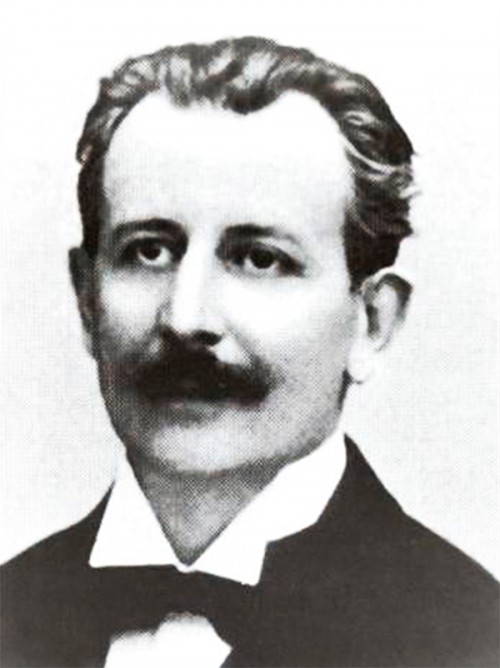
François-Marie-Gabriel Delanne was born in Paris on 23 March 1857, the same year that The Spirits' Book was published. The son of spiritist parents, his father, Alexandre Delanne, was one of the founders of the Parisian Teaching League and an affectionate friend of Allan Kardec, who joined him on the board of the Paris Spiritist Society; his mother, Marie-Alexandrine Didelot, who was an ostensible psychographic medium, was very helpful in codifying Kardec's communications, transmitting reliable information filtered from the spirit world.
Gabriel became familiar with the spiritism vocabulary at an early age, attending numerous spiritism séances at home, where his parents formed a small family study group. He even had contact with Master Kardec in his childhood – Kardec died when Gabriel was 12 years old.
Coming from a simple family, his parents were modest hygiene merchants, Gabriel Delanne always knew that life would not be easy for him. In fact, although he always claimed that his unshakeable belief was Spiritism, and devoted himself from a very young age to the experimental investigation of the events he witnessed in his own home, he received a message from the spirituality, the content of which would make him more dedicated and disciplined in his investigations. The message said: "Fear nothing. Be confident. You will never be rich materially. But you will lack nothing in life".
Gabriel began his studies at the Collège Cluny de Saône et Loire and then met his brother Ernest at the Gray School in Haute Saône. After brilliant scientific studies, he was admitted to the Ecole Centrale des Arts et Manufactures on 3 November 1876. However, his parents' financial situation did not allow him to complete his studies, and he had to work as an engineer for the Popp Compressed Air and Electricity Company, where he remained until 1892, dividing his time between work and dedication to Spiritism.
Delanne was in poor health as a child. He had an abscess in his left eye, which exempted him from military service and led to an infection that progressively affected his eyesight. Over the years, his health worsened.
Gabriel never married and never had children. At the beginning of 1905, he adopted a seven-month-old baby, little Suzanne Rabotin, to whom he devoted immense love and who did him a lot of good. In 1906, paralysis of his lower limbs forced him to walk with two canes. He never stopped giving lectures in France and abroad, always spreading spiritism ideas.
During the First World War (1914/18), Delanne's health deteriorated further. Every movement was a great difficulty, and he also became blind. In 1918, he could no longer walk and had to use a wheelchair. Despite all this physical suffering, he continued to produce without ceasing.
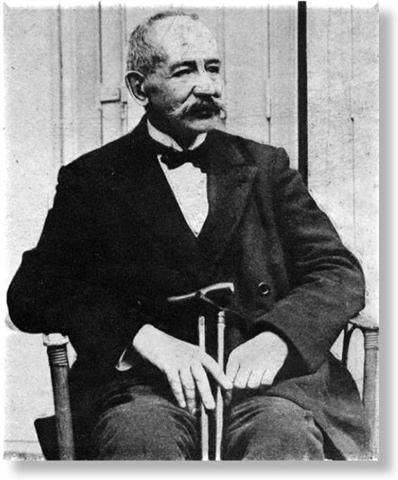
Gabriel Delanne died at seven o'clock in the morning of 15 February 1926, aged 69, in Paris. His funeral took place on 18 February in the famous Père-Lachaise cemetery, the largest in the French capital, where he was cremated and his ashes placed in an urn in the family tomb.
Contribution to spiritism
Born in a spiritual environment favourable to his preparation, Gabriel Dellane was a great advocate of Spiritism, which he did in a rigorously scientific way and with strict fidelity to his Codifier, marking the transition and the continuation of Allan Kardec's work.
He devoted most of his efforts to consolidating Spiritism as an established and complementary science. In 1882, with the reorganisation of Spiritism in France, the French Spiritist Union was founded in Paris on December 24th of that year. Among the founders were the Delanne father and son.
In 1883, Gabriel Delanne founded the journal Spiritism thanks to the generosity of the famous English medium Elisabeth D'Esperance, who donated the sum of five thousand francs towards his expenses. He then began to experiment with great mediums. In 1904, together with Charles Richet and other scholars, he witnessed the prodigious materialisation phenomena at Villa Carme in Algiers.
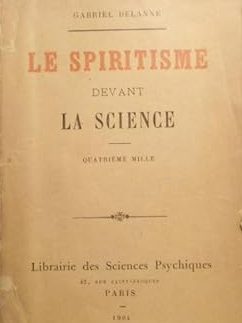
Delanne's literary output is not based on imaginary speculation, but on facts that he himself investigated and confirmed. In 1884, he represented France at the Spiritist Congress in Brussels, and in 1885, he published his first book, Spiritism before Science, in which he emphasised the scientific aspect of the Doctrine in which he was so interested. In December of the same year, he was appointed vice-president of the French Spiritism Union.
In 1892, he left the Popp company for health reasons and began to work as a commercial agent, like his father. He took advantage of many of his trips to propagate the spiritism ideal at conferences in France and abroad.
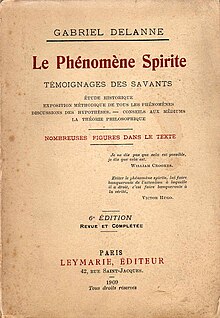
In 1893 he published his second book, The Spiritism Phenomenon, followed by The Evolution of the Soul in 1895. The following year, he bravely abandoned all professional activity to devote himself to the dissemination of spiritism philosophy. He was invited to teach at the newly created University of Higher Studies in Magnetic Practices. He taught in the faculties of Magnetic Sciences, Hermetic Sciences and Spiritism.
In 1897, he published The Soul is Immortal and, the following year, he participated as a delegate in a large international spiritist conference in London, where he presented a long report on reincarnation. In the same year, he launched the Inquiry into Mediumship.
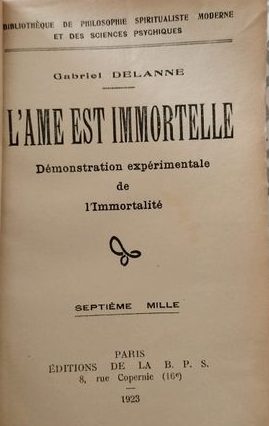
In January 1899, the Universal Spiritist Federation became the French Society for the Study of Psychic Phenomena and, once again, Gabriel was appointed vice-president before the president was quickly appointed. After twenty years of excellent work, in 1919 the Society became the French Spiritist Union, with Gabriel Delanne as president.
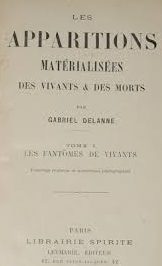
When his ataxia worsened in 1908, his friends put him up in a house in Nice, where he could admire the sea. He spent five months a year there, where he wrote his work The Materialisations of the Living and the Dead, published in two volumes in 1909 and 1911 respectively.
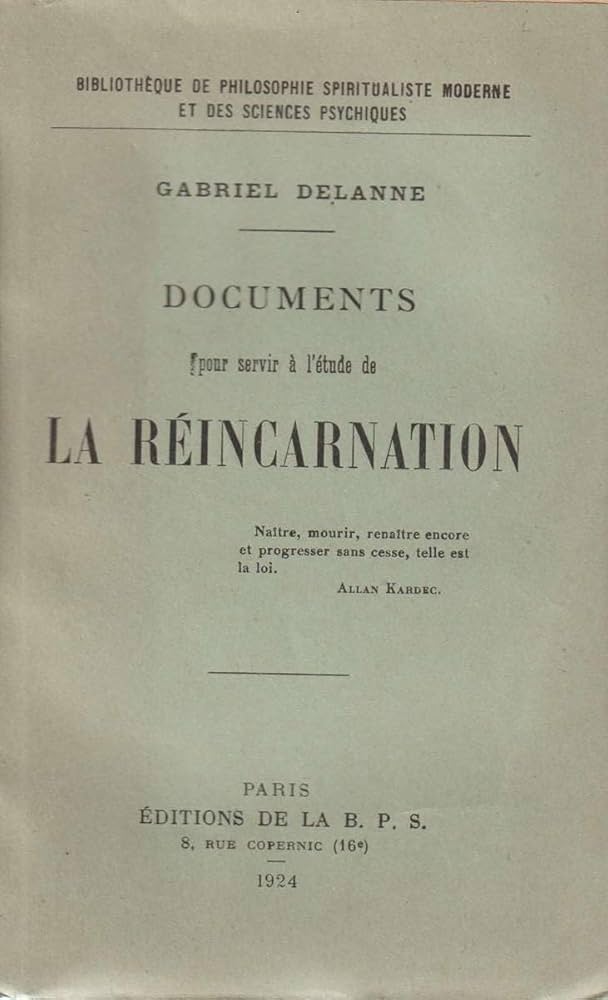
His health deteriorated in his later years. He became blind and, from 1918, could no longer walk, being supported in a wheelchair. Even so, he continued to work to spread his philosophy, his friends read him newspapers, and he wrote articles in preparation for his last book, Reincarnation, which was published in 1924.
Gabriel Delanne was therefore a tireless researcher who knew how to bring science and religion closer together, certain that the two should go hand in hand for a logical understanding of the universe and its inhabitants: the spirits.
 English (UK)
  Español
  Deutsch
  Português do Brasil
  Français
  Русский
  Türkçe
  Italiano